




The perimeter of a \[\vartriangle ABC\] is \[6\] times the arithmetic mean of the sines of its angles. If the side a is \[1\] ,then the angle A is
\[\left( A \right){\text{ }}\dfrac{\pi }{6}\]
\[\left( B \right){\text{ }}\dfrac{\pi }{3}\]
\[\left( C \right){\text{ }}\dfrac{\pi }{2}\]
\[\left( D \right){\text{ }}\pi \]
Answer
 Verified
528.9k+ views
Hint: First we have to use the formula of the perimeter of the triangle. The arithmetic mean of the sine angles is \[\dfrac{{\sin A + \sin B + \sin C}}{3}\] . Then write the equation according to the conditions given in the question. Then apply the sine rule. According to the sine rule, \[\dfrac{a}{{\sin A}} = \dfrac{b}{{\sin B}} = \dfrac{c}{{\sin C}} = 2R\] . From this you will get the values of a, b and c. On further solving you will get the value of R, on substituting it in the value of a you will get the value of \[\angle A\] .
Complete step by step answer:
Let’s see the diagram first,
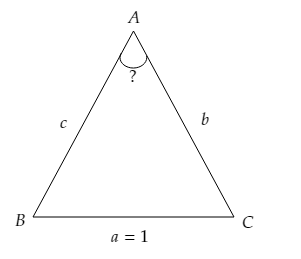
It is given to us that the perimeter of a triangle is six times the arithmetic mean of the sine angles. It is also given that the side of the triangle is one.
The perimeter of a triangle is the sum of all three sides of the triangle. Therefore,
Perimeter \[ = \] a \[ + \] b \[ + \] c
We can also write the above equation as
\[2s = a + b + c\] --------- (i)
Because ‘s’ is used in heron’s formula which denotes the semi-perimeter of a triangle, whose area has to be evaluated. Semi-perimeter is equal to the sum of all three sides of the triangle divided by two that is \[s = \dfrac{{a + b + c}}{2}\] where a, b and c are the three sides of the triangle. From which we can say that \[2s = a + b + c\] .
As the value of a is given as one. Therefore, \[2s = 1 + b + c\] --------- (ii)
Also the arithmetic mean of the sine angles will be \[\dfrac{{\sin A + \sin B + \sin C}}{3}\]
According to the question,
\[ \Rightarrow {\text{ }}2s{\text{ }} = {\text{ }}6{\text{ }} \times {\text{ }}\dfrac{{\sin A + \sin B + \sin C}}{3}\]
On dividing six by three we get
\[ \Rightarrow {\text{ }}2s{\text{ }} = {\text{ 2}}\left( {\sin A + \sin B + \sin C} \right)\]
From equation (ii) we have
\[ \Rightarrow {\text{ 1}} + b + c{\text{ }} = {\text{ 2}}\left( {\sin A + \sin B + \sin C} \right)\] ------------- (iii)
Now here we will now apply the sine rule. According to the sine rule \[\dfrac{a}{{\sin A}} = \dfrac{b}{{\sin B}} = \dfrac{c}{{\sin C}} = 2R\] where R is the radius of the circumcircle of ABC. As the value of a is one, therefore
\[ \Rightarrow \dfrac{1}{{\sin A}} = \dfrac{b}{{\sin B}} = \dfrac{c}{{\sin C}} = 2R\]
Now on further solving we get
\[1 = 2R\sin A\] , \[b = 2R\sin B\] and \[c = 2R\sin C\]
Now put these sine values in equation (iii),
\[ \Rightarrow {\text{ }}2R\sin A + 2R\sin B + 2R\sin C = 2\left( {\sin A + \sin B + \sin C} \right)\]
Take out \[2R\] common in the left hand side
\[ \Rightarrow {\text{ }}2R\left( {\sin A + \sin B + \sin C} \right) = 2\left( {\sin A + \sin B + \sin C} \right)\]
Now the similar terms will cancel out and we are left with
\[ \Rightarrow R = 1\]
By putting this value of R in \[1 = 2R\sin A\] we get
\[ \Rightarrow 1 = 2\left( 1 \right)\sin A\]
On shifting two from the right hand side to the left hand side we get
\[ \Rightarrow \sin A = \dfrac{1}{2}\]
We know that the value of \[\sin 30^\circ \] is \[\dfrac{1}{2}\] .Therefore,
\[ \Rightarrow \sin A = \sin 30^\circ \]
Sine terms on both sides will cancel out and we have
\[ \Rightarrow A = 30^\circ \]
Or \[A = \dfrac{\pi }{6}\]
So, the correct answer is “Option A”.
Note:
Keep in mind the formula of the perimeter of the triangle. Remember that we can denote the perimeter of the triangle by \[2s\] . Also remember the sine rule. Note that sine rule can be used to find an angle from three sides and an angle or a side from three angles and a side. Also remember the trigonometric values of the functions.
Complete step by step answer:
Let’s see the diagram first,
It is given to us that the perimeter of a triangle is six times the arithmetic mean of the sine angles. It is also given that the side of the triangle is one.
The perimeter of a triangle is the sum of all three sides of the triangle. Therefore,
Perimeter \[ = \] a \[ + \] b \[ + \] c
We can also write the above equation as
\[2s = a + b + c\] --------- (i)
Because ‘s’ is used in heron’s formula which denotes the semi-perimeter of a triangle, whose area has to be evaluated. Semi-perimeter is equal to the sum of all three sides of the triangle divided by two that is \[s = \dfrac{{a + b + c}}{2}\] where a, b and c are the three sides of the triangle. From which we can say that \[2s = a + b + c\] .
As the value of a is given as one. Therefore, \[2s = 1 + b + c\] --------- (ii)
Also the arithmetic mean of the sine angles will be \[\dfrac{{\sin A + \sin B + \sin C}}{3}\]
According to the question,
\[ \Rightarrow {\text{ }}2s{\text{ }} = {\text{ }}6{\text{ }} \times {\text{ }}\dfrac{{\sin A + \sin B + \sin C}}{3}\]
On dividing six by three we get
\[ \Rightarrow {\text{ }}2s{\text{ }} = {\text{ 2}}\left( {\sin A + \sin B + \sin C} \right)\]
From equation (ii) we have
\[ \Rightarrow {\text{ 1}} + b + c{\text{ }} = {\text{ 2}}\left( {\sin A + \sin B + \sin C} \right)\] ------------- (iii)
Now here we will now apply the sine rule. According to the sine rule \[\dfrac{a}{{\sin A}} = \dfrac{b}{{\sin B}} = \dfrac{c}{{\sin C}} = 2R\] where R is the radius of the circumcircle of ABC. As the value of a is one, therefore
\[ \Rightarrow \dfrac{1}{{\sin A}} = \dfrac{b}{{\sin B}} = \dfrac{c}{{\sin C}} = 2R\]
Now on further solving we get
\[1 = 2R\sin A\] , \[b = 2R\sin B\] and \[c = 2R\sin C\]
Now put these sine values in equation (iii),
\[ \Rightarrow {\text{ }}2R\sin A + 2R\sin B + 2R\sin C = 2\left( {\sin A + \sin B + \sin C} \right)\]
Take out \[2R\] common in the left hand side
\[ \Rightarrow {\text{ }}2R\left( {\sin A + \sin B + \sin C} \right) = 2\left( {\sin A + \sin B + \sin C} \right)\]
Now the similar terms will cancel out and we are left with
\[ \Rightarrow R = 1\]
By putting this value of R in \[1 = 2R\sin A\] we get
\[ \Rightarrow 1 = 2\left( 1 \right)\sin A\]
On shifting two from the right hand side to the left hand side we get
\[ \Rightarrow \sin A = \dfrac{1}{2}\]
We know that the value of \[\sin 30^\circ \] is \[\dfrac{1}{2}\] .Therefore,
\[ \Rightarrow \sin A = \sin 30^\circ \]
Sine terms on both sides will cancel out and we have
\[ \Rightarrow A = 30^\circ \]
Or \[A = \dfrac{\pi }{6}\]
So, the correct answer is “Option A”.
Note:
Keep in mind the formula of the perimeter of the triangle. Remember that we can denote the perimeter of the triangle by \[2s\] . Also remember the sine rule. Note that sine rule can be used to find an angle from three sides and an angle or a side from three angles and a side. Also remember the trigonometric values of the functions.
Recently Updated Pages
Master Class 12 Economics: Engaging Questions & Answers for Success

Master Class 12 English: Engaging Questions & Answers for Success
Master Class 12 Social Science: Engaging Questions & Answers for Success
Master Class 12 Maths: Engaging Questions & Answers for Success
Master Class 12 Physics: Engaging Questions & Answers for Success
Master Class 10 English: Engaging Questions & Answers for Success
Trending doubts
Explain the Treaty of Vienna of 1815 class 10 social science CBSE
Who Won 36 Oscar Awards? Record Holder Revealed
Why is it 530 pm in india when it is 1200 afternoon class 10 social science CBSE
What is the full form of POSCO class 10 social science CBSE
Define Potential, Developed, Stock and Reserved resources
The speaker of the Lok Sabha is elected by the APresident class 10 social science CBSE