




The path of projectile is represented by $y = ax - b{x^2}$ then match the columns:
Column I Column II (i) Range a (ii) Maximum Height a/b (iii) Tangent of angle of projection a^2/4b
(A) (i)-c, (ii)-b, (iii)-a
(B) (i)-b, (ii)-c, (iii)-a
(C) (i)-a, (ii)-c, (iii)-b
(D) (i)-a, (ii)-b, (iii)-c
| Column I | Column II |
| (i) Range | a |
| (ii) Maximum Height | a/b |
| (iii) Tangent of angle of projection | a^2/4b |
Answer
 Verified
614.7k+ views
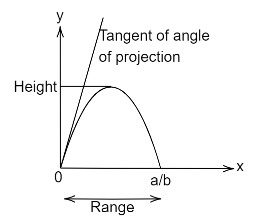
Hint: The following equation represents an inward parabola just like a projectile motion of an object thrown at a certain angle with the horizontal. The trajectory equation when differentiated w.r.t x gives the slope of the curve basically telling the point of maximum y (height). The distance between the points where y is zero gives the range. The slope at the starting point x=0, y=0 gives the slope i.e. tangent of angle of projection.
Complete step by step answer:
If an equation of any kind of motion is given whether simple or complex, linear or nonlinear, homogeneous or nonhomogeneous, differential or integral, etc. then a lot of information can be extracted from it. Like here, we will extract three parameters from a single equation. Given,
\[y = ax - b{x^2}\]
The above equation when plotted is as follows:
The given equation when differentiated gives the slope:
\[\dfrac{{dy}}{{dx}} = a - 2bx\]
When the slope is zero, that point represents the maximum height as shown in the diagram. The point x when substituted back in equation gives value of y which nothing but the maximum height:
\[
\Rightarrow 0 = a - 2bx \\
\Rightarrow x = \dfrac{a}{{2b}} \\
\Rightarrow y = a\left( {\dfrac{a}{{2b}}} \right) - b\left( {\dfrac{{{a^2}}}{{4{b^2}}}} \right) \\
\Rightarrow y = \dfrac{{{a^2}}}{{4b}} \Rightarrow Height \\
\]
The calculated slope at x=0, y=0 is:
\[
\dfrac{{dy}}{{dx}} = a - 2bx \\
{\left. {\dfrac{{dy}}{{dx}}} \right|_{x = 0}} = a \\
\]
Hence the tangent of angle of projection is at slope m=a.
Mathematically, the distance between the roots of the equation is the range. Substitute y=0 in the equation to get the roots:
\[
\Rightarrow ax - b{x^2} = 0 \\
\Rightarrow x(a - bx) = 0 \\
\Rightarrow x = 0 \\
\therefore x = a/b \\
\]
Therefore, the range is R= a/b-0=a/b.
The correct answer is option B.
Note: In this type of questions, we need not calculate every parameter given in the match the following. From the options we can narrow down the options having different answers for the same option. For example, here we see that if we calculate option (ii) and either (i) or (iii) we would get an answer without solving the whole question. This saves time.
Complete step by step answer:
If an equation of any kind of motion is given whether simple or complex, linear or nonlinear, homogeneous or nonhomogeneous, differential or integral, etc. then a lot of information can be extracted from it. Like here, we will extract three parameters from a single equation. Given,
\[y = ax - b{x^2}\]
The above equation when plotted is as follows:
The given equation when differentiated gives the slope:
\[\dfrac{{dy}}{{dx}} = a - 2bx\]
When the slope is zero, that point represents the maximum height as shown in the diagram. The point x when substituted back in equation gives value of y which nothing but the maximum height:
\[
\Rightarrow 0 = a - 2bx \\
\Rightarrow x = \dfrac{a}{{2b}} \\
\Rightarrow y = a\left( {\dfrac{a}{{2b}}} \right) - b\left( {\dfrac{{{a^2}}}{{4{b^2}}}} \right) \\
\Rightarrow y = \dfrac{{{a^2}}}{{4b}} \Rightarrow Height \\
\]
The calculated slope at x=0, y=0 is:
\[
\dfrac{{dy}}{{dx}} = a - 2bx \\
{\left. {\dfrac{{dy}}{{dx}}} \right|_{x = 0}} = a \\
\]
Hence the tangent of angle of projection is at slope m=a.
Mathematically, the distance between the roots of the equation is the range. Substitute y=0 in the equation to get the roots:
\[
\Rightarrow ax - b{x^2} = 0 \\
\Rightarrow x(a - bx) = 0 \\
\Rightarrow x = 0 \\
\therefore x = a/b \\
\]
Therefore, the range is R= a/b-0=a/b.
The correct answer is option B.
Note: In this type of questions, we need not calculate every parameter given in the match the following. From the options we can narrow down the options having different answers for the same option. For example, here we see that if we calculate option (ii) and either (i) or (iii) we would get an answer without solving the whole question. This saves time.
Recently Updated Pages
Master Class 12 Economics: Engaging Questions & Answers for Success

Master Class 12 English: Engaging Questions & Answers for Success
Master Class 12 Social Science: Engaging Questions & Answers for Success
Master Class 12 Maths: Engaging Questions & Answers for Success
Master Class 12 Physics: Engaging Questions & Answers for Success
Master Class 11 Social Science: Engaging Questions & Answers for Success
Trending doubts
One Metric ton is equal to kg A 10000 B 1000 C 100 class 11 physics CBSE
Difference Between Prokaryotic Cells and Eukaryotic Cells
Two of the body parts which do not appear in MRI are class 11 biology CBSE
1 ton equals to A 100 kg B 1000 kg C 10 kg D 10000 class 11 physics CBSE
Draw a diagram of nephron and explain its structur class 11 biology CBSE
10 examples of friction in our daily life