




The path length of one oscillation of a simple pendulum of length of $ 1 $ meter is $ 16cm $ . Its maximum velocity is ( $ g = {\pi ^2}m{s^{ - 2}} $ )
$ \left( A \right)2\pi m{s^{ - 1}} \\
\left( B \right)4\pi m{s^{ - 1}} \\
\left( C \right)8\pi m{s^{ - 1}} \\
\left( D \right)16\pi m{s^{ - 1}} \\ $
Answer
 Verified
552.6k+ views
Hint :In order to solve this question, we are going to draw a schematic diagram of the pendulum and then calculate the height $ h $ of the pendulum bob from the length $ AOB $ and then, by equating the potential and the kinetic energies of the pendulum bob, the maximum velocity is calculated.
The formula used in this question is
The angle $ \theta = \dfrac{{arc}}{{radius}} $
All of the potential energy at $ A $ is converted to the kinetic energy at $ O $
$ P.E. = K.E. \\
mg\Delta x = \dfrac{1}{2}m{v^2} \\ $
Complete Step By Step Answer:
Let us first draw the figure for the given arrangement
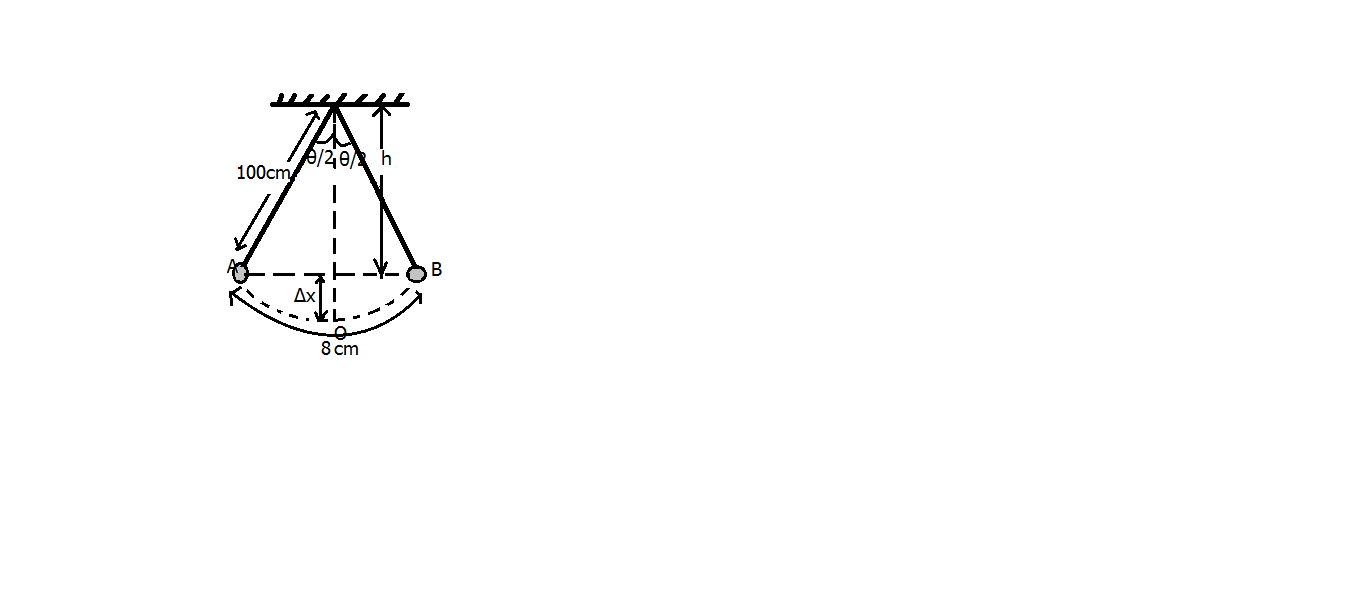
As it is given that the length of the complete oscillation is $ 16cm $ so, the length of $ AOB $ will be $ 8cm $ , Now the angle $ \theta = \dfrac{{arc}}{{radius}} $
Putting the values of the arc and the radius
$ \theta = \dfrac{{8cm}}{{100cm}} = 0.08 $
So, the angles $ \dfrac{\theta }{2} $ equals $ 0.04 $ radians
So, the height, $ h $ is calculated as
$ h = 100cm \times \cos \dfrac{\theta }{2} = 100cm \times \cos \left( {0.04} \right) \\
\Rightarrow h = 100cm \times 0.9992 = 99.92cm \\ $
Therefore, $ \Delta x = 100cm - h = 100 - 99.92 = 0.08cm $
Now, all of the potential energy at $ A $ is converted to the kinetic energy at $ O $
$ P.E. = K.E. $
So,
$ mg\Delta x = \dfrac{1}{2}m{v^2} $
Now, as it is given that, $ g = {x^2} = \dfrac{1}{2}{v^2} = 100{\pi ^2}cm{s^{ - 2}} $
Since, $ 1m = 100cm $
Therefore,
$ g\Delta x = \dfrac{1}{2}{v^2} \\
{v^2} = 2g\Delta x \\
{v^2} = 2 \times 100{\pi ^2}cm{s^{ - 2}} \times 0.08cm \\
{v^2} = 16{\pi ^2}c{m^2}{s^{ - 2}} \\
v = 4\pi cm{s^{ - 1}} \\ $
Note :
The angle $ \theta $ is divided equally by the perpendicular bisector to the line segment. As the pendulum bob moves from a certain height to the reference level, all of its potential energy due to a particular height gets converted to the kinetic energy and when the bob goes from the reference level to the extreme point, the kinetic energy gets converted to the potential energy , this gives an energy equivalence.
The formula used in this question is
The angle $ \theta = \dfrac{{arc}}{{radius}} $
All of the potential energy at $ A $ is converted to the kinetic energy at $ O $
$ P.E. = K.E. \\
mg\Delta x = \dfrac{1}{2}m{v^2} \\ $
Complete Step By Step Answer:
Let us first draw the figure for the given arrangement
As it is given that the length of the complete oscillation is $ 16cm $ so, the length of $ AOB $ will be $ 8cm $ , Now the angle $ \theta = \dfrac{{arc}}{{radius}} $
Putting the values of the arc and the radius
$ \theta = \dfrac{{8cm}}{{100cm}} = 0.08 $
So, the angles $ \dfrac{\theta }{2} $ equals $ 0.04 $ radians
So, the height, $ h $ is calculated as
$ h = 100cm \times \cos \dfrac{\theta }{2} = 100cm \times \cos \left( {0.04} \right) \\
\Rightarrow h = 100cm \times 0.9992 = 99.92cm \\ $
Therefore, $ \Delta x = 100cm - h = 100 - 99.92 = 0.08cm $
Now, all of the potential energy at $ A $ is converted to the kinetic energy at $ O $
$ P.E. = K.E. $
So,
$ mg\Delta x = \dfrac{1}{2}m{v^2} $
Now, as it is given that, $ g = {x^2} = \dfrac{1}{2}{v^2} = 100{\pi ^2}cm{s^{ - 2}} $
Since, $ 1m = 100cm $
Therefore,
$ g\Delta x = \dfrac{1}{2}{v^2} \\
{v^2} = 2g\Delta x \\
{v^2} = 2 \times 100{\pi ^2}cm{s^{ - 2}} \times 0.08cm \\
{v^2} = 16{\pi ^2}c{m^2}{s^{ - 2}} \\
v = 4\pi cm{s^{ - 1}} \\ $
Note :
The angle $ \theta $ is divided equally by the perpendicular bisector to the line segment. As the pendulum bob moves from a certain height to the reference level, all of its potential energy due to a particular height gets converted to the kinetic energy and when the bob goes from the reference level to the extreme point, the kinetic energy gets converted to the potential energy , this gives an energy equivalence.
Recently Updated Pages
Basicity of sulphurous acid and sulphuric acid are

Master Class 11 Business Studies: Engaging Questions & Answers for Success
Master Class 11 Computer Science: Engaging Questions & Answers for Success
Master Class 11 Economics: Engaging Questions & Answers for Success
Master Class 11 Social Science: Engaging Questions & Answers for Success
Master Class 11 English: Engaging Questions & Answers for Success
Trending doubts
One Metric ton is equal to kg A 10000 B 1000 C 100 class 11 physics CBSE
The largest wind power cluster is located in the state class 11 social science CBSE
Explain zero factorial class 11 maths CBSE
State and prove Bernoullis theorem class 11 physics CBSE
What steps did the French revolutionaries take to create class 11 social science CBSE
Which among the following are examples of coming together class 11 social science CBSE