




The outermost layer of earth is called as
A. Mantle
B. Outer Core
C. Crust
D. Inner Core
Answer
 Verified
606k+ views
Hint: The Earth's outermost layer is composed of igneous, metamorphic, and sedimentary rocks, from mud and clay to diamonds and coal. The most abundant rocks, which are produced by the cooling of magma, are igneous. Igneous rocks such as granite and basalt are abundant in it.
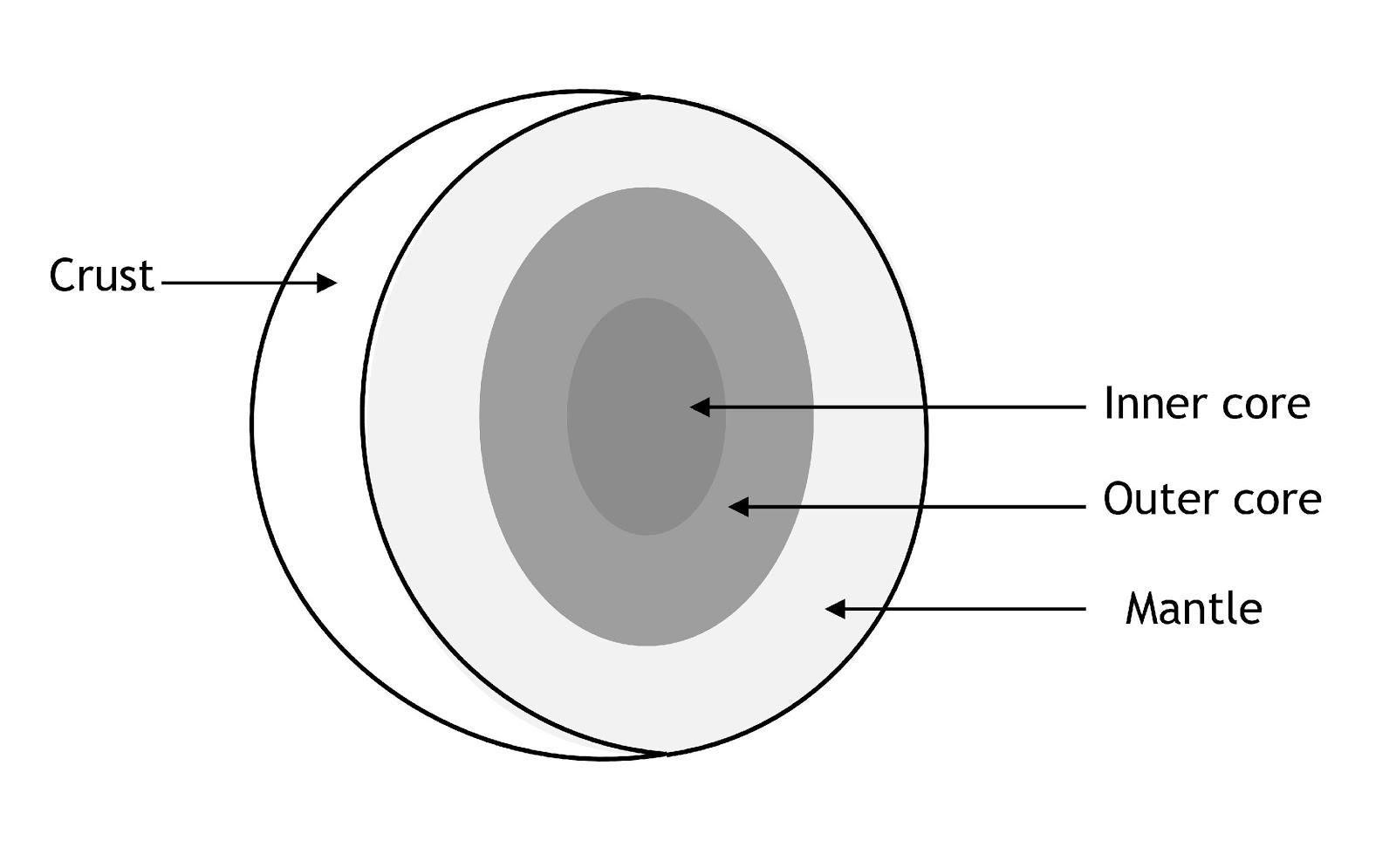
Complete answer: The mantle, which makes up about \[84\% \] of the volume of the Earth, is primarily solid but, in geological time, functions as a very viscous fluid.
The outer core is \[2300\] km wide and has been established to be liquid (based on seismic explorations), spreading to a radius of approximately \[3,400\] km. The inner core is mostly composed of iron and nickel and has a radius of approximately \[1,220\] km.
The crust is the planet's outermost layer, the cooled and stabilized portion of the Earth that ranges from around \[5 - 70\] km in diameter. This layer makes up just 1 percent of the Earth’s entire thickness, while it makes up the whole surface (the continents and the bottom of the ocean). The thinner sections are the oceanic crust which, at a depth of \[5 - 10\] km, underlies the ocean basins, while the thicker crust is the continental crust.
So, the correct answer is “Option C”.
Note: Residual liquid is formed by the freezing of liquid iron into crystalline form at the inner core boundary. More light elements than the overlying liquid are included in it. In turn, this is thought to cause the liquid elements to become buoyant, helping to push the outer core convection. Therefore, through dynamo activity in the liquid outer core, this growth is likely to play an important role in producing the Earth's magnetic field.
Complete answer: The mantle, which makes up about \[84\% \] of the volume of the Earth, is primarily solid but, in geological time, functions as a very viscous fluid.
The outer core is \[2300\] km wide and has been established to be liquid (based on seismic explorations), spreading to a radius of approximately \[3,400\] km. The inner core is mostly composed of iron and nickel and has a radius of approximately \[1,220\] km.
The crust is the planet's outermost layer, the cooled and stabilized portion of the Earth that ranges from around \[5 - 70\] km in diameter. This layer makes up just 1 percent of the Earth’s entire thickness, while it makes up the whole surface (the continents and the bottom of the ocean). The thinner sections are the oceanic crust which, at a depth of \[5 - 10\] km, underlies the ocean basins, while the thicker crust is the continental crust.
So, the correct answer is “Option C”.
Note: Residual liquid is formed by the freezing of liquid iron into crystalline form at the inner core boundary. More light elements than the overlying liquid are included in it. In turn, this is thought to cause the liquid elements to become buoyant, helping to push the outer core convection. Therefore, through dynamo activity in the liquid outer core, this growth is likely to play an important role in producing the Earth's magnetic field.
Recently Updated Pages
Master Class 12 Economics: Engaging Questions & Answers for Success

Master Class 12 English: Engaging Questions & Answers for Success
Master Class 12 Social Science: Engaging Questions & Answers for Success
Master Class 12 Maths: Engaging Questions & Answers for Success
Master Class 12 Physics: Engaging Questions & Answers for Success
Master Class 9 General Knowledge: Engaging Questions & Answers for Success
Trending doubts
One Metric ton is equal to kg A 10000 B 1000 C 100 class 11 physics CBSE
Difference Between Prokaryotic Cells and Eukaryotic Cells
Two of the body parts which do not appear in MRI are class 11 biology CBSE
Find the value of the expression given below sin 30circ class 11 maths CBSE
1 ton equals to A 100 kg B 1000 kg C 10 kg D 10000 class 11 physics CBSE
Draw a diagram of nephron and explain its structur class 11 biology CBSE