




The order of multiple roots of 2 of the equation ${{x}^{4}}-5{{x}^{3}}+6{{x}^{2}}+4x-8=0$ is
[a] 1
[b] 2
[c] 3
[d] 4
Answer
 Verified
644.1k+ views
Hint: Use the fact that if the multiplicity of a root x= a is r in the polynomial p(x), then there exists a polynomial g(x) such that $p\left( x \right)={{\left( x-a \right)}^{r}}g\left( x \right)$ and $g\left( a \right)\ne 0$. Use factor theorem to check that if x-2 is a factor of $p\left( x \right)={{x}^{4}}-5{{x}^{3}}+6{{x}^{2}}+4x-8$. If yes, then write $p\left( x \right)=\left( x-2 \right)g\left( x \right)$ using the long-division method. Apply the same process on g(x). Continue till g(x) is no more divisible by x-2. Hence find the order of the root 2 in the equation ${{x}^{4}}-5{{x}^{3}}+6{{x}^{2}}+4x-8=0$
Complete step-by-step answer:
Let $p\left( x \right)={{x}^{4}}-5{{x}^{3}}+6{{x}^{2}}+4x-8$
Now, we have
$p\left( 2 \right)={{2}^{4}}-5\times {{2}^{3}}+6\times {{2}^{2}}+4\times 2-8=16-40+24+8-8=0$
Hence by factor theorem, x-2 is a factor of p(x).
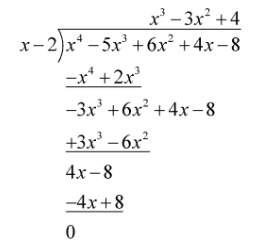
Dividing p(x) by x-2 using long-division method shown as follows:
Hence, we have
$p\left( x \right)=\left( x-2 \right)\left( {{x}^{3}}-3{{x}^{2}}+4 \right)$
Now, we have $g\left( x \right)={{x}^{3}}-3{{x}^{2}}+4$
Now, we have
$g\left( 2 \right)={{2}^{3}}-3\times {{2}^{2}}+4=8-12+4=0$
Hence by factor theorem, x-2 is a factor of g(x).
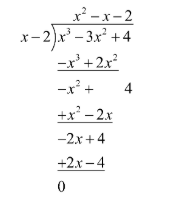
Hence, we have
Hence, we have
$\begin{align}
& g\left( x \right)=\left( x-2 \right)\left( {{x}^{2}}-x-2 \right) \\
& \Rightarrow p\left( x \right)={{\left( x-2 \right)}^{2}}\left( {{x}^{2}}-x-2 \right) \\
\end{align}$
Let $h\left( x \right)={{x}^{2}}-x-2$
Hence, we have
$h\left( 2 \right)={{2}^{2}}-2-2=0$
Hence by factor theorem, x-2 is a factor of h(x)
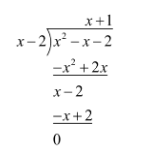
Hence, we have
Hence, we have
$\begin{align}
& h\left( x \right)=\left( x-2 \right)\left( x+1 \right) \\
& \Rightarrow p\left( x \right)={{\left( x-2 \right)}^{3}}\left( x+1 \right) \\
\end{align}$
Let f(x) = x+1
Since $f\left( 2 \right)=1+2\ne 0$, we have
3 is the order of the root 2 of the equation ${{x}^{4}}-5{{x}^{3}}+6{{x}^{2}}+4x-8=0$
Hence option [c] is correct.
Note: Alternative solution: Best method:
We know that if r is the multiplicity of root x=a in the polynomial p(x), then $p\left( a \right),{{\left. \dfrac{d}{dx}p\left( x \right) \right|}_{x=a}},{{\left. \dfrac{{{d}^{2}}}{d{{x}^{2}}}p\left( x \right) \right|}_{x=a}},\cdots ,{{\left. \dfrac{{{d}^{r-1}}}{d{{x}^{r-1}}}p\left( x \right) \right|}_{x=r}}$ are all 0.
Now, we have
$p\left( x \right)={{x}^{4}}-5{{x}^{3}}+6{{x}^{2}}+4x-8$
Hence, we have
$p\left( 2 \right)={{2}^{4}}-5\times {{2}^{3}}+6\times {{2}^{2}}+4\,\times 2-8=16-40+24+8-8=0$
Now, we have
$\dfrac{d}{dx}p\left( x \right)=4{{x}^{3}}-15{{x}^{2}}+12x+4$
Hence, we have
${{\left. \dfrac{d}{dx}p\left( x \right) \right|}_{x=2}}=4\times {{2}^{3}}-15\times {{2}^{2}}+12\times 2+4=32-60+24+4=0$
Now, we have
$\dfrac{{{d}^{2}}}{d{{x}^{2}}}p\left( x \right)=12{{x}^{2}}-30x+12$
Hence, we have
${{\left. \dfrac{{{d}^{2}}}{d{{x}^{2}}}p\left( x \right) \right|}_{x=2}}=12\times {{2}^{2}}-30\times 2+12=48-60+12=0$
Now, we have
$\dfrac{{{d}^{3}}}{d{{x}^{3}}}p\left( x \right)=24x-30$
Hence, we have
${{\left. \dfrac{{{d}^{3}}}{d{{x}^{3}}}p\left( x \right) \right|}_{x=2}}=24\times 2-30=48-30=18\ne 0$
Hence, the multiplicity of the root x= 2 in p(x) is 2+1 =3.
Hence option [c] is correct.
Complete step-by-step answer:
Let $p\left( x \right)={{x}^{4}}-5{{x}^{3}}+6{{x}^{2}}+4x-8$
Now, we have
$p\left( 2 \right)={{2}^{4}}-5\times {{2}^{3}}+6\times {{2}^{2}}+4\times 2-8=16-40+24+8-8=0$
Hence by factor theorem, x-2 is a factor of p(x).
Dividing p(x) by x-2 using long-division method shown as follows:
Hence, we have
$p\left( x \right)=\left( x-2 \right)\left( {{x}^{3}}-3{{x}^{2}}+4 \right)$
Now, we have $g\left( x \right)={{x}^{3}}-3{{x}^{2}}+4$
Now, we have
$g\left( 2 \right)={{2}^{3}}-3\times {{2}^{2}}+4=8-12+4=0$
Hence by factor theorem, x-2 is a factor of g(x).
Hence, we have
Hence, we have
$\begin{align}
& g\left( x \right)=\left( x-2 \right)\left( {{x}^{2}}-x-2 \right) \\
& \Rightarrow p\left( x \right)={{\left( x-2 \right)}^{2}}\left( {{x}^{2}}-x-2 \right) \\
\end{align}$
Let $h\left( x \right)={{x}^{2}}-x-2$
Hence, we have
$h\left( 2 \right)={{2}^{2}}-2-2=0$
Hence by factor theorem, x-2 is a factor of h(x)
Hence, we have
Hence, we have
$\begin{align}
& h\left( x \right)=\left( x-2 \right)\left( x+1 \right) \\
& \Rightarrow p\left( x \right)={{\left( x-2 \right)}^{3}}\left( x+1 \right) \\
\end{align}$
Let f(x) = x+1
Since $f\left( 2 \right)=1+2\ne 0$, we have
3 is the order of the root 2 of the equation ${{x}^{4}}-5{{x}^{3}}+6{{x}^{2}}+4x-8=0$
Hence option [c] is correct.
Note: Alternative solution: Best method:
We know that if r is the multiplicity of root x=a in the polynomial p(x), then $p\left( a \right),{{\left. \dfrac{d}{dx}p\left( x \right) \right|}_{x=a}},{{\left. \dfrac{{{d}^{2}}}{d{{x}^{2}}}p\left( x \right) \right|}_{x=a}},\cdots ,{{\left. \dfrac{{{d}^{r-1}}}{d{{x}^{r-1}}}p\left( x \right) \right|}_{x=r}}$ are all 0.
Now, we have
$p\left( x \right)={{x}^{4}}-5{{x}^{3}}+6{{x}^{2}}+4x-8$
Hence, we have
$p\left( 2 \right)={{2}^{4}}-5\times {{2}^{3}}+6\times {{2}^{2}}+4\,\times 2-8=16-40+24+8-8=0$
Now, we have
$\dfrac{d}{dx}p\left( x \right)=4{{x}^{3}}-15{{x}^{2}}+12x+4$
Hence, we have
${{\left. \dfrac{d}{dx}p\left( x \right) \right|}_{x=2}}=4\times {{2}^{3}}-15\times {{2}^{2}}+12\times 2+4=32-60+24+4=0$
Now, we have
$\dfrac{{{d}^{2}}}{d{{x}^{2}}}p\left( x \right)=12{{x}^{2}}-30x+12$
Hence, we have
${{\left. \dfrac{{{d}^{2}}}{d{{x}^{2}}}p\left( x \right) \right|}_{x=2}}=12\times {{2}^{2}}-30\times 2+12=48-60+12=0$
Now, we have
$\dfrac{{{d}^{3}}}{d{{x}^{3}}}p\left( x \right)=24x-30$
Hence, we have
${{\left. \dfrac{{{d}^{3}}}{d{{x}^{3}}}p\left( x \right) \right|}_{x=2}}=24\times 2-30=48-30=18\ne 0$
Hence, the multiplicity of the root x= 2 in p(x) is 2+1 =3.
Hence option [c] is correct.
Recently Updated Pages
Master Class 11 English: Engaging Questions & Answers for Success

Master Class 11 Social Science: Engaging Questions & Answers for Success
Master Class 11 Maths: Engaging Questions & Answers for Success
Master Class 11 Biology: Engaging Questions & Answers for Success
Master Class 11 Physics: Engaging Questions & Answers for Success
Master Class 11 Chemistry: Engaging Questions & Answers for Success
Trending doubts
Explain the Treaty of Vienna of 1815 class 10 social science CBSE
What is the Total Duration of Football Match?
The shortest day of the year in India
In which year voting age was reduced from 21 to 18?
10 examples of evaporation in daily life with explanations
What planets have no moons Which one has only one moon class 10 physics CBSE