




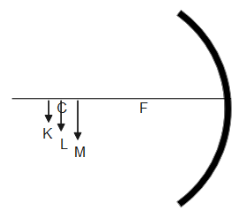
The objects named $K, L$ and $M$ are placed in front of a concave mirror as shown in the figure below correctly showing the images of the objects?
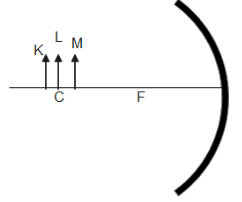
A.
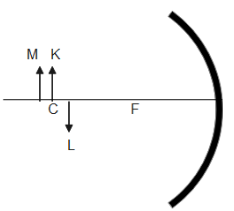
B.
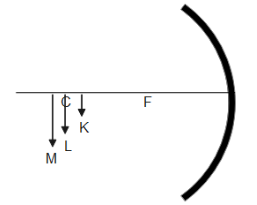
C.
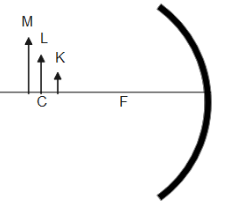
D.
Answer
 Verified
516.9k+ views
Hint: We are given three objects placed at three different positions in front of a concave mirror and we need to find the positions of the image formed of each object. We need to be clear with concepts of image formation by a concave mirror for doing such problems.
Complete step by step answer:
The object $L$ is placed at the center curvature of the mirror which is equal to twice the length of the focal length of the mirror. Therefore using mirror formula for the given situation
$\dfrac{1}{v} + \dfrac{1}{u} = \dfrac{1}{f}$
Where $u$ is the object distance from the mirror, $v$ is the image distance and $f$ is the focal length
Here $u = 2f$, therefore substituting the value we get,
$ \Rightarrow \dfrac{1}{v} + \dfrac{1}{{2f}} = \dfrac{1}{f}$
$ \Rightarrow v = - 2f$
This means the object will be formed at the same distance from the mirror where the object is placed but will be inverted.
Now the magnification can be calculated using $m = - \left( {\dfrac{v}{u}} \right)$.
Substituting the value we get,
$ \therefore m = - 1$
This shows that the object will be the same as that of the object. Now for object $K$, the value of the object distance from the mirror will be more than $2f$ which will give a minimized image and the image distance will be less than $2f$ and more than $f$. For object $M$ the value of the object distance from the mirror will be between $2f$ and $f$ which will give a magnified image and the image distance will be more than $2f$.
Hence, option D is correct.
Note: We should note that the concave mirror produces both real and virtual images. When the object is placed very close to the mirror, a virtual and magnified image is obtained and if we increase the distance between the object and the mirror, the size of the image reduces and real images are formed.
Complete step by step answer:
The object $L$ is placed at the center curvature of the mirror which is equal to twice the length of the focal length of the mirror. Therefore using mirror formula for the given situation
$\dfrac{1}{v} + \dfrac{1}{u} = \dfrac{1}{f}$
Where $u$ is the object distance from the mirror, $v$ is the image distance and $f$ is the focal length
Here $u = 2f$, therefore substituting the value we get,
$ \Rightarrow \dfrac{1}{v} + \dfrac{1}{{2f}} = \dfrac{1}{f}$
$ \Rightarrow v = - 2f$
This means the object will be formed at the same distance from the mirror where the object is placed but will be inverted.
Now the magnification can be calculated using $m = - \left( {\dfrac{v}{u}} \right)$.
Substituting the value we get,
$ \therefore m = - 1$
This shows that the object will be the same as that of the object. Now for object $K$, the value of the object distance from the mirror will be more than $2f$ which will give a minimized image and the image distance will be less than $2f$ and more than $f$. For object $M$ the value of the object distance from the mirror will be between $2f$ and $f$ which will give a magnified image and the image distance will be more than $2f$.
Hence, option D is correct.
Note: We should note that the concave mirror produces both real and virtual images. When the object is placed very close to the mirror, a virtual and magnified image is obtained and if we increase the distance between the object and the mirror, the size of the image reduces and real images are formed.
Recently Updated Pages
Basicity of sulphurous acid and sulphuric acid are

Master Class 10 English: Engaging Questions & Answers for Success
Master Class 10 Social Science: Engaging Questions & Answers for Success
Master Class 10 Computer Science: Engaging Questions & Answers for Success
Class 10 Question and Answer - Your Ultimate Solutions Guide
Master Class 10 General Knowledge: Engaging Questions & Answers for Success
Trending doubts
Which country won the ICC Men's ODI World Cup in 2023?
In cricket, how many legal balls are there in a standard over?
Explain the Treaty of Vienna of 1815 class 10 social science CBSE
What does "powerplay" mean in limited-overs cricket?
What is the full form of PNG A Petrol Natural Gas B class 10 chemistry CBSE
What is the "Powerplay" in T20 cricket?