




The number of ways in which couple can sit around a table with 6 guests, if the couple take consecutive seat is
(A) 1440
(B) 720
(C) 5040
(D) none of these
Answer
 Verified
582.9k+ views
Hint: We have been given an arrangement of people of how they are to be seated around a table. We can get the number of ways for doing so by using the permutation. As the couple is to be seated together always, we will group them together and find the total number of required ways.
For circular permutation, the number of ways for the arrangement are given by $\left( {n - 1} \right)!$ where n is the number of people to be seated.
Complete step by step solution:
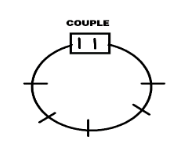
The guests are to be seated round a table where a couple is to be seated consecutive to 6 guests. We can calculate the number ways this arrangement can be done using permutation.
Here, we will be using circular permutation as the seating is to be done around a table. So, the number of ways for the arrangement will be given as:
$\left( {n - 1} \right)!$
Where n will be equal to the number of people to be seated.
Now, as the couple will be seated together anywhere, we will consider them as only 1 person as they will be grouped. We now have to arrange 6 guests and 1 couple, so the value of n becomes:
$
n = 6 + 1 \\
\Rightarrow n = 7 \;
$
Substituting the value of n to find the number of ways for the arrangement:
$\left( {7 - 1} \right)! = 6!$
Factorial is the product of that number backwards till 1, so value of $6!$ will be:
$
6! = 6 \times 5 \times 4 \times 3 \times 2 \times 1 \\
6! = 720 ;
$
But, the couple can also interchange the position among themselves. Their arrangement will be considered as linear as they are grouped together. So, for two people the ways of arrangement will be $2!$
Thus, the total number of ways (N) for the given arrangement can be done will be the product of the two.
$
\Rightarrow N = 6! \times 2! \\
\Rightarrow N = 720 \times 2 \times 1 \\
\Rightarrow N = 1440 \;
$
Therefore, the number of ways in which a couple can sit around a table with 6 guests, if the couple take consecutive seats is $1440$ and the correct option is A).
So, the correct answer is “Option A”.
Note:For a circular arrangement, we take a person less for the factorial because when we arrange, we consider that place of one person is fixed and the arrangement is required to be done among the rest of the persons. Thus we use $\left( {n - 1} \right)!$ to calculate the possible number of ways.
Whenever we are required to make certain people together, remember that they are grouped, counted as 1 but their arrangements can interchange among themselves given by the factorial of the number of persons present in the group.
For circular permutation, the number of ways for the arrangement are given by $\left( {n - 1} \right)!$ where n is the number of people to be seated.
Complete step by step solution:
The guests are to be seated round a table where a couple is to be seated consecutive to 6 guests. We can calculate the number ways this arrangement can be done using permutation.
Here, we will be using circular permutation as the seating is to be done around a table. So, the number of ways for the arrangement will be given as:
$\left( {n - 1} \right)!$
Where n will be equal to the number of people to be seated.
Now, as the couple will be seated together anywhere, we will consider them as only 1 person as they will be grouped. We now have to arrange 6 guests and 1 couple, so the value of n becomes:
$
n = 6 + 1 \\
\Rightarrow n = 7 \;
$
Substituting the value of n to find the number of ways for the arrangement:
$\left( {7 - 1} \right)! = 6!$
Factorial is the product of that number backwards till 1, so value of $6!$ will be:
$
6! = 6 \times 5 \times 4 \times 3 \times 2 \times 1 \\
6! = 720 ;
$
But, the couple can also interchange the position among themselves. Their arrangement will be considered as linear as they are grouped together. So, for two people the ways of arrangement will be $2!$
Thus, the total number of ways (N) for the given arrangement can be done will be the product of the two.
$
\Rightarrow N = 6! \times 2! \\
\Rightarrow N = 720 \times 2 \times 1 \\
\Rightarrow N = 1440 \;
$
Therefore, the number of ways in which a couple can sit around a table with 6 guests, if the couple take consecutive seats is $1440$ and the correct option is A).
So, the correct answer is “Option A”.
Note:For a circular arrangement, we take a person less for the factorial because when we arrange, we consider that place of one person is fixed and the arrangement is required to be done among the rest of the persons. Thus we use $\left( {n - 1} \right)!$ to calculate the possible number of ways.
Whenever we are required to make certain people together, remember that they are grouped, counted as 1 but their arrangements can interchange among themselves given by the factorial of the number of persons present in the group.
Recently Updated Pages
Basicity of sulphurous acid and sulphuric acid are

Master Class 10 English: Engaging Questions & Answers for Success
Master Class 10 Social Science: Engaging Questions & Answers for Success
Master Class 10 Computer Science: Engaging Questions & Answers for Success
Class 10 Question and Answer - Your Ultimate Solutions Guide
Master Class 10 General Knowledge: Engaging Questions & Answers for Success
Trending doubts
Which country won the ICC Men's ODI World Cup in 2023?
In cricket, how many legal balls are there in a standard over?
Explain the Treaty of Vienna of 1815 class 10 social science CBSE
A boat goes 24 km upstream and 28 km downstream in class 10 maths CBSE
What does "powerplay" mean in limited-overs cricket?
What is the "Powerplay" in T20 cricket?