




The number of structural for \[{{\text{C}}_6}{{\text{H}}_{14}}\]
A.3
B.4
C.5
D.6
Answer
 Verified
643.5k+ views
Hint:There are various types of structural isomerism. In the above molecule chain isomerism, position isomerism is contained in but functional group isomerism is not present in the above molecule. The given molecule is a saturated hydrocarbon.
Complete step by step answer:
Isomers are those molecules which have the same molecular formula but have different physical and chemical properties.Structural isomers are those having the same molecular formula but different properties due to different structures. They are classified as chain isomerism, position isomerism, functional group isomerism and linking isomerism.
Functional group isomerism is that structural isomerism which has the same molecular formula but different functional group chain isomerism by that structural isomerism which has the same molecular formula but different length of principal carbon. Chain position isomerism is that structural isomerism which has the same molecular formula but different position of functional groups or multiple bond or side substituents. Ring chain isomerism is that structural isomerism which has the same molecular formula but has either the multiple bonds or ring with respect to its isomer.
The given formula represents an alkane named as hexane representing the general formula \[{{\text{C}}_{\text{n}}}{{\text{H}}_{{\text{2n}} + 2}}\] . It does not have any functional group and hence cannot possess functional isomerism. The conditions are also not suitable for ring formation because it contains only single bonds and the number of hydrogen required in a ring will be 12 and not 14. The structural isomerism of are as follow:
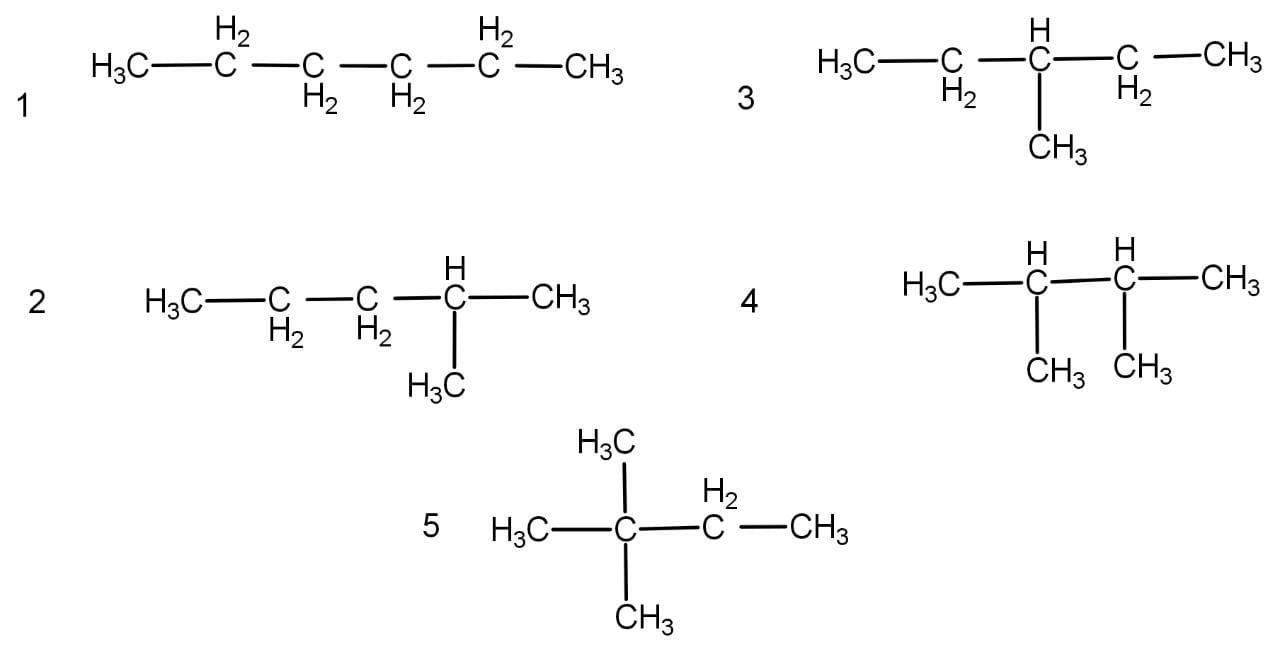
Hence, the correct option is option C.
Note:
There are two types of isomerism: structural isomerism and stereoisomerism. Stereoisomerism is those isomers in which the molecules differ in the arrangement of atoms in space, i.e. 3D arrangement. They include R-S configuration, cis and trans isomers etc.
Complete step by step answer:
Isomers are those molecules which have the same molecular formula but have different physical and chemical properties.Structural isomers are those having the same molecular formula but different properties due to different structures. They are classified as chain isomerism, position isomerism, functional group isomerism and linking isomerism.
Functional group isomerism is that structural isomerism which has the same molecular formula but different functional group chain isomerism by that structural isomerism which has the same molecular formula but different length of principal carbon. Chain position isomerism is that structural isomerism which has the same molecular formula but different position of functional groups or multiple bond or side substituents. Ring chain isomerism is that structural isomerism which has the same molecular formula but has either the multiple bonds or ring with respect to its isomer.
The given formula represents an alkane named as hexane representing the general formula \[{{\text{C}}_{\text{n}}}{{\text{H}}_{{\text{2n}} + 2}}\] . It does not have any functional group and hence cannot possess functional isomerism. The conditions are also not suitable for ring formation because it contains only single bonds and the number of hydrogen required in a ring will be 12 and not 14. The structural isomerism of are as follow:
Hence, the correct option is option C.
Note:
There are two types of isomerism: structural isomerism and stereoisomerism. Stereoisomerism is those isomers in which the molecules differ in the arrangement of atoms in space, i.e. 3D arrangement. They include R-S configuration, cis and trans isomers etc.
Recently Updated Pages
If x a + bt + ct2 where x is in meters and t is in class 11 physics CBSE

A car covers the first half distance between two places class 11 physics CBSE
The resultant of two vectors overrightarrow P and overrightarrow class 11 physics CBSE
Find the value of cos 135 class 11 maths CBSE
A mass M is held in place by an applied force F and class 11 physics CBSE
A solution of glucose in water is labelled as 10 dfracwv class 11 chemistry CBSE
Trending doubts
One Metric ton is equal to kg A 10000 B 1000 C 100 class 11 physics CBSE
Find the value of the expression given below sin 30circ class 11 maths CBSE
Draw a diagram of nephron and explain its structur class 11 biology CBSE
10 examples of friction in our daily life
Proton was discovered by A Thomson B Rutherford C Chadwick class 11 chemistry CBSE
Bond order ofO2 O2+ O2 and O22 is in order A O2 langle class 11 chemistry CBSE