




The number of solutions of the equation $1+\sin x.{{\sin }^{2}}\dfrac{x}{2}=0\left[ -\pi ,\pi \right]$ is,
A. Zero
B. 1
C. 2
D. 3
Answer
 Verified
614.7k+ views
Hint: In this question we will have to know about the range of \[\sin x\ and\ {{\sin }^{2}}\dfrac{x}{2}\] and by using it we will find the number of solution. We know that, \[-1\le \sin x\le 1\,and\ 0\le {{\sin }^{2}}\dfrac{x}{2}\le 1\] for all values of \[x\].
Complete step-by-step answer:
We have been asked to find the number of solutions of the equation $1+\sin x.{{\sin }^{2}}\dfrac{x}{2}=0\left[ -\pi ,\pi \right]$.
We can see the graph of \[\sin x\ and\ {{\sin }^{2}}\dfrac{x}{2}\] as below,
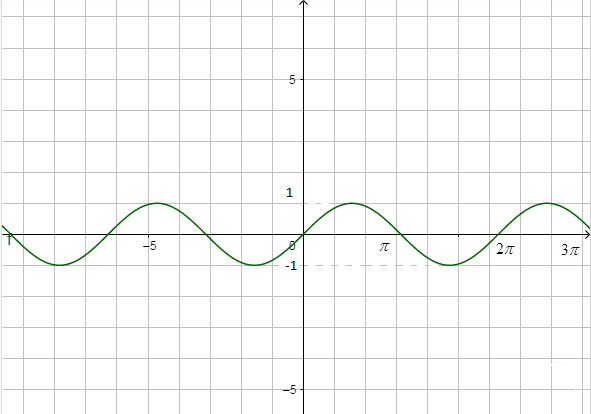
\[\sin x\]
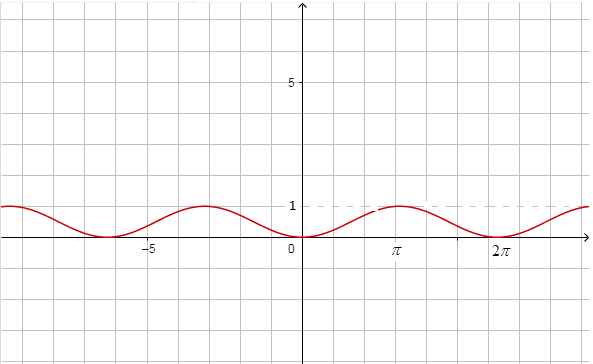
\[{{\sin }^{2}}\dfrac{x}{2}\]
Now, we can observe that for all values of \[x\],
\[\begin{align}
& -1\le \sin x\le 1\, \\
& 0\le {{\sin }^{2}}\dfrac{x}{2}\le 1 \\
\end{align}\]
And, \[{{\sin }^{2}}\dfrac{x}{2}\ne \sin x\] for any value of \[x\].
When \[\sin x\] has maximum or minimum value, \[{{\sin }^{2}}\dfrac{x}{2}\] will have less than 1.
So, we can say that $-1<\sin x.{{\sin }^{2}}\dfrac{x}{2}<1$ i.e. the value of the expression $\left( \sin x{{\sin }^{2}}\dfrac{x}{2} \right)$ must be lies between – 1 to 1.
Now, $-1<\sin x.{{\sin }^{2}}\dfrac{x}{2}<1$.
By adding 1 to inequality, we get,
$\begin{align}
& -1+1<1+\sin x.{{\sin }^{2}}\dfrac{x}{2}<1+1 \\
& \Rightarrow 0<1+\sin x.{{\sin }^{2}}\dfrac{x}{2}<2 \\
\end{align}$
So, we get the function $f\left( x \right)=1+\sin x.{{\sin }^{2}}\dfrac{x}{2}>0$ for all values of \[x\].
Hence, there will be no any solution of the $f\left( x \right)=0$ i.e., $1+\sin x.{{\sin }^{2}}\dfrac{x}{2}=0$.
Therefore, the correct option is A.
Note: In this type of question try to draw the graph of the function if it is possible as it becomes easy to solve the equation. Also, the graphical method to solve the equation is a shortcut method which you can apply anywhere in these types of questions.
Complete step-by-step answer:
We have been asked to find the number of solutions of the equation $1+\sin x.{{\sin }^{2}}\dfrac{x}{2}=0\left[ -\pi ,\pi \right]$.
We can see the graph of \[\sin x\ and\ {{\sin }^{2}}\dfrac{x}{2}\] as below,
\[\sin x\]
\[{{\sin }^{2}}\dfrac{x}{2}\]
Now, we can observe that for all values of \[x\],
\[\begin{align}
& -1\le \sin x\le 1\, \\
& 0\le {{\sin }^{2}}\dfrac{x}{2}\le 1 \\
\end{align}\]
And, \[{{\sin }^{2}}\dfrac{x}{2}\ne \sin x\] for any value of \[x\].
When \[\sin x\] has maximum or minimum value, \[{{\sin }^{2}}\dfrac{x}{2}\] will have less than 1.
So, we can say that $-1<\sin x.{{\sin }^{2}}\dfrac{x}{2}<1$ i.e. the value of the expression $\left( \sin x{{\sin }^{2}}\dfrac{x}{2} \right)$ must be lies between – 1 to 1.
Now, $-1<\sin x.{{\sin }^{2}}\dfrac{x}{2}<1$.
By adding 1 to inequality, we get,
$\begin{align}
& -1+1<1+\sin x.{{\sin }^{2}}\dfrac{x}{2}<1+1 \\
& \Rightarrow 0<1+\sin x.{{\sin }^{2}}\dfrac{x}{2}<2 \\
\end{align}$
So, we get the function $f\left( x \right)=1+\sin x.{{\sin }^{2}}\dfrac{x}{2}>0$ for all values of \[x\].
Hence, there will be no any solution of the $f\left( x \right)=0$ i.e., $1+\sin x.{{\sin }^{2}}\dfrac{x}{2}=0$.
Therefore, the correct option is A.
Note: In this type of question try to draw the graph of the function if it is possible as it becomes easy to solve the equation. Also, the graphical method to solve the equation is a shortcut method which you can apply anywhere in these types of questions.
Recently Updated Pages
Basicity of sulphurous acid and sulphuric acid are

Master Class 11 Business Studies: Engaging Questions & Answers for Success
Master Class 11 Computer Science: Engaging Questions & Answers for Success
Master Class 11 Economics: Engaging Questions & Answers for Success
Master Class 11 Social Science: Engaging Questions & Answers for Success
Master Class 11 English: Engaging Questions & Answers for Success
Trending doubts
One Metric ton is equal to kg A 10000 B 1000 C 100 class 11 physics CBSE
The largest wind power cluster is located in the state class 11 social science CBSE
Explain zero factorial class 11 maths CBSE
State and prove Bernoullis theorem class 11 physics CBSE
What steps did the French revolutionaries take to create class 11 social science CBSE
Which among the following are examples of coming together class 11 social science CBSE