




The number of sigma and pi-bonds in 1-butene 3-yne are:
(A) 5 sigma and 5 pi
(B) 7 sigma and 3 pi
(C) 8 sigma and 2 pi
(D) 6 sigma and 4 pi
Answer
 Verified
615.3k+ views
Hint: Pi Bonds can form in double and triple bonds but do not form in single bonds in most cases. Pi bonds are generally weaker than sigma bonds because they are formed of lateral overlapping, however, sigma bonds are formed by axial overlapping.
Complete step by step answer:
The structure of 1-butene 3-yne is as follows:
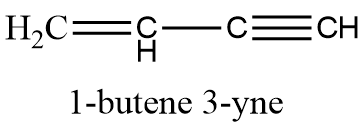
Sigma bonds ($\sigma $bonds) are the strongest type of covalent chemical bond. They are formed by head-on overlapping between atomic orbitals. Single bonds are formed by sigma bonds. Axial overlapping of s-s orbitals, and s-p and p-p orbitals results in formation of sigma bonds.
Pi bonds ($\pi $ bonds) are covalent chemical bonds where two lobes of an orbital on one atom overlap two lobes of an orbital on another atom and this overlap occurs laterally.
The compound 1-butene 3-yne has 4 C-H single bonds, that is 4 sigma bonds, and 3 C-C sigma bonds, therefore, there are a total of 7 sigma bonds.
The compound has one double bond and one triple bond. Each double bond has one sigma and one pi bond , and each triple bond has one sigma and two pi bonds, therefore, the compound has 3 pi bonds. So, the correct answer is “Option B”.
Note: Each of these atomic orbitals in $\pi $ bonds has zero electron density at a shared nodal plane, passing through the two bonded nuclei. The same plane is also a nodal plane for the molecular orbital of the pi bond.
Complete step by step answer:
The structure of 1-butene 3-yne is as follows:
Sigma bonds ($\sigma $bonds) are the strongest type of covalent chemical bond. They are formed by head-on overlapping between atomic orbitals. Single bonds are formed by sigma bonds. Axial overlapping of s-s orbitals, and s-p and p-p orbitals results in formation of sigma bonds.
Pi bonds ($\pi $ bonds) are covalent chemical bonds where two lobes of an orbital on one atom overlap two lobes of an orbital on another atom and this overlap occurs laterally.
The compound 1-butene 3-yne has 4 C-H single bonds, that is 4 sigma bonds, and 3 C-C sigma bonds, therefore, there are a total of 7 sigma bonds.
The compound has one double bond and one triple bond. Each double bond has one sigma and one pi bond , and each triple bond has one sigma and two pi bonds, therefore, the compound has 3 pi bonds. So, the correct answer is “Option B”.
Note: Each of these atomic orbitals in $\pi $ bonds has zero electron density at a shared nodal plane, passing through the two bonded nuclei. The same plane is also a nodal plane for the molecular orbital of the pi bond.
Recently Updated Pages
Master Class 12 Economics: Engaging Questions & Answers for Success

Master Class 12 English: Engaging Questions & Answers for Success
Master Class 12 Social Science: Engaging Questions & Answers for Success
Master Class 12 Maths: Engaging Questions & Answers for Success
Master Class 12 Physics: Engaging Questions & Answers for Success
Master Class 9 General Knowledge: Engaging Questions & Answers for Success
Trending doubts
One Metric ton is equal to kg A 10000 B 1000 C 100 class 11 physics CBSE
Difference Between Prokaryotic Cells and Eukaryotic Cells
Two of the body parts which do not appear in MRI are class 11 biology CBSE
Find the value of the expression given below sin 30circ class 11 maths CBSE
1 ton equals to A 100 kg B 1000 kg C 10 kg D 10000 class 11 physics CBSE
Draw a diagram of nephron and explain its structur class 11 biology CBSE