




The number of real circle cutting orthogonally the circle \[{{x}^{2}}+{{y}^{2}}+2x-2y+7=0\] is _______
(a) 0
(b) 1
(c) 2
(d) Infinitely many
Answer
 Verified
616.2k+ views
Hint: To solve the given question, we will use the fact that if two circles are orthogonal, then the tangents at intersection point will have an angle of \[{{90}^{o}}\] between them. Then we will make a triangle joining the centres of the circle and their point of intersection. The triangle obtained will be right-angled. We will apply Pythagoras theorem in this right-angled triangle to get the relation between the unknown quantities of the circle. Then we will determine how many circles are possible which are cutting orthogonally the given circle.
Complete step by step solution:
Before we solve the question, we must know what orthogonal of circles is. Two circles \[{{S}_{1}}=0\] and \[{{S}_{2}}=0\] are said to be orthogonal or intersect orthogonally if the tangents at their points of intersection include a right angle.
Now, we will assume that, \[{{S}_{1}}={{x}^{2}}+{{y}^{2}}+2gx+2fy+c=0\] and \[{{S}_{2}}={{x}^{2}}+{{y}^{2}}+2x-2y+7=0.\] The centre of \[{{S}_{1}}=0\] is (– g, – f) and the centre of \[{{S}_{2}}=0\] is (a, b) as shown in the following figure.
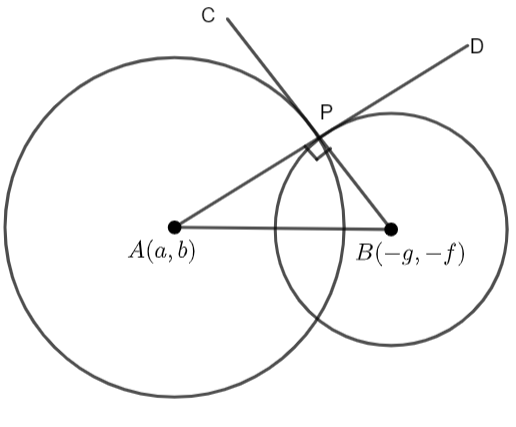
Now, the two circles are orthogonal if the tangents AD and BC are at right angles. So, the angle between the tangents AD and BC is \[{{90}^{o}}.\] P is the intersection point of the circle or tangents.
Now, we will find the values of ‘a’ and ‘b’. ‘a’ is the x – coordinate of the centre of \[{{S}_{2}}=0\] and b is the y – coordinate of the centre \[{{S}_{2}}=0.\] We know that if the equation of a circle is \[{{x}^{2}}+{{y}^{2}}+px+qy+r=0\] then its centre is \[\left( \dfrac{-p}{2},\dfrac{-q}{2} \right).\] So, in our case,
\[a=\dfrac{-\left( 2 \right)}{2}\]
\[\Rightarrow a=-1\]
Similarly,
\[b=\dfrac{-\left( -2 \right)}{2}\]
\[\Rightarrow b=1\]
Therefore, the centre of \[{{S}_{2}}=0\] is (– 1, 1).
Now, we can see that PAB is a right-angled triangle. So, here we will apply the Pythagoras theorem. The Pythagoras theorem states that, in a right-angled triangle, if H is the hypotenuse, R is the perpendicular and J is the base, then we have,
\[{{H}^{2}}={{R}^{2}}+{{J}^{2}}\]
In our case, H = AB, R = AP and J = BP. Thus, we have,
\[{{\left( AB \right)}^{2}}={{\left( AP \right)}^{2}}+{{\left( BP \right)}^{2}}.....\left( i \right)\]
Here, AP and BP are the radii of the circles \[{{S}_{2}}=0\] and \[{{S}_{1}}=0\] respectively. If a circle has equation \[{{x}^{2}}+{{y}^{2}}+px+qy+r=0\] then its radius is \[\sqrt{\dfrac{{{p}^{2}}}{{{2}^{2}}}+\dfrac{{{q}^{2}}}{{{2}^{2}}}-r}.\] Therefore,
\[AP=\sqrt{\dfrac{{{2}^{2}}}{{{2}^{2}}}+\dfrac{{{\left( -2 \right)}^{2}}}{{{2}^{2}}}-\left( 7 \right)}\]
\[\Rightarrow AP=\sqrt{-5}\]
\[\Rightarrow AP=\sqrt{5}i....\left( ii \right)\]
\[BP=\sqrt{{{g}^{2}}+{{f}^{2}}-c}.....\left( iii \right)\]
Now, AB is calculated with the help of the distance formula. The distance formula is given by,
\[\text{Distance }=\sqrt{{{\left( {{x}_{2}}-{{x}_{1}} \right)}^{2}}+{{\left( {{y}_{2}}-{{y}_{1}} \right)}^{2}}}\]
where \[\left( {{x}_{1}},{{y}_{1}} \right)\] and \[\left( {{x}_{2}},{{y}_{2}} \right)\] are the coordinates.
\[\Rightarrow AB=\sqrt{{{\left[ a-\left( -g \right) \right]}^{2}}+{{\left[ b-\left( -f \right) \right]}^{2}}}\]
\[\Rightarrow AB=\sqrt{{{\left( a+g \right)}^{2}}+{{\left( b+f \right)}^{2}}}\]
\[\Rightarrow AB=\sqrt{{{\left( -1+g \right)}^{2}}+{{\left( 1+f \right)}^{2}}}.....\left( iv \right)\]
Now, we will put the values of AB, AP and BP from (iv), (ii) and (iii) to (i). Thus, we will get,
\[\Rightarrow \left( \sqrt{{{\left( -1+g \right)}^{2}}+{{\left( 1+f \right)}^{2}}} \right)={{\left( \sqrt{5}i \right)}^{2}}+{{\left( \sqrt{{{g}^{2}}+{{f}^{2}}-c} \right)}^{2}}\]
\[\Rightarrow {{\left( g-1 \right)}^{2}}+{{\left( f+1 \right)}^{2}}=-5+\left( {{g}^{2}}+{{f}^{2}}-c \right)\]
\[\Rightarrow {{g}^{2}}-2g+1+{{f}^{2}}+2f+1=-5+{{g}^{2}}+{{f}^{2}}-c\]
\[\Rightarrow -2g+2f=-1-1-5-c\]
\[\Rightarrow -2g+2f=-7-c\]
\[\Rightarrow 2f+7+c=2g\]
\[\Rightarrow 2g=2f+7+c\]
Here, we can see that there are infinite values of g, f and c that satisfy the above relation. So, we will have infinite circles which are orthogonal to the given circle.
Hence, option (d) is the right answer.
Note: The alternate method of solving the question is if the two circles \[{{S}_{1}}={{x}^{2}}+{{y}^{2}}+2{{g}_{1}}x+2{{f}_{1}}y+{{c}_{1}}=0\] and \[{{S}_{2}}={{x}^{2}}+{{y}^{2}}+2{{g}_{2}}x+2{{f}_{2}}y+{{c}_{2}}=0\] are orthogonal then we have the following relation:
\[2{{g}_{1}}{{g}_{2}}+2{{f}_{1}}{{f}_{2}}={{c}_{1}}+{{c}_{2}}\]
In our case, \[{{g}_{1}}=g,{{f}_{1}}=f,{{c}_{1}}=c,{{g}_{2}}=1,{{f}_{2}}=-1,{{c}_{2}}=7.\] Thus, we get,
\[\Rightarrow 2g\left( 1 \right)+2f\left( -1 \right)=c+7\]
\[\Rightarrow 2g-2f=c+7\]
\[\Rightarrow 2g=2f+c+7\]
We will replace g by x, f by y and c by z and we get,
\[2x=2y+z+7\]
The above equation is an equation of the plane which contains infinite points. So, there are infinite values of x, y and x. Hence, there are infinite orthogonal circles.
Complete step by step solution:
Before we solve the question, we must know what orthogonal of circles is. Two circles \[{{S}_{1}}=0\] and \[{{S}_{2}}=0\] are said to be orthogonal or intersect orthogonally if the tangents at their points of intersection include a right angle.
Now, we will assume that, \[{{S}_{1}}={{x}^{2}}+{{y}^{2}}+2gx+2fy+c=0\] and \[{{S}_{2}}={{x}^{2}}+{{y}^{2}}+2x-2y+7=0.\] The centre of \[{{S}_{1}}=0\] is (– g, – f) and the centre of \[{{S}_{2}}=0\] is (a, b) as shown in the following figure.
Now, the two circles are orthogonal if the tangents AD and BC are at right angles. So, the angle between the tangents AD and BC is \[{{90}^{o}}.\] P is the intersection point of the circle or tangents.
Now, we will find the values of ‘a’ and ‘b’. ‘a’ is the x – coordinate of the centre of \[{{S}_{2}}=0\] and b is the y – coordinate of the centre \[{{S}_{2}}=0.\] We know that if the equation of a circle is \[{{x}^{2}}+{{y}^{2}}+px+qy+r=0\] then its centre is \[\left( \dfrac{-p}{2},\dfrac{-q}{2} \right).\] So, in our case,
\[a=\dfrac{-\left( 2 \right)}{2}\]
\[\Rightarrow a=-1\]
Similarly,
\[b=\dfrac{-\left( -2 \right)}{2}\]
\[\Rightarrow b=1\]
Therefore, the centre of \[{{S}_{2}}=0\] is (– 1, 1).
Now, we can see that PAB is a right-angled triangle. So, here we will apply the Pythagoras theorem. The Pythagoras theorem states that, in a right-angled triangle, if H is the hypotenuse, R is the perpendicular and J is the base, then we have,
\[{{H}^{2}}={{R}^{2}}+{{J}^{2}}\]
In our case, H = AB, R = AP and J = BP. Thus, we have,
\[{{\left( AB \right)}^{2}}={{\left( AP \right)}^{2}}+{{\left( BP \right)}^{2}}.....\left( i \right)\]
Here, AP and BP are the radii of the circles \[{{S}_{2}}=0\] and \[{{S}_{1}}=0\] respectively. If a circle has equation \[{{x}^{2}}+{{y}^{2}}+px+qy+r=0\] then its radius is \[\sqrt{\dfrac{{{p}^{2}}}{{{2}^{2}}}+\dfrac{{{q}^{2}}}{{{2}^{2}}}-r}.\] Therefore,
\[AP=\sqrt{\dfrac{{{2}^{2}}}{{{2}^{2}}}+\dfrac{{{\left( -2 \right)}^{2}}}{{{2}^{2}}}-\left( 7 \right)}\]
\[\Rightarrow AP=\sqrt{-5}\]
\[\Rightarrow AP=\sqrt{5}i....\left( ii \right)\]
\[BP=\sqrt{{{g}^{2}}+{{f}^{2}}-c}.....\left( iii \right)\]
Now, AB is calculated with the help of the distance formula. The distance formula is given by,
\[\text{Distance }=\sqrt{{{\left( {{x}_{2}}-{{x}_{1}} \right)}^{2}}+{{\left( {{y}_{2}}-{{y}_{1}} \right)}^{2}}}\]
where \[\left( {{x}_{1}},{{y}_{1}} \right)\] and \[\left( {{x}_{2}},{{y}_{2}} \right)\] are the coordinates.
\[\Rightarrow AB=\sqrt{{{\left[ a-\left( -g \right) \right]}^{2}}+{{\left[ b-\left( -f \right) \right]}^{2}}}\]
\[\Rightarrow AB=\sqrt{{{\left( a+g \right)}^{2}}+{{\left( b+f \right)}^{2}}}\]
\[\Rightarrow AB=\sqrt{{{\left( -1+g \right)}^{2}}+{{\left( 1+f \right)}^{2}}}.....\left( iv \right)\]
Now, we will put the values of AB, AP and BP from (iv), (ii) and (iii) to (i). Thus, we will get,
\[\Rightarrow \left( \sqrt{{{\left( -1+g \right)}^{2}}+{{\left( 1+f \right)}^{2}}} \right)={{\left( \sqrt{5}i \right)}^{2}}+{{\left( \sqrt{{{g}^{2}}+{{f}^{2}}-c} \right)}^{2}}\]
\[\Rightarrow {{\left( g-1 \right)}^{2}}+{{\left( f+1 \right)}^{2}}=-5+\left( {{g}^{2}}+{{f}^{2}}-c \right)\]
\[\Rightarrow {{g}^{2}}-2g+1+{{f}^{2}}+2f+1=-5+{{g}^{2}}+{{f}^{2}}-c\]
\[\Rightarrow -2g+2f=-1-1-5-c\]
\[\Rightarrow -2g+2f=-7-c\]
\[\Rightarrow 2f+7+c=2g\]
\[\Rightarrow 2g=2f+7+c\]
Here, we can see that there are infinite values of g, f and c that satisfy the above relation. So, we will have infinite circles which are orthogonal to the given circle.
Hence, option (d) is the right answer.
Note: The alternate method of solving the question is if the two circles \[{{S}_{1}}={{x}^{2}}+{{y}^{2}}+2{{g}_{1}}x+2{{f}_{1}}y+{{c}_{1}}=0\] and \[{{S}_{2}}={{x}^{2}}+{{y}^{2}}+2{{g}_{2}}x+2{{f}_{2}}y+{{c}_{2}}=0\] are orthogonal then we have the following relation:
\[2{{g}_{1}}{{g}_{2}}+2{{f}_{1}}{{f}_{2}}={{c}_{1}}+{{c}_{2}}\]
In our case, \[{{g}_{1}}=g,{{f}_{1}}=f,{{c}_{1}}=c,{{g}_{2}}=1,{{f}_{2}}=-1,{{c}_{2}}=7.\] Thus, we get,
\[\Rightarrow 2g\left( 1 \right)+2f\left( -1 \right)=c+7\]
\[\Rightarrow 2g-2f=c+7\]
\[\Rightarrow 2g=2f+c+7\]
We will replace g by x, f by y and c by z and we get,
\[2x=2y+z+7\]
The above equation is an equation of the plane which contains infinite points. So, there are infinite values of x, y and x. Hence, there are infinite orthogonal circles.
Recently Updated Pages
Master Class 11 Social Science: Engaging Questions & Answers for Success

Master Class 11 Physics: Engaging Questions & Answers for Success
Master Class 11 Maths: Engaging Questions & Answers for Success
Master Class 11 Economics: Engaging Questions & Answers for Success
Master Class 11 Computer Science: Engaging Questions & Answers for Success
Master Class 11 Chemistry: Engaging Questions & Answers for Success
Trending doubts
One Metric ton is equal to kg A 10000 B 1000 C 100 class 11 physics CBSE
There are 720 permutations of the digits 1 2 3 4 5 class 11 maths CBSE
1 Quintal is equal to a 110 kg b 10 kg c 100kg d 1000 class 11 physics CBSE
State and prove Bernoullis theorem class 11 physics CBSE
Difference Between Prokaryotic Cells and Eukaryotic Cells
Which among the following are examples of coming together class 11 social science CBSE