




The number of bridging $CO$ ligand (s) and $Co - Co$ bond (s) in $C{o_2}{(CO)_8}$ , respectively are:
a.) 0 and 2
b.) 2 and 0
c.) 4 and 0
d.) 2 and 1
Answer
 Verified
585k+ views
Hint: Spanning ligands can be fundamentally classified as ligands that are associating or joining or at least two iotas/atoms together. These ligands are generally used to interface metal particles. Presently, these ligands may either be mono - nuclear or polyatomic in nature.
Complete step by step answer:
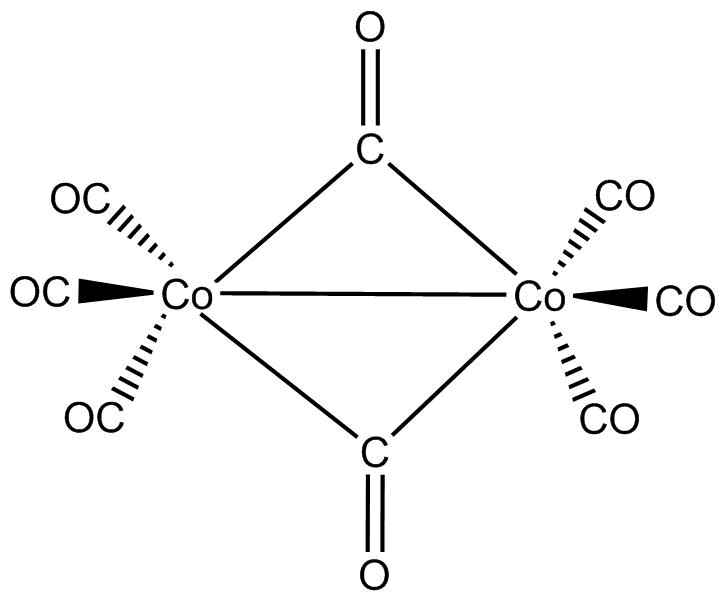
As can be seen from the structure of $C{o_2}{(CO)_8}$, there are two $CO$ crossing over ligands and one $Co - Co$ (Metal-Metal) bond.
Number of $M - M$ Bonds = $\dfrac{{18 \times n - VE}}{2}$
n = number of metals
(i) $C{o_2}{(CO)_8}$
$VE = 9 \times 2 + 2 \times 8$
$ \Rightarrow VE = 34$
Number of $M - M$ Bonds = $\dfrac{{18 \times 2 - 34}}{2}$ = 1
So the number of $Co - Co$ bond is 1.
Verification:
$C{o_2}{(CO)_8}$ is Octahedral in nature
So, the number of ligands in $C{o_2}{(CO)_8}$ are 6.
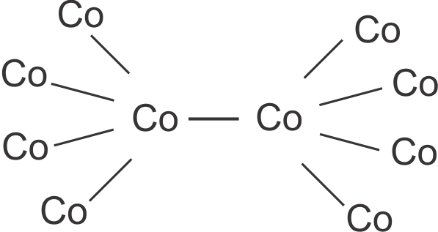
So, if we re draw the above diagram we would get 2 bridging $CO$ ligands in $C{o_2}{(CO)_8}$
The correct answer is option “D” .
Additional Information :
Bridging ligands: A bridging ligand is a ligand that interfaces at least two molecules, normally metal particles. The ligand might be nuclear or polyatomic. Essentially all intricate natural mixes can fill in as bridging ligands, so the term is normally limited to little ligands, for example, pseudo-halides or to ligands that are explicitly intended to connect two metals.
Note: In naming a complex wherein a solitary particle spans two metals, the connecting ligand is gone before by the Greek letter mu, $\mu $, with a superscript number indicating the quantity of metals bound to the crossing over the ligand. ${\mu _2}$ is frequently signified basically as $\mu $. While depicting coordination buildings care ought to be taken not to mistake $\mu $ for $\eta $, which identifies with hapticity. Ligands that are not connecting are called terminal ligands.
Complete step by step answer:
As can be seen from the structure of $C{o_2}{(CO)_8}$, there are two $CO$ crossing over ligands and one $Co - Co$ (Metal-Metal) bond.
Number of $M - M$ Bonds = $\dfrac{{18 \times n - VE}}{2}$
n = number of metals
(i) $C{o_2}{(CO)_8}$
$VE = 9 \times 2 + 2 \times 8$
$ \Rightarrow VE = 34$
Number of $M - M$ Bonds = $\dfrac{{18 \times 2 - 34}}{2}$ = 1
So the number of $Co - Co$ bond is 1.
Verification:
$C{o_2}{(CO)_8}$ is Octahedral in nature
So, the number of ligands in $C{o_2}{(CO)_8}$ are 6.
So, if we re draw the above diagram we would get 2 bridging $CO$ ligands in $C{o_2}{(CO)_8}$
The correct answer is option “D” .
Additional Information :
Bridging ligands: A bridging ligand is a ligand that interfaces at least two molecules, normally metal particles. The ligand might be nuclear or polyatomic. Essentially all intricate natural mixes can fill in as bridging ligands, so the term is normally limited to little ligands, for example, pseudo-halides or to ligands that are explicitly intended to connect two metals.
Note: In naming a complex wherein a solitary particle spans two metals, the connecting ligand is gone before by the Greek letter mu, $\mu $, with a superscript number indicating the quantity of metals bound to the crossing over the ligand. ${\mu _2}$ is frequently signified basically as $\mu $. While depicting coordination buildings care ought to be taken not to mistake $\mu $ for $\eta $, which identifies with hapticity. Ligands that are not connecting are called terminal ligands.
Recently Updated Pages
Master Class 11 Social Science: Engaging Questions & Answers for Success

Master Class 11 English: Engaging Questions & Answers for Success
Master Class 11 Maths: Engaging Questions & Answers for Success
Master Class 11 Chemistry: Engaging Questions & Answers for Success
Master Class 11 Biology: Engaging Questions & Answers for Success
Master Class 11 Physics: Engaging Questions & Answers for Success
Trending doubts
One Metric ton is equal to kg A 10000 B 1000 C 100 class 11 physics CBSE
Difference Between Prokaryotic Cells and Eukaryotic Cells
How many of the following diseases can be studied with class 11 biology CBSE
Draw a diagram of a plant cell and label at least eight class 11 biology CBSE
Two of the body parts which do not appear in MRI are class 11 biology CBSE
Which gas is abundant in air class 11 chemistry CBSE