




The new segments during strobilation are added in which of the following end/side?
(a)The posterior end
(b)The anterior end
(c)Lateral side
(d)External side
Answer
 Verified
616.8k+ views
Hint: Strobilation is also called as transverse fission is a form of asexual reproduction (binary fission in protozoan protist) consisting of the voluntary transverse segmentation of the body and here cytokinesis takes place along the transverse axis.
Complete answer:
The new segment during strobilation is located at the anterior end and the parent body is at the posterior end.
ln protozoans, the replicated chromosomes are separated by intranuclear(closed) mitosis and the nucleus divides by furrowing. Then the cytoplasm slowly compresses between the two separating nuclei, eventually forming two equal-sized daughter individuals, each with a nucleus. The new daughter individuals grow to the size of the parent before dividing again. Transverse binary fission occurs in ciliates such as Paramecium, and also in moon jellyfish, cestodes and scyphozoans. The cytoplasm divides transversely between two sets of nuclei, forming two dissimilar daughter individuals. Planarians also divide by transverse fission. The worm fixes the posterior part of the body firmly to the substratum and moves the anterior part forward. Thus, the anterior part exerts a pull over the posterior part, which holds on. Due to the pull, the middle part is stretched, constricted, and finally breaks. The anterior part regenerates the posterior part, and the posterior part regrows the anterior part. Thus, two complete worms are formed from one. Strobilation mostly tends to happen in the springtime.
Some other types of binary fission in Protozoan Protists are:
-Irregular binary fission: It occurs in amebae. The plane of the division of cytoplasm is variable but is always at right angles to the elongated dividing nucleus.
-Longitudinal binary fission: It occurs in flagellates such as Egluena. The cytoplasm splits lengthwise forming two similar daughter individuals.
So the correct answer is ‘ the anterior end’.
Note: In binary fission, the parent body as a whole constitutes the reproductive unit and disappears when its division into daughter individuals is completed. However, the parent can not be said to have died as no dead body is left. In fact, after binary fission, the parent continues living as two daughter individuals. Thus, the organisms that undergo binary fission are immortal.
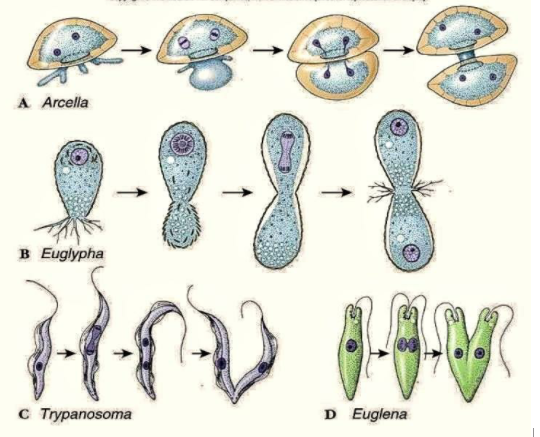
Complete answer:
The new segment during strobilation is located at the anterior end and the parent body is at the posterior end.
ln protozoans, the replicated chromosomes are separated by intranuclear(closed) mitosis and the nucleus divides by furrowing. Then the cytoplasm slowly compresses between the two separating nuclei, eventually forming two equal-sized daughter individuals, each with a nucleus. The new daughter individuals grow to the size of the parent before dividing again. Transverse binary fission occurs in ciliates such as Paramecium, and also in moon jellyfish, cestodes and scyphozoans. The cytoplasm divides transversely between two sets of nuclei, forming two dissimilar daughter individuals. Planarians also divide by transverse fission. The worm fixes the posterior part of the body firmly to the substratum and moves the anterior part forward. Thus, the anterior part exerts a pull over the posterior part, which holds on. Due to the pull, the middle part is stretched, constricted, and finally breaks. The anterior part regenerates the posterior part, and the posterior part regrows the anterior part. Thus, two complete worms are formed from one. Strobilation mostly tends to happen in the springtime.
Some other types of binary fission in Protozoan Protists are:
-Irregular binary fission: It occurs in amebae. The plane of the division of cytoplasm is variable but is always at right angles to the elongated dividing nucleus.
-Longitudinal binary fission: It occurs in flagellates such as Egluena. The cytoplasm splits lengthwise forming two similar daughter individuals.
So the correct answer is ‘ the anterior end’.
Note: In binary fission, the parent body as a whole constitutes the reproductive unit and disappears when its division into daughter individuals is completed. However, the parent can not be said to have died as no dead body is left. In fact, after binary fission, the parent continues living as two daughter individuals. Thus, the organisms that undergo binary fission are immortal.
Recently Updated Pages
Master Class 12 Economics: Engaging Questions & Answers for Success

Master Class 12 English: Engaging Questions & Answers for Success
Master Class 12 Social Science: Engaging Questions & Answers for Success
Master Class 12 Maths: Engaging Questions & Answers for Success
Master Class 12 Physics: Engaging Questions & Answers for Success
Master Class 9 General Knowledge: Engaging Questions & Answers for Success
Trending doubts
One Metric ton is equal to kg A 10000 B 1000 C 100 class 11 physics CBSE
Difference Between Prokaryotic Cells and Eukaryotic Cells
Two of the body parts which do not appear in MRI are class 11 biology CBSE
Find the value of the expression given below sin 30circ class 11 maths CBSE
1 ton equals to A 100 kg B 1000 kg C 10 kg D 10000 class 11 physics CBSE
Draw a diagram of nephron and explain its structur class 11 biology CBSE