




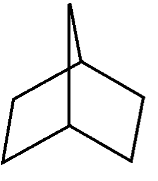
What should be the name of the given compound?
Answer
 Verified
584.7k+ views
Hint: The nomenclature of bicyclio compounds are done by using bicyclo as a prefix and then the various bridge length measured between two carbons at ring junction is put in a square bracket in a decreasing manner followed by the parent hydrocarbon name.
Format – Bicyclo [x, y, z] parent hydrocarbon name
Complete step by step solution: The compound given in the question is a bicyclo compound with a total number of 7 carbon atoms. Thus, the parent hydrocarbon open-chain is heptane.
Now, we need to find the bridge lengths between two carbons present at the junctions of the ring. These two junctional carbon atoms are known as bridgeheads.
The bridge length is the number of carbon atoms that come between two bridgeheads. The different pathways will give different bridge lengths.
So, let us draw and find out the different pathways and the bridge length values for corresponding pathways.
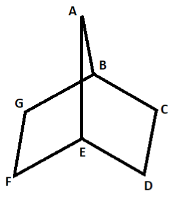
1) – When we follow the pathway from B to E in the anti-clockwise direction, then we come across the carbon atoms at points G and F. Thus, the bridge length for this path is 2.
2) – If we go through the path BAE, then we end up with only 1 carbon atom between the two bridgeheads. So, in this case, the bridge length is 1.
3) – Lastly, if we go through the pathway from B to E in the clockwise direction, then again, we get carbon atoms at two points – C and D. so, again the bridge length is 2.
Now, we must write these bridge lengths in decreasing order in a square bracket followed by the parent carbon chain name and use bicyclo as a prefix. Putting all these things together we get the name – Bicyclo[2.2.1]heptane.
Hence, the name of the given compound is Bicyclo[2.2.1]heptane.
Note: The bridgeheads are the carbon atoms that join the three-ring system together and are present at the point of attachment of rings. These bridgehead carbons are not counted while calculating the bridge lengths.
Format – Bicyclo [x, y, z] parent hydrocarbon name
Complete step by step solution: The compound given in the question is a bicyclo compound with a total number of 7 carbon atoms. Thus, the parent hydrocarbon open-chain is heptane.
Now, we need to find the bridge lengths between two carbons present at the junctions of the ring. These two junctional carbon atoms are known as bridgeheads.
The bridge length is the number of carbon atoms that come between two bridgeheads. The different pathways will give different bridge lengths.
So, let us draw and find out the different pathways and the bridge length values for corresponding pathways.
1) – When we follow the pathway from B to E in the anti-clockwise direction, then we come across the carbon atoms at points G and F. Thus, the bridge length for this path is 2.
2) – If we go through the path BAE, then we end up with only 1 carbon atom between the two bridgeheads. So, in this case, the bridge length is 1.
3) – Lastly, if we go through the pathway from B to E in the clockwise direction, then again, we get carbon atoms at two points – C and D. so, again the bridge length is 2.
Now, we must write these bridge lengths in decreasing order in a square bracket followed by the parent carbon chain name and use bicyclo as a prefix. Putting all these things together we get the name – Bicyclo[2.2.1]heptane.
Hence, the name of the given compound is Bicyclo[2.2.1]heptane.
Note: The bridgeheads are the carbon atoms that join the three-ring system together and are present at the point of attachment of rings. These bridgehead carbons are not counted while calculating the bridge lengths.
Recently Updated Pages
Basicity of sulphurous acid and sulphuric acid are

Master Class 11 English: Engaging Questions & Answers for Success
Master Class 11 Physics: Engaging Questions & Answers for Success
Master Class 11 Computer Science: Engaging Questions & Answers for Success
Master Class 11 Chemistry: Engaging Questions & Answers for Success
Master Class 11 Social Science: Engaging Questions & Answers for Success
Trending doubts
Difference Between Prokaryotic Cells and Eukaryotic Cells
Two of the body parts which do not appear in MRI are class 11 biology CBSE
One Metric ton is equal to kg A 10000 B 1000 C 100 class 11 physics CBSE
10 examples of friction in our daily life
Draw a diagram of nephron and explain its structur class 11 biology CBSE
What will happen if the mucus is not secreted by the class 11 biology CBSE