




The movable skull bone is
(A) Maxilla
(B) Vomer
(C) Mandible
(D) All of the above
Answer
 Verified
615.9k+ views
Hint: The movable skull bone is also known as the lower jaw as it forms the lower jaw. It is known to be the largest and strongest bone in the human facial skeleton. In all, 33 irregular bones are present in this region.
Complete step by step answer:
The movable skull bone is Mandible. The mandible, is that the bone that forms the lower part of the skull, and in conjunction with the maxilla (upper jaw) , forms the mouth structure.
Movement of the mandible opens and closes the mouth and also allows for the chewing of food. The lower set of teeth within the mouth is rooted within the mandible.
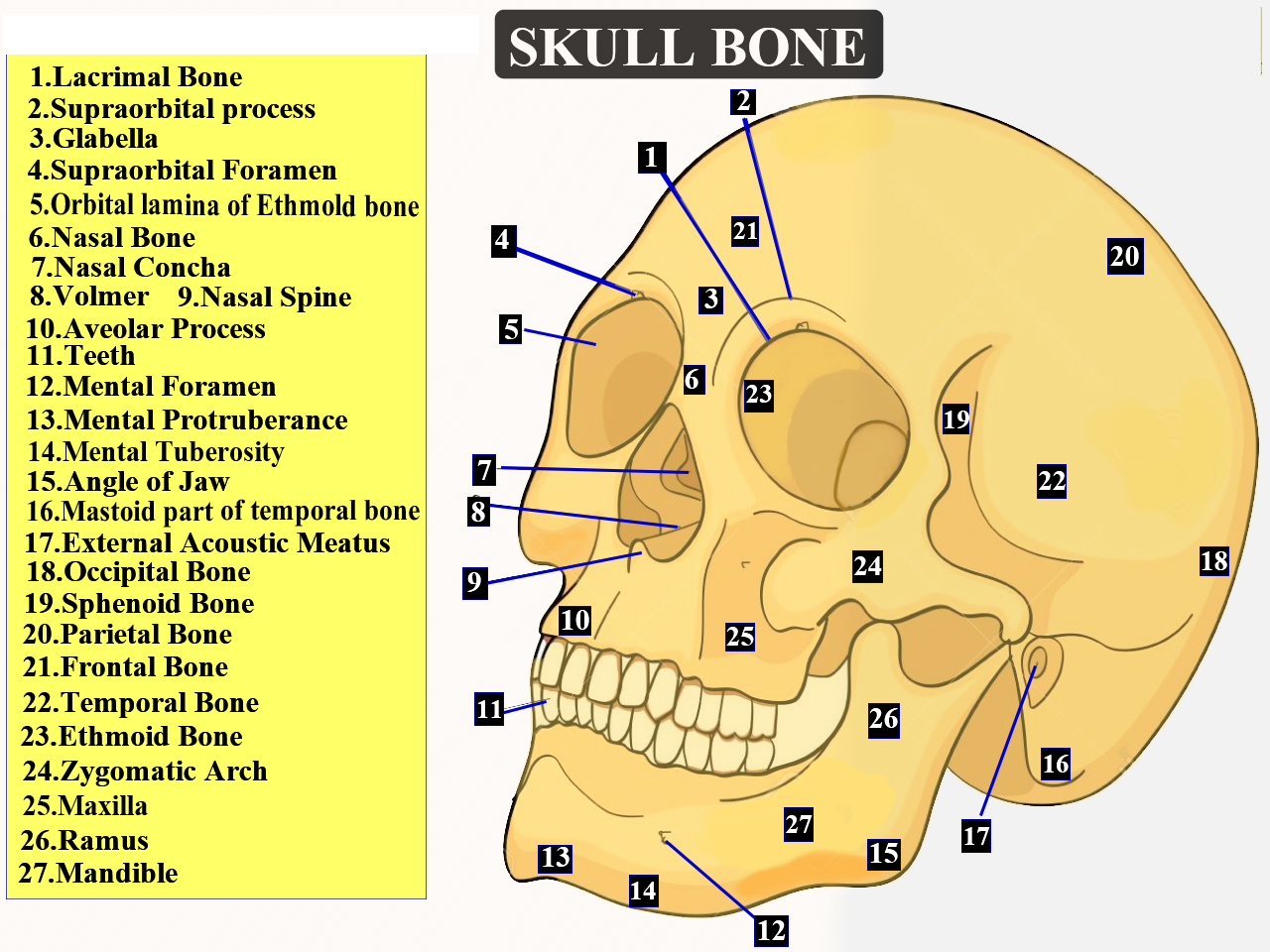
The mandible consists of: - The body, found at the front. - A ramus on the left and also on the right.
- The body of the mandible is curved, and therefore the front part gives structure to the chin. It has two surfaces and two borders.
- Alveolar border (superior) – contains 16 sockets to carry the lower teeth.
- Base (inferior) – It is the site of attachment for the digastric muscle medially.
- The body is marked within the midline by the mandibular symphysis. This is often a little ridge of bone that represents the fusion of the 2 halves during development.
- The ramus of the human mandible has four sides, two surfaces, four borders, and two processes.
- Each ramus contains the subsequent bony landmarks:
- Head – situated posteriorly, and articulates with the temporal bone to create the temporomandibular joint.
- Neck – supports the top of the head of the ramus, and site of attachment of the lateral skeletal muscle.
- Coronoid process – site of attachment of the temporal muscle
The internal surface of the ramus is additionally marked by the mandibular foramen, which acts as a passageway for neurovascular structures.
So, the correct answer is ‘(C) Mandible '.
Note: Four different muscles connect with the mandible to facilitate its movement. These muscles are the masseter, the temporalis, the medial pterygoid, and also the lateral pterygoid. Each of these muscles occurs in pairs, with one amongst each muscle appearing on either side of the skull. The muscles always work in combination to pivot the mandible up and down and to permit movement of the jaw from side to side.
Complete step by step answer:
The movable skull bone is Mandible. The mandible, is that the bone that forms the lower part of the skull, and in conjunction with the maxilla (upper jaw) , forms the mouth structure.
Movement of the mandible opens and closes the mouth and also allows for the chewing of food. The lower set of teeth within the mouth is rooted within the mandible.
The mandible consists of: - The body, found at the front. - A ramus on the left and also on the right.
- The body of the mandible is curved, and therefore the front part gives structure to the chin. It has two surfaces and two borders.
- Alveolar border (superior) – contains 16 sockets to carry the lower teeth.
- Base (inferior) – It is the site of attachment for the digastric muscle medially.
- The body is marked within the midline by the mandibular symphysis. This is often a little ridge of bone that represents the fusion of the 2 halves during development.
- The ramus of the human mandible has four sides, two surfaces, four borders, and two processes.
- Each ramus contains the subsequent bony landmarks:
- Head – situated posteriorly, and articulates with the temporal bone to create the temporomandibular joint.
- Neck – supports the top of the head of the ramus, and site of attachment of the lateral skeletal muscle.
- Coronoid process – site of attachment of the temporal muscle
The internal surface of the ramus is additionally marked by the mandibular foramen, which acts as a passageway for neurovascular structures.
So, the correct answer is ‘(C) Mandible '.
Note: Four different muscles connect with the mandible to facilitate its movement. These muscles are the masseter, the temporalis, the medial pterygoid, and also the lateral pterygoid. Each of these muscles occurs in pairs, with one amongst each muscle appearing on either side of the skull. The muscles always work in combination to pivot the mandible up and down and to permit movement of the jaw from side to side.
Recently Updated Pages
Master Class 11 Social Science: Engaging Questions & Answers for Success

Master Class 11 Chemistry: Engaging Questions & Answers for Success
Master Class 12 Business Studies: Engaging Questions & Answers for Success
Master Class 12 Chemistry: Engaging Questions & Answers for Success
Master Class 12 Biology: Engaging Questions & Answers for Success
Class 12 Question and Answer - Your Ultimate Solutions Guide
Trending doubts
One Metric ton is equal to kg A 10000 B 1000 C 100 class 11 physics CBSE
Difference Between Prokaryotic Cells and Eukaryotic Cells
Two of the body parts which do not appear in MRI are class 11 biology CBSE
Explain zero factorial class 11 maths CBSE
10 examples of friction in our daily life
Name the Largest and the Smallest Cell in the Human Body ?