




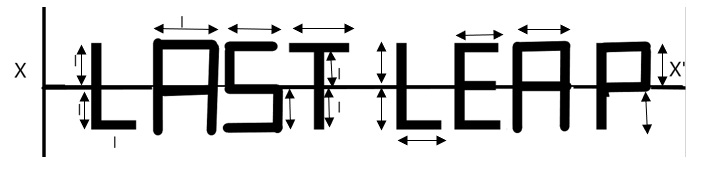
The moment of inertia of the following structure about the axis XX’ made up of uniform thin wire of mass per unit length \[\lambda \] as shown in the figure is (all the double arrows indicate ‘l’ length) –
\[\begin{align}
& \text{A) 12}\lambda {{l}^{3}} \\
& \text{B) 10}\lambda {{l}^{3}} \\
& \text{C) 5}\lambda {{l}^{3}} \\
& \text{D) 17}\lambda {{l}^{3}} \\
\end{align}\]
Answer
 Verified
589.5k+ views
Hint: We need to find the moment of inertia with respect to each of the alignment used in the text in the questions. We have to use the formula for the perpendicular to the axis and the formula for parallel to the axis and add them all together.
Complete answer:
We know that the moment of inertia of a body is the mass about its origin or a point under consideration. The moment of inertia is generally the product of the mass and the square of the distance from the axis.
\[I=m{{r}^{2}}\]
We are provided with a combination of masses about an axis. We need to find the moment of inertia of each element and add all the moments to get the required solution. We are also provided with the line density \[\lambda \], which when multiplied by the length gives the mass.
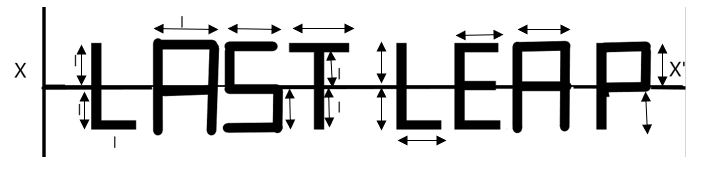
So, let us consider the masses which are parallel to the axis XX’ and that are not on the axis. The masses parallel to and on the axis don't have a moment about the axis.
There are 10 such masses at a distance ‘l’ from the axis. The moment of inertia of these are given by –
\[\begin{align}
& {{I}_{1}}=m{{r}^{2}}\times 10 \\
& \Rightarrow \text{ }{{I}_{1}}=\lambda l\times {{l}^{2}}\times 10=10\lambda {{l}^{3}} \\
\end{align}\]
Now, let us consider the perpendicular masses to the axis XX’.
For this we can consider the ‘2l’ as the distance for and count the number of such masses. We can see that there are also 10 such masses. The moment of inertia of these perpendicular masses are given by –
\[\begin{align}
& {{I}_{2}}=\dfrac{m{{r}^{2}}}{12}\times 10 \\
& \Rightarrow \text{ }{{I}_{2}}=\dfrac{\lambda (2l){{(2l)}^{2}}}{12}\times 10=\dfrac{20\lambda {{l}^{3}}}{3} \\
\end{align}\]
But we see that we haven’t included the perpendicular mass represented by the letter P which has a length ‘l’. The moment of inertia of mass with the axis as the end is given by –
\[\begin{align}
& {{I}_{3}}=\dfrac{m{{r}^{2}}}{3} \\
& \Rightarrow \text{ }{{I}_{3}}=\dfrac{\lambda l\times {{l}^{2}}}{3}=\dfrac{\lambda {{l}^{3}}}{3} \\
\end{align}\]
Now, the total moment of inertia is given the sum of the three individual moments of inertia as –
\[\begin{align}
& I={{I}_{1}}+{{I}_{2}}+{{I}_{3}} \\
& \Rightarrow \text{ }I=10\lambda {{l}^{3}}+\dfrac{20\lambda {{l}^{3}}}{3}+\dfrac{\lambda {{l}^{3}}}{3} \\
& \therefore \text{ }I=17\lambda {{l}^{3}} \\
\end{align}\]
So, the correct answer is “Option C”.
Note:
We can either use the perpendicular axes theorem or the formula we have used to find the moment of inertia on a mass with its end as the axis of rotation. We should take care not to include it with the other perpendicular masses which have the mass distributed equally about the two sides of the axis.
Complete answer:
We know that the moment of inertia of a body is the mass about its origin or a point under consideration. The moment of inertia is generally the product of the mass and the square of the distance from the axis.
\[I=m{{r}^{2}}\]
We are provided with a combination of masses about an axis. We need to find the moment of inertia of each element and add all the moments to get the required solution. We are also provided with the line density \[\lambda \], which when multiplied by the length gives the mass.
So, let us consider the masses which are parallel to the axis XX’ and that are not on the axis. The masses parallel to and on the axis don't have a moment about the axis.
There are 10 such masses at a distance ‘l’ from the axis. The moment of inertia of these are given by –
\[\begin{align}
& {{I}_{1}}=m{{r}^{2}}\times 10 \\
& \Rightarrow \text{ }{{I}_{1}}=\lambda l\times {{l}^{2}}\times 10=10\lambda {{l}^{3}} \\
\end{align}\]
Now, let us consider the perpendicular masses to the axis XX’.
For this we can consider the ‘2l’ as the distance for and count the number of such masses. We can see that there are also 10 such masses. The moment of inertia of these perpendicular masses are given by –
\[\begin{align}
& {{I}_{2}}=\dfrac{m{{r}^{2}}}{12}\times 10 \\
& \Rightarrow \text{ }{{I}_{2}}=\dfrac{\lambda (2l){{(2l)}^{2}}}{12}\times 10=\dfrac{20\lambda {{l}^{3}}}{3} \\
\end{align}\]
But we see that we haven’t included the perpendicular mass represented by the letter P which has a length ‘l’. The moment of inertia of mass with the axis as the end is given by –
\[\begin{align}
& {{I}_{3}}=\dfrac{m{{r}^{2}}}{3} \\
& \Rightarrow \text{ }{{I}_{3}}=\dfrac{\lambda l\times {{l}^{2}}}{3}=\dfrac{\lambda {{l}^{3}}}{3} \\
\end{align}\]
Now, the total moment of inertia is given the sum of the three individual moments of inertia as –
\[\begin{align}
& I={{I}_{1}}+{{I}_{2}}+{{I}_{3}} \\
& \Rightarrow \text{ }I=10\lambda {{l}^{3}}+\dfrac{20\lambda {{l}^{3}}}{3}+\dfrac{\lambda {{l}^{3}}}{3} \\
& \therefore \text{ }I=17\lambda {{l}^{3}} \\
\end{align}\]
So, the correct answer is “Option C”.
Note:
We can either use the perpendicular axes theorem or the formula we have used to find the moment of inertia on a mass with its end as the axis of rotation. We should take care not to include it with the other perpendicular masses which have the mass distributed equally about the two sides of the axis.
Recently Updated Pages
Basicity of sulphurous acid and sulphuric acid are

Master Class 11 Business Studies: Engaging Questions & Answers for Success
Master Class 11 Computer Science: Engaging Questions & Answers for Success
Master Class 11 Economics: Engaging Questions & Answers for Success
Master Class 11 Social Science: Engaging Questions & Answers for Success
Master Class 11 English: Engaging Questions & Answers for Success
Trending doubts
One Metric ton is equal to kg A 10000 B 1000 C 100 class 11 physics CBSE
The largest wind power cluster is located in the state class 11 social science CBSE
Explain zero factorial class 11 maths CBSE
State and prove Bernoullis theorem class 11 physics CBSE
What steps did the French revolutionaries take to create class 11 social science CBSE
Which among the following are examples of coming together class 11 social science CBSE