



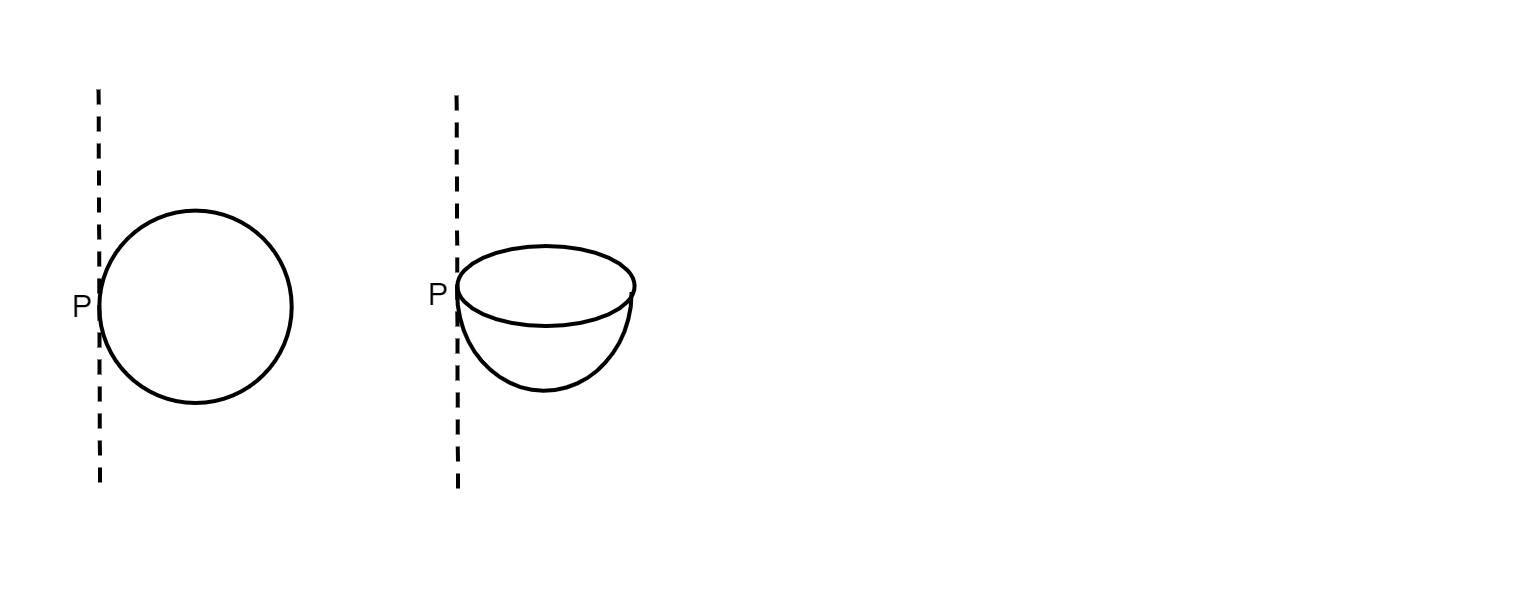
The moment of inertia of a spherical shell and a hemispherical shell of same mass and radius about a tangential axis, passing through $P$ will be
A.Different
B.Same
C.Data insufficient
D.None of these
Answer
 Verified
561k+ views
Hint: To solve this question, we should calculate moment of inertia of both the spherical shell and hemispherical shell separately about a tangential axis and then find out whether the moment of inertia is the same or different. Also, we would have to use parallel axis theorem to find the moment of inertia about a tangential axis.
Complete answer:
The moment of inertia of a spherical shell about an axis passing through its centroid is:
$\dfrac{2}{3}M{{R}^{2}}$
Here, $M$ is the mass of the spherical shell and $R$ is its radius.
Now, using parallel axis theorem, the moment of inertia of the spherical shell about a tangential axis will be:
$\begin{align}
& \dfrac{2}{3}M{{R}^{2}}+M{{R}^{2}} \\
& \Rightarrow \dfrac{5}{3}M{{R}^{2}} \\
\end{align}$
The moment of inertia of a hemi-spherical shell about an axis passing through its centroid is:
$\dfrac{2}{3}M{{R}^{2}}$
Here, $M$ is the mass of the spherical shell and $R$ is its radius.
Now, using parallel axis theorem, the moment of inertia of the hemi-spherical shell about a tangential axis will be as follows:
$\begin{align}
& \dfrac{2}{3}M{{R}^{2}}+M{{R}^{2}} \\
& \Rightarrow \dfrac{5}{3}M{{R}^{2}} \\
\end{align}$
Thus, the moment of inertia of a spherical shell and a hemispherical shell of same mass and radius about a tangential axis, passing through $P$ will be the same.
Hence option $B$ is the correct option.
Note:
The parallel axis theorem helps us to find the moment of inertia of a body about an axis that is parallel to an axis about whom, the moment of inertia of that body is known to us. We used this theorem to solve the given question and found out the moment of inertia of the two bodies about a tangential axis.
Complete answer:
The moment of inertia of a spherical shell about an axis passing through its centroid is:
$\dfrac{2}{3}M{{R}^{2}}$
Here, $M$ is the mass of the spherical shell and $R$ is its radius.
Now, using parallel axis theorem, the moment of inertia of the spherical shell about a tangential axis will be:
$\begin{align}
& \dfrac{2}{3}M{{R}^{2}}+M{{R}^{2}} \\
& \Rightarrow \dfrac{5}{3}M{{R}^{2}} \\
\end{align}$
The moment of inertia of a hemi-spherical shell about an axis passing through its centroid is:
$\dfrac{2}{3}M{{R}^{2}}$
Here, $M$ is the mass of the spherical shell and $R$ is its radius.
Now, using parallel axis theorem, the moment of inertia of the hemi-spherical shell about a tangential axis will be as follows:
$\begin{align}
& \dfrac{2}{3}M{{R}^{2}}+M{{R}^{2}} \\
& \Rightarrow \dfrac{5}{3}M{{R}^{2}} \\
\end{align}$
Thus, the moment of inertia of a spherical shell and a hemispherical shell of same mass and radius about a tangential axis, passing through $P$ will be the same.
Hence option $B$ is the correct option.
Note:
The parallel axis theorem helps us to find the moment of inertia of a body about an axis that is parallel to an axis about whom, the moment of inertia of that body is known to us. We used this theorem to solve the given question and found out the moment of inertia of the two bodies about a tangential axis.
Recently Updated Pages
Master Class 11 Social Science: Engaging Questions & Answers for Success

Master Class 11 English: Engaging Questions & Answers for Success
Master Class 11 Maths: Engaging Questions & Answers for Success
Master Class 11 Chemistry: Engaging Questions & Answers for Success
Master Class 11 Biology: Engaging Questions & Answers for Success
Master Class 11 Physics: Engaging Questions & Answers for Success
Trending doubts
One Metric ton is equal to kg A 10000 B 1000 C 100 class 11 physics CBSE
Difference Between Prokaryotic Cells and Eukaryotic Cells
How many of the following diseases can be studied with class 11 biology CBSE
Draw a diagram of a plant cell and label at least eight class 11 biology CBSE
Two of the body parts which do not appear in MRI are class 11 biology CBSE
Which gas is abundant in air class 11 chemistry CBSE