




The moment of inertia of a rod of mass M and length L about an axis passing through on edge of perpendicular to its length will be:
A. \[\dfrac{{M{L^2}}}{{12}}\]
B. \[\dfrac{{M{L^2}}}{6}\]
C. \[\dfrac{{M{L^2}}}{3}\]
D. \[M{L^2}\]
Answer
 Verified
613.5k+ views
Hint – In this question we need to know the moment of inertia about an axis perpendicular to the rod and then apply parallel and perpendicular theorem, to find the required moment of inertia about the given axis.
Formula used – 1) ${I_C} = \dfrac{{M{L^2}}}{{12}}$
1) Parallel theorem: $I = {I_C} + M{(\dfrac{L}{2})^2}$
Complete step-by-step answer:
Inertia is the measure of resistance that a body of a certain mass offers when plunged into motion or, on the contrary, bought to a halt by an external force. Inertia, or the tendency of objects to resist change, varies with mass. Heavier objects are difficult to accelerate when at rest and equally difficult to stop when in motion, as compared to lighter objects.
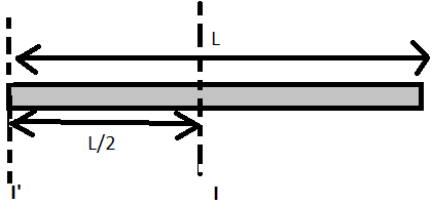
Given,
Length =L
Mass = M
We know that the moment of inertia about an axis perpendicular to the rod and passing through its centre is $\dfrac{{M{L^2}}}{{12}}$. Now we need to M.O.I about an axis through its edge and perpendicular to the rod.
Applying parallel theorem, we get
$
I' = {I_0} + M{(\dfrac{L}{2})^2} \\
I' = \dfrac{{M{L^2}}}{{12}} + \dfrac{{M{L^2}}}{4} \\
I' = \dfrac{{4M{L^2}}}{{12}} = \dfrac{{M{L^2}}}{3} \\
I' = \dfrac{{M{L^2}}}{3} \\
$
Hence, the correct option is C.
Note – In this type of question we need to remember their M.O.I. about an axis perpendicular to the object and then we can easily apply parallel and perpendicular theorems to get the desired conditions of the axis. Rotational inertia is significant in almost all physical problems involving mass in rotational motion. It is used to measure angular momentum which helps one to understand (by retaining angular momentum) how rotational motion varies as the distribution of mass changes. Inertia is directly proportional to the body's density. If you're going to feel inertia, then I'd say you drive a car and a paper ball. The car has more mass, and thus more inertia.
Formula used – 1) ${I_C} = \dfrac{{M{L^2}}}{{12}}$
1) Parallel theorem: $I = {I_C} + M{(\dfrac{L}{2})^2}$
Complete step-by-step answer:
Inertia is the measure of resistance that a body of a certain mass offers when plunged into motion or, on the contrary, bought to a halt by an external force. Inertia, or the tendency of objects to resist change, varies with mass. Heavier objects are difficult to accelerate when at rest and equally difficult to stop when in motion, as compared to lighter objects.
Given,
Length =L
Mass = M
We know that the moment of inertia about an axis perpendicular to the rod and passing through its centre is $\dfrac{{M{L^2}}}{{12}}$. Now we need to M.O.I about an axis through its edge and perpendicular to the rod.
Applying parallel theorem, we get
$
I' = {I_0} + M{(\dfrac{L}{2})^2} \\
I' = \dfrac{{M{L^2}}}{{12}} + \dfrac{{M{L^2}}}{4} \\
I' = \dfrac{{4M{L^2}}}{{12}} = \dfrac{{M{L^2}}}{3} \\
I' = \dfrac{{M{L^2}}}{3} \\
$
Hence, the correct option is C.
Note – In this type of question we need to remember their M.O.I. about an axis perpendicular to the object and then we can easily apply parallel and perpendicular theorems to get the desired conditions of the axis. Rotational inertia is significant in almost all physical problems involving mass in rotational motion. It is used to measure angular momentum which helps one to understand (by retaining angular momentum) how rotational motion varies as the distribution of mass changes. Inertia is directly proportional to the body's density. If you're going to feel inertia, then I'd say you drive a car and a paper ball. The car has more mass, and thus more inertia.
Recently Updated Pages
Master Class 11 Business Studies: Engaging Questions & Answers for Success

Master Class 11 Computer Science: Engaging Questions & Answers for Success
Master Class 11 Economics: Engaging Questions & Answers for Success
Master Class 11 Social Science: Engaging Questions & Answers for Success
Master Class 11 English: Engaging Questions & Answers for Success
Master Class 11 Chemistry: Engaging Questions & Answers for Success
Trending doubts
Draw a diagram of nephron and explain its structur class 11 biology CBSE
Explain zero factorial class 11 maths CBSE
Chemical formula of Bleaching powder is A Ca2OCl2 B class 11 chemistry CBSE
Name the part of the brain responsible for the precision class 11 biology CBSE
The growth of tendril in pea plants is due to AEffect class 11 biology CBSE
One Metric ton is equal to kg A 10000 B 1000 C 100 class 11 physics CBSE