




The molecular geometry of \[B{F_3}\] is:
A. Tetrahedral
B. Pyramidal
C. Square planar
D. Trigonal planar
Answer
 Verified
594.6k+ views
Hint: The molecular geometry depends on the hybridization of the central atom. It also depends on the number of bond pairs and lone pairs of electrons present on the central atom.
Complete step by step answer: The given compound is boron trifluoride. It is an inorganic compound which consists of boron and fluorine elements. Boron is the central atom which is bonded to three fluorine atoms as boron is the least electronegative of the two elements.
Boron is an element in the periodic table with atomic number \[5\] and electronic configuration \[\left[ {He} \right]2{s^2}2{p^1}\] . Thus the valence shell of boron is \[2\] and contains three electrons of which two are in \[2s\] and one in \[2p\] orbital.
The number of bonded fluorine atoms with the central boron atom is three. Thus the VSEP number is equal to = \[\dfrac{1}{2}\] (number of valence electrons of central boron atom + number of electrons shared by other bonded fluorine atoms)
$ = \dfrac{1}{2}(3 + 3) = 3$
The VSEP number equal to \[3\] belongs to \[s{p^2}\] hybridization. The shape or geometry of the molecule is trigonal planar. The bond angles between the \[F - B - F\] bond is \[120^\circ \] . The structure of the molecule is
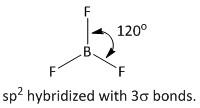
Thus option D is the correct answer..
Note:The rules for predicting the shapes of the molecules are: a) identify the central atom (the bonded atom which is the least electronegative), b) count the number of valence electrons of central atom, c) count the number of electrons shared by other bonded atoms, d) sum up the total of b and c and divide by two gives the VSEP number. The VSEP number corresponds to shape of the molecule as \[2\] for linear shape, \[3\] for trigonal planar, \[4\] for tetrahedral, \[5\] for trigonal bipyramidal, \[6\] for octahedral, and \[7\] for pentagonal bipyramidal.
Complete step by step answer: The given compound is boron trifluoride. It is an inorganic compound which consists of boron and fluorine elements. Boron is the central atom which is bonded to three fluorine atoms as boron is the least electronegative of the two elements.
Boron is an element in the periodic table with atomic number \[5\] and electronic configuration \[\left[ {He} \right]2{s^2}2{p^1}\] . Thus the valence shell of boron is \[2\] and contains three electrons of which two are in \[2s\] and one in \[2p\] orbital.
The number of bonded fluorine atoms with the central boron atom is three. Thus the VSEP number is equal to = \[\dfrac{1}{2}\] (number of valence electrons of central boron atom + number of electrons shared by other bonded fluorine atoms)
$ = \dfrac{1}{2}(3 + 3) = 3$
The VSEP number equal to \[3\] belongs to \[s{p^2}\] hybridization. The shape or geometry of the molecule is trigonal planar. The bond angles between the \[F - B - F\] bond is \[120^\circ \] . The structure of the molecule is
Thus option D is the correct answer..
Note:The rules for predicting the shapes of the molecules are: a) identify the central atom (the bonded atom which is the least electronegative), b) count the number of valence electrons of central atom, c) count the number of electrons shared by other bonded atoms, d) sum up the total of b and c and divide by two gives the VSEP number. The VSEP number corresponds to shape of the molecule as \[2\] for linear shape, \[3\] for trigonal planar, \[4\] for tetrahedral, \[5\] for trigonal bipyramidal, \[6\] for octahedral, and \[7\] for pentagonal bipyramidal.
Recently Updated Pages
Master Class 12 Economics: Engaging Questions & Answers for Success

Master Class 12 English: Engaging Questions & Answers for Success
Master Class 12 Social Science: Engaging Questions & Answers for Success
Master Class 12 Maths: Engaging Questions & Answers for Success
Master Class 12 Physics: Engaging Questions & Answers for Success
Master Class 9 General Knowledge: Engaging Questions & Answers for Success
Trending doubts
One Metric ton is equal to kg A 10000 B 1000 C 100 class 11 physics CBSE
Difference Between Prokaryotic Cells and Eukaryotic Cells
Two of the body parts which do not appear in MRI are class 11 biology CBSE
1 ton equals to A 100 kg B 1000 kg C 10 kg D 10000 class 11 physics CBSE
10 examples of friction in our daily life
Name the Largest and the Smallest Cell in the Human Body ?