




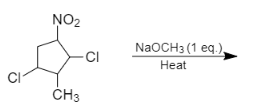
The major product formed in the following reaction is:
Answer
 Verified
603.3k+ views
Hint: Sodium methoxide having a chemical formula, $C{{H}_{3}}ONa$ is an organic compound which is formed by removing hydrogen from methanol. It is a white solid which is used as a reagent in the laboratory. It acts as a base.
Complete step-by-step answer:Sodium methoxide is used as a base in organic chemistry and is used in the synthesis of many compounds in pharmaceutical and agrichemical. It acts as a base and is employed in dehydrohalogenation and condensation reaction. It also acts as a nucleophile in the production of methyl ether. It is highly caustic and when it reacts with water it gives methanol, which is very volatile and toxic.
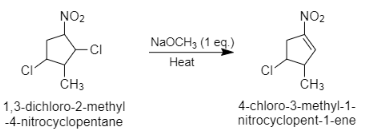
When \[1,3-\]dichloro\[-2-\]methyl\[-4-\]nitrocyclopentane reacts with sodium methoxide, it results in the formation of \[4-\]chloro\[-3-\]methyl\[-1-\]nitrocyclopentane\[-1-\]ene. Here, sodium methoxide acts as a base. It attacks on more acidic hydrogen and donates its electrons on the carbon. Now these electrons move to the single bond and chlorine is removed as it is a good leaving group. This results in the formation of double bonds. Acidic hydrogen is the hydrogen which is near to the nitro group which acts as an electron withdrawing group. The nitro group shows resonance effect and withdraws electrons from the carbon. Therefore, the hydrogen near the nitro group will be more acidic than the other hydrogens.
The reaction can be given as follows:
Note:It is to note that electron withdrawing group is defined as the group that has the tendency to withdraw electrons from the reaction center. In this question, the nitrogen group $(N{{O}_{2}})$ is an electron withdrawing group. It withdraws electrons from the carbon and makes it electron deficient. Therefore, the hydrogen attached to this carbon will be more acidic.
Complete step-by-step answer:Sodium methoxide is used as a base in organic chemistry and is used in the synthesis of many compounds in pharmaceutical and agrichemical. It acts as a base and is employed in dehydrohalogenation and condensation reaction. It also acts as a nucleophile in the production of methyl ether. It is highly caustic and when it reacts with water it gives methanol, which is very volatile and toxic.
When \[1,3-\]dichloro\[-2-\]methyl\[-4-\]nitrocyclopentane reacts with sodium methoxide, it results in the formation of \[4-\]chloro\[-3-\]methyl\[-1-\]nitrocyclopentane\[-1-\]ene. Here, sodium methoxide acts as a base. It attacks on more acidic hydrogen and donates its electrons on the carbon. Now these electrons move to the single bond and chlorine is removed as it is a good leaving group. This results in the formation of double bonds. Acidic hydrogen is the hydrogen which is near to the nitro group which acts as an electron withdrawing group. The nitro group shows resonance effect and withdraws electrons from the carbon. Therefore, the hydrogen near the nitro group will be more acidic than the other hydrogens.
The reaction can be given as follows:
Note:It is to note that electron withdrawing group is defined as the group that has the tendency to withdraw electrons from the reaction center. In this question, the nitrogen group $(N{{O}_{2}})$ is an electron withdrawing group. It withdraws electrons from the carbon and makes it electron deficient. Therefore, the hydrogen attached to this carbon will be more acidic.
Recently Updated Pages
Master Class 12 Business Studies: Engaging Questions & Answers for Success

Master Class 12 Biology: Engaging Questions & Answers for Success
Master Class 12 Chemistry: Engaging Questions & Answers for Success
Class 12 Question and Answer - Your Ultimate Solutions Guide
Master Class 12 Economics: Engaging Questions & Answers for Success
Master Class 11 English: Engaging Questions & Answers for Success
Trending doubts
Draw a labelled sketch of the human eye class 12 physics CBSE
Which are the Top 10 Largest Countries of the World?
Draw ray diagrams each showing i myopic eye and ii class 12 physics CBSE
Which is the correct genotypic ratio of mendel dihybrid class 12 biology CBSE
Differentiate between homogeneous and heterogeneous class 12 chemistry CBSE
An alga which can be possibly used in space flight class 12 biology CBSE