




The magnitude of displacement is equal to the distance covered in a given interval of time if the particle
a) Moves with a constant acceleration along any path
b) Moves with constant speed
c) Moves in the same direction with constant velocity
d) None of these
Answer
 Verified
654.6k+ views
Hint: The distance covered by a particle or an object cannot be zero since it is a scalar quantity. The displacement of a particle can be zero if the particle comes back to the same position as it is a vector. Hence we can use this fact to determine the necessary conditions for displacement to be equal to distance covered.
Complete answer:
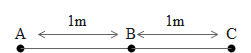
To begin with let us consider an object moving from A to C through B and back to A from C and then again from A to B. In this case the displacement of the object would be 1m but its distance covered will be 5m. The displacement in moving back to the same initial point is zero. This implies that displacement is path dependent and distance is path independent.
For the same case let us say that the object moves with constant acceleration in the same path in that case as well the distance covered will be 5m and displacement will be equal to 1m. This condition also applies if the object moves with constant velocity since the path traversed is the same.
Now let us say if the object moves with a constant velocity in the same i.e. If the object moves from A to B and then continues to move in the same direction to C, then the distance covered will be equal to displacement of the object
So, the correct answer is “Option C”.
Note:
The distance covered is the magnitude of the displacement vector. Since velocity is given as displacement by time taken velocity of the particle can be zero. The speed of a particle cannot be zero if the particle covers some distance in a given time.
Complete answer:
To begin with let us consider an object moving from A to C through B and back to A from C and then again from A to B. In this case the displacement of the object would be 1m but its distance covered will be 5m. The displacement in moving back to the same initial point is zero. This implies that displacement is path dependent and distance is path independent.
For the same case let us say that the object moves with constant acceleration in the same path in that case as well the distance covered will be 5m and displacement will be equal to 1m. This condition also applies if the object moves with constant velocity since the path traversed is the same.
Now let us say if the object moves with a constant velocity in the same i.e. If the object moves from A to B and then continues to move in the same direction to C, then the distance covered will be equal to displacement of the object
So, the correct answer is “Option C”.
Note:
The distance covered is the magnitude of the displacement vector. Since velocity is given as displacement by time taken velocity of the particle can be zero. The speed of a particle cannot be zero if the particle covers some distance in a given time.
Recently Updated Pages
Master Class 11 Social Science: Engaging Questions & Answers for Success

Master Class 11 English: Engaging Questions & Answers for Success
Master Class 11 Accountancy: Engaging Questions & Answers for Success
Master Class 11 Physics: Engaging Questions & Answers for Success
Master Class 11 Computer Science: Engaging Questions & Answers for Success
Master Class 11 Business Studies: Engaging Questions & Answers for Success
Trending doubts
One Metric ton is equal to kg A 10000 B 1000 C 100 class 11 physics CBSE
Find the value of the expression given below sin 30circ class 11 maths CBSE
Draw a diagram of nephron and explain its structur class 11 biology CBSE
10 examples of friction in our daily life
Proton was discovered by A Thomson B Rutherford C Chadwick class 11 chemistry CBSE
The teeth used for biting and cutting food are called class 11 biology CBSE