




The locomotory structure of amoeba is
(a)Cilia
(b)Flagella
(c)Pseudopodia
(d)Tentacle
Answer
 Verified
616.8k+ views
Hint: Locomotion is an essential function of every organism for survival. Amoeba is single-celled eukaryotic organisms that can perform every living function with only one cell.
Complete answer:
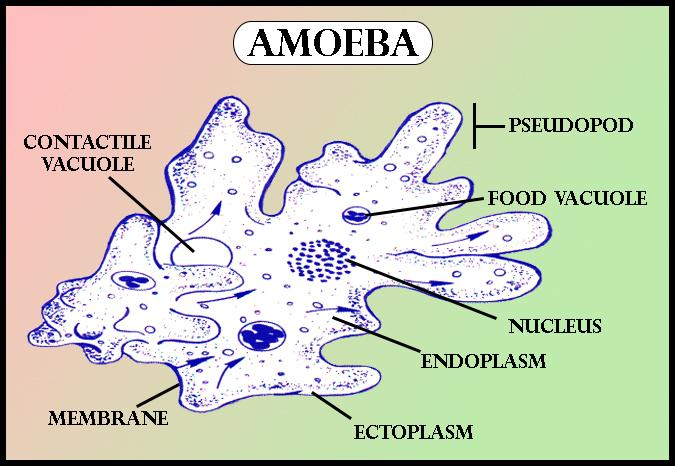
Amoeba is a eukaryotic single-cell organism that performs locomotion with the help of temporary arm-like projections called Pseudopodia which consist of actin filaments. They also help amoeba in ingestion. Generally, Amoebozoa organisms contain the lobopodian type of Pseudopodia.
Additional Information: Let us know more about each type of locomotory structure mentioned in the question
Pseudopodia: These are temporary arm-like projections made of actin fibers and filled with cytoplasm often found in amoebas. These may also contain microtubules and intermediate filaments. There are different types of Pseudopodia shown by different organisms- lamellipodia, lobopodia, filopodia, reticulopodia, and axopodia. They are sensible organisms that can engulf substance from the environment which helps the organism in the ingestion of food and also in excretion. The organisms like amoeba perform locomotion with help of these structures.
Cilia: These are hair-like structures found on the surface of almost all mammalian cells. These structures help in the locomotion of many organisms and are also sensory organs of those organisms. Some examples are paramecium, flatworms, etc.
Flagella: It is a lash like structure produced by the cell body of organisms like bacteria and eukaryotic flagellates. They perform locomotion as well as sensory functions. Some examples of organisms that use these structures for locomotion are dinoflagellates, euglenoids, etc.
Tentacles: These are motile elongated parts present in some animals that perform functions like muscular hydrostats and sensory functions as well as locomotion. Some organisms possessing tentacles are jellyfish, hydra, etc.
Therefore, the correct answer is Pseudopodia.
Note: There are many different structures used by various animals for locomotion and movement. The single-celled animals like amoeba only have one cell therefore, that cell made itself capable of all living activities such as locomotion. The cytoplasmic extension pseudopodia is a temporary structure of the amoeba cell but performs locomotion and ingestion.
Complete answer:
Amoeba is a eukaryotic single-cell organism that performs locomotion with the help of temporary arm-like projections called Pseudopodia which consist of actin filaments. They also help amoeba in ingestion. Generally, Amoebozoa organisms contain the lobopodian type of Pseudopodia.
Additional Information: Let us know more about each type of locomotory structure mentioned in the question
Pseudopodia: These are temporary arm-like projections made of actin fibers and filled with cytoplasm often found in amoebas. These may also contain microtubules and intermediate filaments. There are different types of Pseudopodia shown by different organisms- lamellipodia, lobopodia, filopodia, reticulopodia, and axopodia. They are sensible organisms that can engulf substance from the environment which helps the organism in the ingestion of food and also in excretion. The organisms like amoeba perform locomotion with help of these structures.
Cilia: These are hair-like structures found on the surface of almost all mammalian cells. These structures help in the locomotion of many organisms and are also sensory organs of those organisms. Some examples are paramecium, flatworms, etc.
Flagella: It is a lash like structure produced by the cell body of organisms like bacteria and eukaryotic flagellates. They perform locomotion as well as sensory functions. Some examples of organisms that use these structures for locomotion are dinoflagellates, euglenoids, etc.
Tentacles: These are motile elongated parts present in some animals that perform functions like muscular hydrostats and sensory functions as well as locomotion. Some organisms possessing tentacles are jellyfish, hydra, etc.
Therefore, the correct answer is Pseudopodia.
Note: There are many different structures used by various animals for locomotion and movement. The single-celled animals like amoeba only have one cell therefore, that cell made itself capable of all living activities such as locomotion. The cytoplasmic extension pseudopodia is a temporary structure of the amoeba cell but performs locomotion and ingestion.
Recently Updated Pages
Master Class 11 English: Engaging Questions & Answers for Success

Master Class 11 Social Science: Engaging Questions & Answers for Success
Master Class 11 Maths: Engaging Questions & Answers for Success
Master Class 11 Biology: Engaging Questions & Answers for Success
Master Class 11 Physics: Engaging Questions & Answers for Success
Master Class 11 Chemistry: Engaging Questions & Answers for Success
Trending doubts
Find the value of the expression given below sin 30circ class 11 maths CBSE
Draw a diagram of nephron and explain its structur class 11 biology CBSE
Difference between physical and chemical change class 11 chemistry CBSE
How do I convert ms to kmh Give an example class 11 physics CBSE
What is the atomic mass of Sodium a 22 gmol b 23 gmol class 11 chemistry CBSE
In which country Lascaux cave is located A India B class 11 social science CBSE