




The line\[y=mx+c\] will be a tangent to the circle \[{{x}^{2}}+{{y}^{2}}={{a}^{2}}\]if\[c=\pm a\sqrt{1+{{m}^{2}}}\]. The equation of any tangent to the circle \[{{x}^{2}}+{{y}^{2}}={{a}^{2}}\]can be considered as \[y=mx+a\sqrt{1+{{m}^{2}}}\]and the co-ordinates of the points of contact are \[\left( \pm \dfrac{am}{\sqrt{{{1}^{{}}}+{{m}^{2}}}},\mp \dfrac{a}{\sqrt{{{1}^{{}}}+{{m}^{2}}}} \right)\] and the length of the tangent from the point \[P\left( {{x}_{1}}+{{y}_{1}} \right)\] to the circle \[{{x}^{2}}+{{y}^{2}}+2gx+2fy+c=0\] is \[\sqrt{{{x}_{1}}^{2}+{{y}_{1}}^{2}+2g{{x}_{1}}+2f{{y}_{1}}+c}\].
The equation of tangent to the circle \[{{x}^{2}}+{{y}^{2}}+4x+2y=0\] from the point \[P\left( 1,-2 \right)\]is
(a) \[y-2x-5=0\]
(b) \[x+2y+5=0\]
(c) \[x-2y=0\]
(d) \[y-3x=0\]
Answer
 Verified
611.4k+ views
Hint:First, before proceeding for this, we must know the equation of circle is given by where (h, k) is centre and r is radius as ${{\left( x-h \right)}^{2}}+{{\left( y-k \right)}^{2}}={{r}^{2}}$. Then, we must draw the figure that illustrates the condition and get the idea of the question more clearly. Then, by using the equation of straight line where N is slope and $\left( {{x}_{1}},{{y}_{1}} \right)$is the point where line passes is given by $y-{{y}_{1}}=N\left( x-{{x}_{1}} \right)$and the condition of perpendicular lines, we get the required result.
Complete step by step answer:
In this question, we are supposed to find the equation of tangent to the circle \[{{x}^{2}}+{{y}^{2}}+4x+2y=0\] from the point \[P\left( 1,-2 \right)\].
So, before proceeding for this, we must know the equation of circle is given by where (h, k) is centre and r is radius as:
${{\left( x-h \right)}^{2}}+{{\left( y-k \right)}^{2}}={{r}^{2}}$
So, by using the completing the square and adding and subtracting 4 and 1, we get:
\[\begin{align}
& {{x}^{2}}+{{y}^{2}}+4x+2y+4-4+1-1=0 \\
& \Rightarrow {{x}^{2}}+{{y}^{2}}+4x+2y+{{2}^{2}}-4+{{1}^{2}}-1=0 \\
& \Rightarrow {{\left( x+2 \right)}^{2}}+{{\left( y+1 \right)}^{2}}=5 \\
& \Rightarrow {{\left( x+2 \right)}^{2}}+{{\left( y+1 \right)}^{2}}={{\left( \sqrt{5} \right)}^{2}} \\
\end{align}\]
So, by comparing we get the centre as (-2, -1) and radius as $\sqrt{5}$.
Now, we must draw the figure that illustrates the condition and get the idea of the question more clearly as:
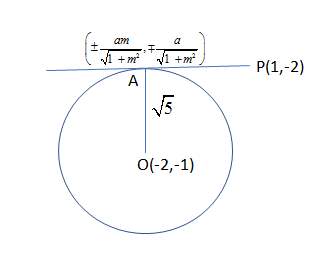
Then, by using the equation of straight line where N is slope and $\left( {{x}_{1}},{{y}_{1}} \right)$is the point where line passes is given by:
$y-{{y}_{1}}=N\left( x-{{x}_{1}} \right)$
Now, we also know the formula for the slope of any line N is given by:
$N=\dfrac{{{y}_{2}}-{{y}_{1}}}{{{x}_{2}}-{{x}_{1}}}$
So, by using this formula to get the slope of the line OA as:
$\begin{align}
& N=\dfrac{\dfrac{a}{\sqrt{1+{{m}^{2}}}}-\left( -1 \right)}{\dfrac{am}{\sqrt{1+{{m}^{2}}}}-\left( -2 \right)} \\
& \Rightarrow N=\dfrac{\dfrac{a+\sqrt{1+{{m}^{2}}}}{\sqrt{1+{{m}^{2}}}}}{\dfrac{am+2\sqrt{1+{{m}^{2}}}}{\sqrt{1+{{m}^{2}}}}} \\
& \Rightarrow N=\dfrac{a+\sqrt{1+{{m}^{2}}}}{am+2\sqrt{1+{{m}^{2}}}} \\
\end{align}$
Then, by using another condition of the lines that are perpendicular as OA and AP as tangent always makes an angle of ${{90}^{\circ }}$.
So, for the two lines when perpendicular the slope of the line AP is negative reciprocal of slope M of OA as:
$\begin{align}
& M=\dfrac{-1}{N} \\
& \Rightarrow M=\dfrac{-1}{\dfrac{a+\sqrt{1+{{m}^{2}}}}{am+2\sqrt{1+{{m}^{2}}}}} \\
& \Rightarrow M=-\left( \dfrac{am+2\sqrt{1+{{m}^{2}}}}{a+\sqrt{1+{{m}^{2}}}} \right) \\
\end{align}$
Now, by using the equation of straight line for line AP with above calculated slope and point P, we get:
$\begin{align}
& y-{{y}_{1}}=M\left( x-{{x}_{1}} \right) \\
& \Rightarrow y-\left( -2 \right)=-\left( \dfrac{am+2\sqrt{1+{{m}^{2}}}}{a+\sqrt{1+{{m}^{2}}}} \right)\left( x-1 \right) \\
& \Rightarrow \Rightarrow y-\left( -2 \right)=-\left( \dfrac{am+2\sqrt{1+{{m}^{2}}}}{a+\sqrt{1+{{m}^{2}}}} \right)x+\left( \dfrac{am+2\sqrt{1+{{m}^{2}}}}{a+\sqrt{1+{{m}^{2}}}} \right) \\
\end{align}$
Now, by comparing the above equation of tangent from the equation of tangent given in the question as \[y=mx+a\sqrt{1+{{m}^{2}}}\], we get:
$\left( \dfrac{am+2\sqrt{1+{{m}^{2}}}}{a+\sqrt{1+{{m}^{2}}}} \right)=m$
Then, by substituting the value of a as $\sqrt{5}$ as calculated above and compared to the equation in the question as \[{{x}^{2}}+{{y}^{2}}={{a}^{2}}\], we get:
$\begin{align}
& \left( \dfrac{\sqrt{5}m+2\sqrt{1+{{m}^{2}}}}{\sqrt{5}+\sqrt{1+{{m}^{2}}}} \right)=m \\
& \Rightarrow \left( \sqrt{5}m+2\sqrt{1+{{m}^{2}}} \right)=m\left( \sqrt{5}+\sqrt{1+{{m}^{2}}} \right) \\
& \Rightarrow \sqrt{5}m+2\sqrt{1+{{m}^{2}}}=m\sqrt{5}+m\sqrt{1+{{m}^{2}}} \\
& \Rightarrow 2\sqrt{1+{{m}^{2}}}=m\sqrt{1+{{m}^{2}}} \\
& \Rightarrow m=2 \\
\end{align}$
Now, by substituting the value of m as 2 and a as $\sqrt{5}$ in the given expression of tangent in the question as \[y=mx+a\sqrt{1+{{m}^{2}}}\], we get:
\[\begin{align}
& y=2x+\sqrt{5}\sqrt{1+{{2}^{2}}} \\
& \Rightarrow y=2x+\sqrt{5}\times \sqrt{5} \\
& \Rightarrow y=2x+5 \\
& \Rightarrow y-2x-5=0 \\
\end{align}\]
So, we get the equation of the tangent as \[y-2x-5=0\].
Hence, option (a) is correct.
Note:
Now, to solve these types of questions we need to know some of the basics of the equation of the circle and equation of the straight line to proceed easily. So, the required equation of the circle and straight-line are as:
Equation of circle is given by ${{\left( x-h \right)}^{2}}+{{\left( y-k \right)}^{2}}={{r}^{2}}$where (h, k) as centre.
Equation of the line is given by $y-{{y}_{1}}=N\left( x-{{x}_{1}} \right)$where N is slope.
Complete step by step answer:
In this question, we are supposed to find the equation of tangent to the circle \[{{x}^{2}}+{{y}^{2}}+4x+2y=0\] from the point \[P\left( 1,-2 \right)\].
So, before proceeding for this, we must know the equation of circle is given by where (h, k) is centre and r is radius as:
${{\left( x-h \right)}^{2}}+{{\left( y-k \right)}^{2}}={{r}^{2}}$
So, by using the completing the square and adding and subtracting 4 and 1, we get:
\[\begin{align}
& {{x}^{2}}+{{y}^{2}}+4x+2y+4-4+1-1=0 \\
& \Rightarrow {{x}^{2}}+{{y}^{2}}+4x+2y+{{2}^{2}}-4+{{1}^{2}}-1=0 \\
& \Rightarrow {{\left( x+2 \right)}^{2}}+{{\left( y+1 \right)}^{2}}=5 \\
& \Rightarrow {{\left( x+2 \right)}^{2}}+{{\left( y+1 \right)}^{2}}={{\left( \sqrt{5} \right)}^{2}} \\
\end{align}\]
So, by comparing we get the centre as (-2, -1) and radius as $\sqrt{5}$.
Now, we must draw the figure that illustrates the condition and get the idea of the question more clearly as:
Then, by using the equation of straight line where N is slope and $\left( {{x}_{1}},{{y}_{1}} \right)$is the point where line passes is given by:
$y-{{y}_{1}}=N\left( x-{{x}_{1}} \right)$
Now, we also know the formula for the slope of any line N is given by:
$N=\dfrac{{{y}_{2}}-{{y}_{1}}}{{{x}_{2}}-{{x}_{1}}}$
So, by using this formula to get the slope of the line OA as:
$\begin{align}
& N=\dfrac{\dfrac{a}{\sqrt{1+{{m}^{2}}}}-\left( -1 \right)}{\dfrac{am}{\sqrt{1+{{m}^{2}}}}-\left( -2 \right)} \\
& \Rightarrow N=\dfrac{\dfrac{a+\sqrt{1+{{m}^{2}}}}{\sqrt{1+{{m}^{2}}}}}{\dfrac{am+2\sqrt{1+{{m}^{2}}}}{\sqrt{1+{{m}^{2}}}}} \\
& \Rightarrow N=\dfrac{a+\sqrt{1+{{m}^{2}}}}{am+2\sqrt{1+{{m}^{2}}}} \\
\end{align}$
Then, by using another condition of the lines that are perpendicular as OA and AP as tangent always makes an angle of ${{90}^{\circ }}$.
So, for the two lines when perpendicular the slope of the line AP is negative reciprocal of slope M of OA as:
$\begin{align}
& M=\dfrac{-1}{N} \\
& \Rightarrow M=\dfrac{-1}{\dfrac{a+\sqrt{1+{{m}^{2}}}}{am+2\sqrt{1+{{m}^{2}}}}} \\
& \Rightarrow M=-\left( \dfrac{am+2\sqrt{1+{{m}^{2}}}}{a+\sqrt{1+{{m}^{2}}}} \right) \\
\end{align}$
Now, by using the equation of straight line for line AP with above calculated slope and point P, we get:
$\begin{align}
& y-{{y}_{1}}=M\left( x-{{x}_{1}} \right) \\
& \Rightarrow y-\left( -2 \right)=-\left( \dfrac{am+2\sqrt{1+{{m}^{2}}}}{a+\sqrt{1+{{m}^{2}}}} \right)\left( x-1 \right) \\
& \Rightarrow \Rightarrow y-\left( -2 \right)=-\left( \dfrac{am+2\sqrt{1+{{m}^{2}}}}{a+\sqrt{1+{{m}^{2}}}} \right)x+\left( \dfrac{am+2\sqrt{1+{{m}^{2}}}}{a+\sqrt{1+{{m}^{2}}}} \right) \\
\end{align}$
Now, by comparing the above equation of tangent from the equation of tangent given in the question as \[y=mx+a\sqrt{1+{{m}^{2}}}\], we get:
$\left( \dfrac{am+2\sqrt{1+{{m}^{2}}}}{a+\sqrt{1+{{m}^{2}}}} \right)=m$
Then, by substituting the value of a as $\sqrt{5}$ as calculated above and compared to the equation in the question as \[{{x}^{2}}+{{y}^{2}}={{a}^{2}}\], we get:
$\begin{align}
& \left( \dfrac{\sqrt{5}m+2\sqrt{1+{{m}^{2}}}}{\sqrt{5}+\sqrt{1+{{m}^{2}}}} \right)=m \\
& \Rightarrow \left( \sqrt{5}m+2\sqrt{1+{{m}^{2}}} \right)=m\left( \sqrt{5}+\sqrt{1+{{m}^{2}}} \right) \\
& \Rightarrow \sqrt{5}m+2\sqrt{1+{{m}^{2}}}=m\sqrt{5}+m\sqrt{1+{{m}^{2}}} \\
& \Rightarrow 2\sqrt{1+{{m}^{2}}}=m\sqrt{1+{{m}^{2}}} \\
& \Rightarrow m=2 \\
\end{align}$
Now, by substituting the value of m as 2 and a as $\sqrt{5}$ in the given expression of tangent in the question as \[y=mx+a\sqrt{1+{{m}^{2}}}\], we get:
\[\begin{align}
& y=2x+\sqrt{5}\sqrt{1+{{2}^{2}}} \\
& \Rightarrow y=2x+\sqrt{5}\times \sqrt{5} \\
& \Rightarrow y=2x+5 \\
& \Rightarrow y-2x-5=0 \\
\end{align}\]
So, we get the equation of the tangent as \[y-2x-5=0\].
Hence, option (a) is correct.
Note:
Now, to solve these types of questions we need to know some of the basics of the equation of the circle and equation of the straight line to proceed easily. So, the required equation of the circle and straight-line are as:
Equation of circle is given by ${{\left( x-h \right)}^{2}}+{{\left( y-k \right)}^{2}}={{r}^{2}}$where (h, k) as centre.
Equation of the line is given by $y-{{y}_{1}}=N\left( x-{{x}_{1}} \right)$where N is slope.
Recently Updated Pages
Master Class 12 Business Studies: Engaging Questions & Answers for Success

Master Class 12 Biology: Engaging Questions & Answers for Success
Master Class 12 Chemistry: Engaging Questions & Answers for Success
Class 12 Question and Answer - Your Ultimate Solutions Guide
Master Class 11 Social Science: Engaging Questions & Answers for Success
Master Class 11 English: Engaging Questions & Answers for Success
Trending doubts
What is the full form of NDA a National Democratic class 10 social science CBSE
Explain the Treaty of Vienna of 1815 class 10 social science CBSE
Who Won 36 Oscar Awards? Record Holder Revealed
Bharatiya Janata Party was founded in the year A 1979 class 10 social science CBSE
What is the median of the first 10 natural numbers class 10 maths CBSE
Why is it 530 pm in india when it is 1200 afternoon class 10 social science CBSE