




The line drawn through the centre of a circle to bisect a chord is perpendicular to the chord. Prove this statement.
Answer
 Verified
601.5k+ views
Hint: First, draw a circle with centre O and chord AB. Then join OA and OB. Then we will construct a line passing through the centre O and bisecting AB at C. Now, use SAS (Side – Angle – Side) Congruence criteria to prove the two triangles OAC and OBC congruent to each other. Finally, use the information that “Sum of the angles in the linear pair is 180 degrees” to prove the required statement.
Complete step by step answer:
Here, we are required to prove the statement, “The line drawn through the centre of a circle to bisect a chord is perpendicular to the chord”. So, let us draw a diagram for better understanding.
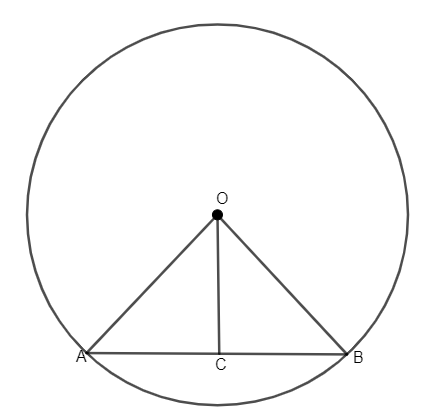
Here, we have drawn a circle with centre O and chord AB. We have joined OA and OB such that OA = OB = radius. Also, we have constructed OC meeting AB at C. It is given that OC bisects AB.
\[\Rightarrow AC=BC....\left( i \right)\]
We have to show that OC is perpendicular to AB.
Now, in triangle OAC and OBC, we have,
OA = OB (Since they are radius)
\[\angle OAC=\angle OBC\]
(Since OA = OB, therefore triangle OAB is isosceles)
AC = BC (given in equation (i))
Clearly, we can see that triangle OAC and triangle OBC are congruent to each other by SAS (Side – Angle – Side) congruence criteria. Here, two sides and the included angle of triangle OAC is congruent to the two sides and the included angle of triangle OBC.
Since triangle OAC and triangle OBC are congruent, therefore we can say that,
\[\angle OCA=\angle OCB.....\left( ii \right)\]
Now, we know that AB is a straight line. Therefore, \[\angle ACB={{180}^{\circ }}.\] Now this angle is made up of two angles, namely, angle OCA and angle OCB. So, we can say that these angles are linear pairs.
\[\Rightarrow \angle OCA+\angle OCB={{180}^{\circ }}\]
\[\Rightarrow 2\angle OCA={{180}^{\circ }}\left[ \text{using equation (ii)} \right]\]
\[\Rightarrow \angle OCA={{90}^{\circ }}\]
So, we can say that OC is perpendicular to AB.
Hence proved.
Note: One may note that we can also prove the given statement without using congruence criteria. We already know that triangle OAB is isosceles and OC bisects the side AB, therefore OC is the median. In an isosceles triangle, the median is also the perpendicular bisector. Hence, it can be proved. But remember that this property of the isosceles triangle is proved using the same SAS congruence rule. So, indirectly we will use the same rule. Finally, note that the statement given in the question should be remembered as a theorem because in many places it is used directly.
Complete step by step answer:
Here, we are required to prove the statement, “The line drawn through the centre of a circle to bisect a chord is perpendicular to the chord”. So, let us draw a diagram for better understanding.
Here, we have drawn a circle with centre O and chord AB. We have joined OA and OB such that OA = OB = radius. Also, we have constructed OC meeting AB at C. It is given that OC bisects AB.
\[\Rightarrow AC=BC....\left( i \right)\]
We have to show that OC is perpendicular to AB.
Now, in triangle OAC and OBC, we have,
OA = OB (Since they are radius)
\[\angle OAC=\angle OBC\]
(Since OA = OB, therefore triangle OAB is isosceles)
AC = BC (given in equation (i))
Clearly, we can see that triangle OAC and triangle OBC are congruent to each other by SAS (Side – Angle – Side) congruence criteria. Here, two sides and the included angle of triangle OAC is congruent to the two sides and the included angle of triangle OBC.
Since triangle OAC and triangle OBC are congruent, therefore we can say that,
\[\angle OCA=\angle OCB.....\left( ii \right)\]
Now, we know that AB is a straight line. Therefore, \[\angle ACB={{180}^{\circ }}.\] Now this angle is made up of two angles, namely, angle OCA and angle OCB. So, we can say that these angles are linear pairs.
\[\Rightarrow \angle OCA+\angle OCB={{180}^{\circ }}\]
\[\Rightarrow 2\angle OCA={{180}^{\circ }}\left[ \text{using equation (ii)} \right]\]
\[\Rightarrow \angle OCA={{90}^{\circ }}\]
So, we can say that OC is perpendicular to AB.
Hence proved.
Note: One may note that we can also prove the given statement without using congruence criteria. We already know that triangle OAB is isosceles and OC bisects the side AB, therefore OC is the median. In an isosceles triangle, the median is also the perpendicular bisector. Hence, it can be proved. But remember that this property of the isosceles triangle is proved using the same SAS congruence rule. So, indirectly we will use the same rule. Finally, note that the statement given in the question should be remembered as a theorem because in many places it is used directly.
Recently Updated Pages
Master Class 11 English: Engaging Questions & Answers for Success

Master Class 11 Maths: Engaging Questions & Answers for Success
Class 11 Question and Answer - Your Ultimate Solutions Guide
Master Class 11 Biology: Engaging Questions & Answers for Success
Master Class 11 Physics: Engaging Questions & Answers for Success
Master Class 11 Accountancy: Engaging Questions & Answers for Success
Trending doubts
Explain the Treaty of Vienna of 1815 class 10 social science CBSE
Who Won 36 Oscar Awards? Record Holder Revealed
What is the median of the first 10 natural numbers class 10 maths CBSE
Why is it 530 pm in india when it is 1200 afternoon class 10 social science CBSE
Why is there a time difference of about 5 hours between class 10 social science CBSE
What is the full form of POSCO class 10 social science CBSE