




The length of the diagonal of the square is $\sqrt 2 \left( {6 + 2\sqrt 5 } \right)$ cm. Then find the length of a side of the square.
Answer
 Verified
660.9k+ views
Hint: In this question, we use the formula of Pythagoras theorem. We know in square all four interior angles are equal to 900. So, we can easily use Pythagoras theorem in which diagonal as a hypotenuse and perpendicular and base are sides of square.
Complete step-by-step answer:
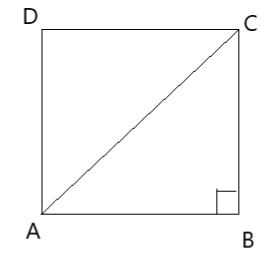
Consider a square ABCD of side x in which diagonal AC and right angle at B.
Given, length of diagonal of square $AC = \sqrt 2 \left( {6 + 2\sqrt 5 } \right)$
Now, use of Pythagoras theorem in $\vartriangle ABC$ and right angle at B.
${\left( {AC} \right)^2} = {\left( {AB} \right)^2} + {\left( {BC} \right)^2}$
We know in square all sides are equal, $AB = BC = CD = DA = x$
$
\Rightarrow {\left( {AC} \right)^2} = {\left( x \right)^2} + {\left( x \right)^2} \\
\Rightarrow {\left( {AC} \right)^2} = 2{x^2} \\
\Rightarrow {x^2} = \dfrac{{{{\left( {AC} \right)}^2}}}{2} \\
$
Taking square root on both sides
$ \Rightarrow x = \dfrac{{AC}}{{\sqrt 2 }}$
We know value of $AC = \sqrt 2 \left( {6 + 2\sqrt 5 } \right)$
$
\Rightarrow x = \dfrac{{\sqrt 2 \left( {6 + 2\sqrt 5 } \right)}}{{\sqrt 2 }} \\
\Rightarrow x = \left( {6 + 2\sqrt 5 } \right)cm \\
$
So, the length of a side of the square is $\left( {6 + 2\sqrt 5 } \right)$ cm.
Note: Whenever we face such types of problems we use some important points. Like we use the Pythagoras theorem to make a relation between diagonal and sides of a square then put the value of diagonal in relation. So, after calculation we will get the required answer.
Complete step-by-step answer:
Consider a square ABCD of side x in which diagonal AC and right angle at B.
Given, length of diagonal of square $AC = \sqrt 2 \left( {6 + 2\sqrt 5 } \right)$
Now, use of Pythagoras theorem in $\vartriangle ABC$ and right angle at B.
${\left( {AC} \right)^2} = {\left( {AB} \right)^2} + {\left( {BC} \right)^2}$
We know in square all sides are equal, $AB = BC = CD = DA = x$
$
\Rightarrow {\left( {AC} \right)^2} = {\left( x \right)^2} + {\left( x \right)^2} \\
\Rightarrow {\left( {AC} \right)^2} = 2{x^2} \\
\Rightarrow {x^2} = \dfrac{{{{\left( {AC} \right)}^2}}}{2} \\
$
Taking square root on both sides
$ \Rightarrow x = \dfrac{{AC}}{{\sqrt 2 }}$
We know value of $AC = \sqrt 2 \left( {6 + 2\sqrt 5 } \right)$
$
\Rightarrow x = \dfrac{{\sqrt 2 \left( {6 + 2\sqrt 5 } \right)}}{{\sqrt 2 }} \\
\Rightarrow x = \left( {6 + 2\sqrt 5 } \right)cm \\
$
So, the length of a side of the square is $\left( {6 + 2\sqrt 5 } \right)$ cm.
Note: Whenever we face such types of problems we use some important points. Like we use the Pythagoras theorem to make a relation between diagonal and sides of a square then put the value of diagonal in relation. So, after calculation we will get the required answer.
Recently Updated Pages
Master Class 5 English: Engaging Questions & Answers for Success

Master Class 5 Maths: Engaging Questions & Answers for Success
Master Class 5 Social Science: Engaging Questions & Answers for Success
Master Class 5 Science: Engaging Questions & Answers for Success
Class 5 Question and Answer - Your Ultimate Solutions Guide
Master Class 9 General Knowledge: Engaging Questions & Answers for Success
Trending doubts
Explain the Treaty of Vienna of 1815 class 10 social science CBSE
What is the Total Duration of Football Match?
The shortest day of the year in India
In which year voting age was reduced from 21 to 18?
10 examples of evaporation in daily life with explanations
Why is there a time difference of about 5 hours between class 10 social science CBSE