




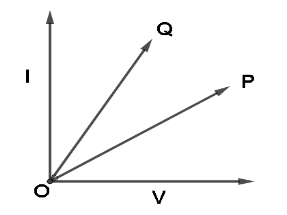
The I-V graph for two different electrical appliances $P$ and $Q$ are shown in the figure in the diagram if $R_p$ and $R_q$ the resistances of the devices then :
A. \[{R_p} = {R_q}\]
B. \[{R_p} > {R_q}\]
C. \[{R_p} < {R_q}\]
D. None of these
Answer
 Verified
530.7k+ views
Hint: To solve this question we will have to apply the basic knowledge about ohm’s law which gives the relationship between resistance (R), potential (V) and current (I). We will then equate the equation of ohm's law to the formula for the equation of straight line and then compare to answer the question.
Formula used:
Ohm’s law: \[V = IR\]
where, $V$= potential, $I$=current and $R$= resistance.
Complete step by step answer:
The link between electric current and potential difference is described by Ohm's law. The current flowing through most conductors is proportional to the voltage applied to them. We will use this law to answer this question. Ohm's law is only valid if the temperature and other physical variables remain constant.
Increasing the current in some components boosts the temperature. The filament of a light bulb is an example of this.. In this case, Ohm’s law cannot be applied. The light bulb filament violates Ohm’s Law. Now look at the formula \[V = IR\] if we equate it with \[x = ym\] we get that slope is given by $R$. Hence equation of graph becomes:
\[\dfrac{x}{m} = y\]
Hence as slope increases y decreases that is current decreases.Hence the correct answer would be \[{R_p} > {R_q}\].
Hence the correct answer is option B.
Note:In this question we equate the equation for ohm's law with the equation of the straight line, at that time remember that In this question , potential(V ) is placed on y-axis whereas current (I) is placed on x-axis. Do not exchange both the terms, or the answer would come out option C, which would be wrong.
Formula used:
Ohm’s law: \[V = IR\]
where, $V$= potential, $I$=current and $R$= resistance.
Complete step by step answer:
The link between electric current and potential difference is described by Ohm's law. The current flowing through most conductors is proportional to the voltage applied to them. We will use this law to answer this question. Ohm's law is only valid if the temperature and other physical variables remain constant.
Increasing the current in some components boosts the temperature. The filament of a light bulb is an example of this.. In this case, Ohm’s law cannot be applied. The light bulb filament violates Ohm’s Law. Now look at the formula \[V = IR\] if we equate it with \[x = ym\] we get that slope is given by $R$. Hence equation of graph becomes:
\[\dfrac{x}{m} = y\]
Hence as slope increases y decreases that is current decreases.Hence the correct answer would be \[{R_p} > {R_q}\].
Hence the correct answer is option B.
Note:In this question we equate the equation for ohm's law with the equation of the straight line, at that time remember that In this question , potential(V ) is placed on y-axis whereas current (I) is placed on x-axis. Do not exchange both the terms, or the answer would come out option C, which would be wrong.
Recently Updated Pages
Master Class 11 English: Engaging Questions & Answers for Success

Master Class 11 Social Science: Engaging Questions & Answers for Success
Master Class 11 Maths: Engaging Questions & Answers for Success
Master Class 11 Biology: Engaging Questions & Answers for Success
Master Class 11 Physics: Engaging Questions & Answers for Success
Master Class 11 Chemistry: Engaging Questions & Answers for Success
Trending doubts
Explain the Treaty of Vienna of 1815 class 10 social science CBSE
What is the full form of POSCO class 10 social science CBSE
Define Potential, Developed, Stock and Reserved resources
The diagonals of a rhombus are 10cm and 24cm Find the class 10 maths CBSE
One number is chosen from numbers 1 to 200 Find the class 10 maths CBSE
Why is Venus called Earths sister planet class 10 physics CBSE