




The internal bisector of an angle of a triangle divides the opposite side internally in the ratio of corresponding sides containing angles. Prove it.
Answer
 Verified
637.8k+ views
Hint: To solve this problem we need to have a basic knowledge about the properties of triangles and Thales theorem and a basic idea about the construction part which helps us to solve the problem in a simple way by using the required theorems.
Complete step-by-step answer:
Let us consider a triangle ABC.
Here AD is the internal bisector of $\angle BAC$ which meets BC at D.
According to the question given
We have to prove that $\dfrac{{BD}}{{DC}} = \dfrac{{AB}}{{AC}}$
Now here let us do a simple construction which helps to prove the above condition.
Construction: Draw $CE\parallel DA$ to meet BA which produces at E.
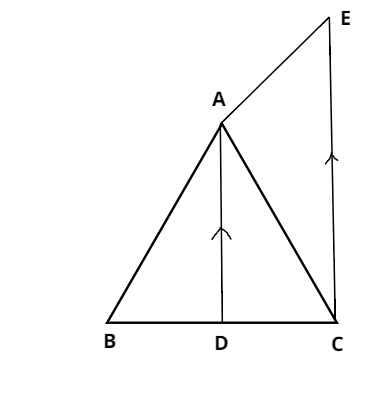
After the construction part is done, we can say that
$CE\parallel DA$ and AC is the transversal (By construction)
$\angle DAC = \angle ACE - - - - (1)$ (Alternate angles)
$\angle BAD = \angle AEC - - - - - (2)$ (Corresponding angles)
Since AD is the angle bisector of $\angle A$
Therefore we can say that $\angle BAD = \angle DAC - - - - - > (3)$
So from (1) (2) and (3) we say that
$\angle ACE = \angle AEC$
Now from triangle $\Delta ACE$
$ \Rightarrow AE = AC$ (Therefore sides opposite to equal angles are equal)
Again now from triangle BCE
$ \Rightarrow CE\parallel DA$
$ \Rightarrow \dfrac{{BD}}{{DC}} = \dfrac{{BA}}{{AE}}$ (By using Thales theorem)
$ \Rightarrow \dfrac{{BD}}{{DC}} = \dfrac{{AB}}{{AC}}$ (Since we know that AE=AC)
Hence we have proved that the internal bisector of an angle of a triangle divides the opposite side internally in the ratio of corresponding sides containing angles.
NOTE: This question is generally a theorem type question that we have to prove by considering the required concepts. For this type of proof question we have to do required construction to prove the condition. We generally take other theorems to prove the given theorem, in this theorem we have used Thales theorem and some required properties of triangles.
Complete step-by-step answer:
Let us consider a triangle ABC.
Here AD is the internal bisector of $\angle BAC$ which meets BC at D.
According to the question given
We have to prove that $\dfrac{{BD}}{{DC}} = \dfrac{{AB}}{{AC}}$
Now here let us do a simple construction which helps to prove the above condition.
Construction: Draw $CE\parallel DA$ to meet BA which produces at E.
After the construction part is done, we can say that
$CE\parallel DA$ and AC is the transversal (By construction)
$\angle DAC = \angle ACE - - - - (1)$ (Alternate angles)
$\angle BAD = \angle AEC - - - - - (2)$ (Corresponding angles)
Since AD is the angle bisector of $\angle A$
Therefore we can say that $\angle BAD = \angle DAC - - - - - > (3)$
So from (1) (2) and (3) we say that
$\angle ACE = \angle AEC$
Now from triangle $\Delta ACE$
$ \Rightarrow AE = AC$ (Therefore sides opposite to equal angles are equal)
Again now from triangle BCE
$ \Rightarrow CE\parallel DA$
$ \Rightarrow \dfrac{{BD}}{{DC}} = \dfrac{{BA}}{{AE}}$ (By using Thales theorem)
$ \Rightarrow \dfrac{{BD}}{{DC}} = \dfrac{{AB}}{{AC}}$ (Since we know that AE=AC)
Hence we have proved that the internal bisector of an angle of a triangle divides the opposite side internally in the ratio of corresponding sides containing angles.
NOTE: This question is generally a theorem type question that we have to prove by considering the required concepts. For this type of proof question we have to do required construction to prove the condition. We generally take other theorems to prove the given theorem, in this theorem we have used Thales theorem and some required properties of triangles.
Recently Updated Pages
Master Class 12 Business Studies: Engaging Questions & Answers for Success

Master Class 12 Biology: Engaging Questions & Answers for Success
Master Class 12 Chemistry: Engaging Questions & Answers for Success
Class 12 Question and Answer - Your Ultimate Solutions Guide
Master Class 11 Social Science: Engaging Questions & Answers for Success
Master Class 11 English: Engaging Questions & Answers for Success
Trending doubts
Explain the Treaty of Vienna of 1815 class 10 social science CBSE
Who Won 36 Oscar Awards? Record Holder Revealed
What is the median of the first 10 natural numbers class 10 maths CBSE
Why is it 530 pm in india when it is 1200 afternoon class 10 social science CBSE
The highest temperature in Karnataka is recorded in class 10 social science CBSE
Define Potential, Developed, Stock and Reserved resources