




The intermediates of Krebs cycle forms
(a) Nucleotides
(b) Amino acids
(c) Cytochrome
(d) All of the above
Answer
 Verified
637.8k+ views
Hint: In the citric acid cycle all the intermediates (e.g. citrate, iso-citrate, alpha-ketoglutarate, succinate, fumarate, malate, and oxaloacetate) are regenerated during each turn of the cycle.
Complete answer:Krebs cycle is also known as Citric Acid Cycle or Tricarboxylic Acid Cycle. It is used to oxidize the pyruvate formed during the glycolysis into carbon dioxide and water. It also oxidizes acetyl CoA which arises from breakdown of carbohydrate, lipid, and protein.Intermediate compounds formed during Krebs cycle are used for the synthesis of amino acids, nucleotides, chlorophyll, cytochromes and fats.
Oxaloacetate forms aspartate and asparagine amino acids. Alpha-ketoglutarate forms glutamine, proline and arginine amino acids.
Amino acids aspartate and glutamine are used to form the purines. Amino acid aspartate is used to form the pyrimidines. Intermediate succinyl CoA forms chlorophyll and cytochromes.
So,the correct answer is 'All of the above’
Note: The cycle of citric acid is a key metabolic pathway which connects the metabolism of carbohydrates , fats and proteins. The cycle reactions are carried out of two molecules each of carbon dioxide and water by eight enzymes that fully oxidize acetate (a two carbon molecule), in the form of acetyl-CoA.
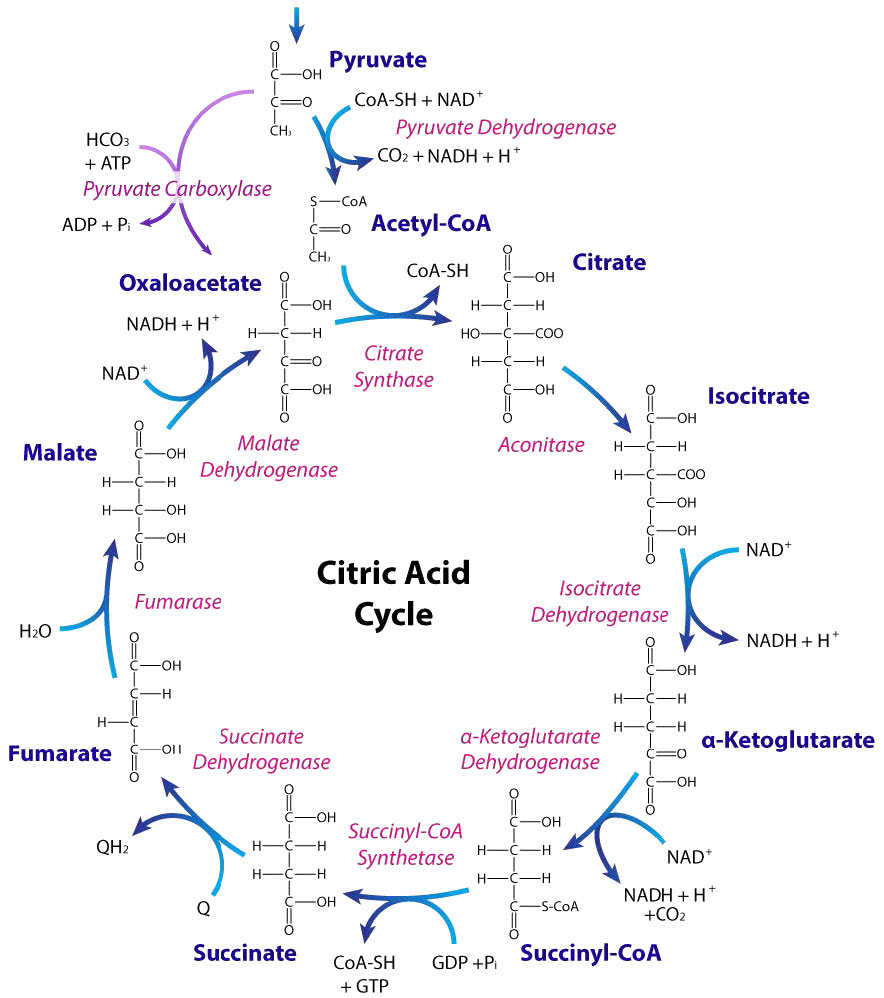
Complete answer:Krebs cycle is also known as Citric Acid Cycle or Tricarboxylic Acid Cycle. It is used to oxidize the pyruvate formed during the glycolysis into carbon dioxide and water. It also oxidizes acetyl CoA which arises from breakdown of carbohydrate, lipid, and protein.Intermediate compounds formed during Krebs cycle are used for the synthesis of amino acids, nucleotides, chlorophyll, cytochromes and fats.
Oxaloacetate forms aspartate and asparagine amino acids. Alpha-ketoglutarate forms glutamine, proline and arginine amino acids.
Amino acids aspartate and glutamine are used to form the purines. Amino acid aspartate is used to form the pyrimidines. Intermediate succinyl CoA forms chlorophyll and cytochromes.
So,the correct answer is 'All of the above’
Note: The cycle of citric acid is a key metabolic pathway which connects the metabolism of carbohydrates , fats and proteins. The cycle reactions are carried out of two molecules each of carbon dioxide and water by eight enzymes that fully oxidize acetate (a two carbon molecule), in the form of acetyl-CoA.
Recently Updated Pages
Master Class 5 English: Engaging Questions & Answers for Success

Master Class 5 Maths: Engaging Questions & Answers for Success
Master Class 5 Social Science: Engaging Questions & Answers for Success
Master Class 5 Science: Engaging Questions & Answers for Success
Class 5 Question and Answer - Your Ultimate Solutions Guide
Master Class 9 General Knowledge: Engaging Questions & Answers for Success
Trending doubts
Which are the Top 10 Largest Countries of the World?
The total number of vertebrae in man is a30 b31 c32 class 12 biology CBSE
Draw a labelled sketch of the human eye class 12 physics CBSE
The number of cranial nerves in a frog is A 10 pairs class 12 biology CBSE
Differentiate between homogeneous and heterogeneous class 12 chemistry CBSE
Antibodies present in colostrum which protect the new class 12 biology CBSE