




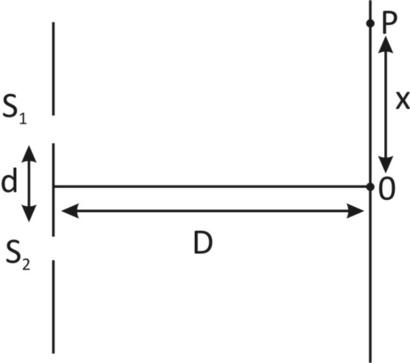
The intensity, at the central maxima (O) in a Young’s double slit set up is ${I_0}.$ If the distance OP equals one third of the fringe width of the pattern, show that the intensity, at point P, would equal \[{I_2}/4.\]
Answer
 Verified
617.4k+ views
Hint: Concept of Young’s double slit experiment and the variation of intensity from central maximum to decreasing values as we go away from centre O. Also the lights entering from slits are from the same source , so the intensity at both slits are taken the same.
Formula used:
1. $\beta = \dfrac{{\lambda D}}{d}$
2. Path difference $ = \dfrac{{2\pi }}{\lambda } \times $phase differences
\[\varphi = \dfrac{{2\pi }}{\lambda } \times \]Path differences
Complete step by step answer:
In the question the intensity at central maxima is \[{I_{0.}}\] and we know that maximum intensity is given by
${\operatorname{I} _{max}} = {I_0} = {\left( {\sqrt {{I_1}} + \sqrt {{I_2}} } \right)^2}$Where ${I_1}$ and ${I_2}$respectively.
Here, ${I_1} = {I_2} = I$ (say)
So, maximum intensity becomes,
${I_0} = {\left( {\sqrt I + \sqrt I } \right)^2}$
${I_0} = {\left( {2\sqrt I } \right)^2}$
${I_0} = 4\,I\,\,.........\left( 1 \right)$
Now, intensity at point P which is at a distance of x from O us given by
\[{I_p} = \left( {{I_2} + {I_2} + 2\sqrt {{I_1}} \,\sqrt {{I_2}} \,\cos \phi } \right)\]
Where $\varphi $is the phase difference between two waves.
Since, ${I_1} = {I_2} = I$
So, \[{I_P} = \left( {I + {I_2} + 2\sqrt I \sqrt 1 \cos \phi } \right)\]
$ = \left( {2I + 2I\,\,\cos \phi } \right)$
$ = 2I\left( {I + \cos \phi } \right)$
$ = 2I \times 2{\cos ^2}\phi /2$ (as $I + \cos \phi = 2{\cos ^2}\dfrac{\phi }{2}$)
${I_P} = 4I\,\,{\cos ^2}\dfrac{\phi }{2}\,\,........\left( 2 \right)$
From (1) and (2), we have
\[{I_P} = {I_0}{\cos ^2}\dfrac{\phi }{2}\]
Now, according to question, distance OP us one-third of the fringe width i.e. $x = \dfrac{1}{3}\beta $
Where $\beta $ is fringe width
Now, we know that fringe width is given by $\beta = \dfrac{{\lambda D}}{\alpha }$
So, distance OP becomes,
$x = \dfrac{1}{3}\beta \,\, = \,\dfrac{1}{3} \times \dfrac{{\lambda D}}{d}$
$x = \dfrac{{\lambda D}}{{3d}}$ and we know that path difference and phase difference are related as $2\pi \times $phase difference $ = \alpha \times $path difference
\[ \Rightarrow d = \dfrac{{2\pi }}{\lambda } \times \dfrac{{xd}}{D}\]
\[ \Rightarrow d = \dfrac{{2\pi }}{\lambda } \times \dfrac{{\lambda D}}{{3d}} \times \dfrac{d}{D}\]
$ \Rightarrow \phi = \dfrac{{2\pi }}{3}........\left( 3 \right)$
Put equation $\left( 3 \right)$ in equation$\left( 2 \right)$, we get
$I = {I_0}{\cos ^2}\left( {\dfrac{{2\pi }}{{\dfrac{3}{2}}}} \right)$
\[I = {I_0}{\cos ^2}\left( {\dfrac{\pi }{3}} \right)\]
$I = {I_0}{\left( {\dfrac{1}{2}} \right)^2}$
\[I = \dfrac{{{I_0}}}{4}\]
Hence Proved.
Note:
Remember that for the same source ${I_1} = {I_2}$and for different sources ${I_1} \ne {I_2}$ and the also remember that with change in path length there is corresponding change in phase also.
Formula used:
1. $\beta = \dfrac{{\lambda D}}{d}$
2. Path difference $ = \dfrac{{2\pi }}{\lambda } \times $phase differences
\[\varphi = \dfrac{{2\pi }}{\lambda } \times \]Path differences
Complete step by step answer:
In the question the intensity at central maxima is \[{I_{0.}}\] and we know that maximum intensity is given by
${\operatorname{I} _{max}} = {I_0} = {\left( {\sqrt {{I_1}} + \sqrt {{I_2}} } \right)^2}$Where ${I_1}$ and ${I_2}$respectively.
Here, ${I_1} = {I_2} = I$ (say)
So, maximum intensity becomes,
${I_0} = {\left( {\sqrt I + \sqrt I } \right)^2}$
${I_0} = {\left( {2\sqrt I } \right)^2}$
${I_0} = 4\,I\,\,.........\left( 1 \right)$
Now, intensity at point P which is at a distance of x from O us given by
\[{I_p} = \left( {{I_2} + {I_2} + 2\sqrt {{I_1}} \,\sqrt {{I_2}} \,\cos \phi } \right)\]
Where $\varphi $is the phase difference between two waves.
Since, ${I_1} = {I_2} = I$
So, \[{I_P} = \left( {I + {I_2} + 2\sqrt I \sqrt 1 \cos \phi } \right)\]
$ = \left( {2I + 2I\,\,\cos \phi } \right)$
$ = 2I\left( {I + \cos \phi } \right)$
$ = 2I \times 2{\cos ^2}\phi /2$ (as $I + \cos \phi = 2{\cos ^2}\dfrac{\phi }{2}$)
${I_P} = 4I\,\,{\cos ^2}\dfrac{\phi }{2}\,\,........\left( 2 \right)$
From (1) and (2), we have
\[{I_P} = {I_0}{\cos ^2}\dfrac{\phi }{2}\]
Now, according to question, distance OP us one-third of the fringe width i.e. $x = \dfrac{1}{3}\beta $
Where $\beta $ is fringe width
Now, we know that fringe width is given by $\beta = \dfrac{{\lambda D}}{\alpha }$
So, distance OP becomes,
$x = \dfrac{1}{3}\beta \,\, = \,\dfrac{1}{3} \times \dfrac{{\lambda D}}{d}$
$x = \dfrac{{\lambda D}}{{3d}}$ and we know that path difference and phase difference are related as $2\pi \times $phase difference $ = \alpha \times $path difference
\[ \Rightarrow d = \dfrac{{2\pi }}{\lambda } \times \dfrac{{xd}}{D}\]
\[ \Rightarrow d = \dfrac{{2\pi }}{\lambda } \times \dfrac{{\lambda D}}{{3d}} \times \dfrac{d}{D}\]
$ \Rightarrow \phi = \dfrac{{2\pi }}{3}........\left( 3 \right)$
Put equation $\left( 3 \right)$ in equation$\left( 2 \right)$, we get
$I = {I_0}{\cos ^2}\left( {\dfrac{{2\pi }}{{\dfrac{3}{2}}}} \right)$
\[I = {I_0}{\cos ^2}\left( {\dfrac{\pi }{3}} \right)\]
$I = {I_0}{\left( {\dfrac{1}{2}} \right)^2}$
\[I = \dfrac{{{I_0}}}{4}\]
Hence Proved.
Note:
Remember that for the same source ${I_1} = {I_2}$and for different sources ${I_1} \ne {I_2}$ and the also remember that with change in path length there is corresponding change in phase also.
Recently Updated Pages
Master Class 12 Economics: Engaging Questions & Answers for Success

Master Class 12 English: Engaging Questions & Answers for Success
Master Class 12 Social Science: Engaging Questions & Answers for Success
Master Class 12 Maths: Engaging Questions & Answers for Success
Master Class 12 Physics: Engaging Questions & Answers for Success
Master Class 9 General Knowledge: Engaging Questions & Answers for Success
Trending doubts
Which are the Top 10 Largest Countries of the World?
Draw a labelled sketch of the human eye class 12 physics CBSE
Differentiate between homogeneous and heterogeneous class 12 chemistry CBSE
Sulphuric acid is known as the king of acids State class 12 chemistry CBSE
Why is the cell called the structural and functional class 12 biology CBSE
Draw ray diagrams each showing i myopic eye and ii class 12 physics CBSE