




The important muscle proteins that help in the movement are
A. Actin and myosin
B. Tropomyosin
C. Troponin
D. All of these
Answer
 Verified
572.4k+ views
Hint: Motor proteins that are responsible for muscle contraction are ATP-dependent and are responsible for the motility. They form the building block of thick and thin filaments of the sarcomere.
Complete answer: A myofibril or myofilament is a characteristic feature of muscle fiber and has a large number of parallelly arranged filaments. Each myofilament has alternate light and dark bands. The light band is known as an I or isotropic band and contains actin whereas the dark band is known as an A or anisotropic band contains myosin. Proteins are arranged as rod-like structures, along the longitudinal axis of the myofibrils. Actin filaments are also known as thin filaments while myosin filaments are known as thick filaments. An elastic fiber known as the Z line bisects the I band in the center whereas the fibres of the A band are also attached to a thin fibrous membrane known as the M line. Along the length of myofibrils, A and I bands are arranged alternatively. The portion of myofibril between two Z lines is known as a sarcomere.
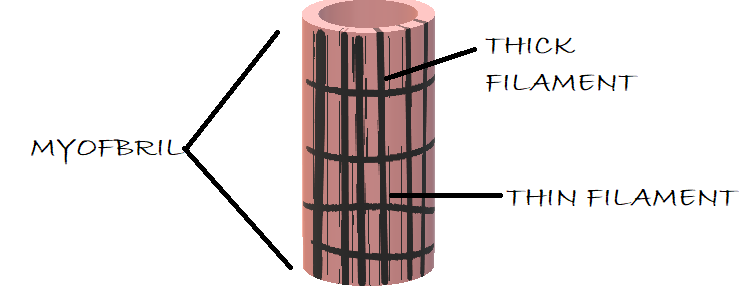 Two filamentous or F actin helically wound to each other to form an actin filament. The monomer G or globular actin polymerizes to form an F actin. Two filaments of tropomyosin run along the actin filaments. Troponin is a complex protein that is distributed at regular intervals along the tropomyosin. Hence, the correct option is (D)-All of these.
Note: Striated muscle tissue contains a complex unit of contraction known as a sarcomere. A single sarcomere contains many myofibrils that are made of actin and myosin. The length of the muscle changes due to modification of proteins which results in an overall change. These filaments help in conducting cellular movements.
Complete answer: A myofibril or myofilament is a characteristic feature of muscle fiber and has a large number of parallelly arranged filaments. Each myofilament has alternate light and dark bands. The light band is known as an I or isotropic band and contains actin whereas the dark band is known as an A or anisotropic band contains myosin. Proteins are arranged as rod-like structures, along the longitudinal axis of the myofibrils. Actin filaments are also known as thin filaments while myosin filaments are known as thick filaments. An elastic fiber known as the Z line bisects the I band in the center whereas the fibres of the A band are also attached to a thin fibrous membrane known as the M line. Along the length of myofibrils, A and I bands are arranged alternatively. The portion of myofibril between two Z lines is known as a sarcomere.
Note: Striated muscle tissue contains a complex unit of contraction known as a sarcomere. A single sarcomere contains many myofibrils that are made of actin and myosin. The length of the muscle changes due to modification of proteins which results in an overall change. These filaments help in conducting cellular movements.
Recently Updated Pages
Master Class 11 Business Studies: Engaging Questions & Answers for Success

Master Class 11 Computer Science: Engaging Questions & Answers for Success
Master Class 11 Economics: Engaging Questions & Answers for Success
Master Class 11 Social Science: Engaging Questions & Answers for Success
Master Class 11 English: Engaging Questions & Answers for Success
Master Class 11 Chemistry: Engaging Questions & Answers for Success
Trending doubts
Draw a diagram of nephron and explain its structur class 11 biology CBSE
Explain zero factorial class 11 maths CBSE
Chemical formula of Bleaching powder is A Ca2OCl2 B class 11 chemistry CBSE
Name the part of the brain responsible for the precision class 11 biology CBSE
The growth of tendril in pea plants is due to AEffect class 11 biology CBSE
One Metric ton is equal to kg A 10000 B 1000 C 100 class 11 physics CBSE