




The image formed by a convex mirror is always:
A. erect, virtual, large.
B. erect, virtual, diminished.
C. upright, virtual.
D. none of the above.
Answer
 Verified
646.2k+ views
Hint: We need to know the principle of image forming of a convex mirror to solve this problem. The convex mirror is a spherical mirror in which light reflects on the convex surface (or bubbles out of the air).
Complete step-by-step solution -
Image is an optical illusion that is created when a mirror reflects light rays coming from an object.
We know that the image you can get on a screen is called a true image. The image not obtainable on a screen is called a virtual image.
The rules of obtaining images formed by a convex mirror are:
Rule 1. A beam of light parallel to a convex mirror 's main axis tends to come from its focus after mirror reflection.
Rule 2. A ray of light going towards the center of curvature of a convex mirror is reflected back along the same path.
Rule 3. A ray of light going towards the focus of the convex mirror becomes parallel to the principal axis after reflection.
Rule 4. A ray of light which is incident at the pole of a convex mirror is reflected back making the same angle with the principal axis.
Whatever the position of the object in front of a convex mirror in a convex mirror, the image formed by a convex mirror is always behind the mirror, it is virtual, erect, and smaller than the object itself. (Or shrunk).
In the figure below, the formation of an image by a convex mirror is shown when the object is placed anywhere between the pole of the mirror and infinity.
The image created by a convex mirror is thus always virtual, erect, and diminished.
So choice (B) is the correct one.
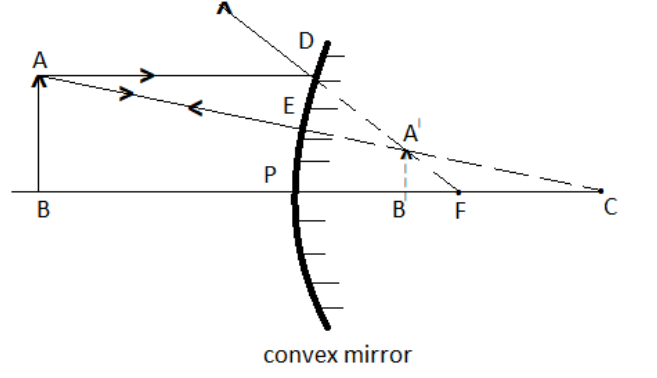
Note: If we ask questions of this kind, we must first note that the image formed behind the mirror is always virtual and erect and that the image formed in front of the mirror is always real and inverted. We should realize that a convex mirror still shapes behind the mirror images. We will be getting the answer through this.
Complete step-by-step solution -
Image is an optical illusion that is created when a mirror reflects light rays coming from an object.
We know that the image you can get on a screen is called a true image. The image not obtainable on a screen is called a virtual image.
The rules of obtaining images formed by a convex mirror are:
Rule 1. A beam of light parallel to a convex mirror 's main axis tends to come from its focus after mirror reflection.
Rule 2. A ray of light going towards the center of curvature of a convex mirror is reflected back along the same path.
Rule 3. A ray of light going towards the focus of the convex mirror becomes parallel to the principal axis after reflection.
Rule 4. A ray of light which is incident at the pole of a convex mirror is reflected back making the same angle with the principal axis.
Whatever the position of the object in front of a convex mirror in a convex mirror, the image formed by a convex mirror is always behind the mirror, it is virtual, erect, and smaller than the object itself. (Or shrunk).
In the figure below, the formation of an image by a convex mirror is shown when the object is placed anywhere between the pole of the mirror and infinity.
The image created by a convex mirror is thus always virtual, erect, and diminished.
So choice (B) is the correct one.
Note: If we ask questions of this kind, we must first note that the image formed behind the mirror is always virtual and erect and that the image formed in front of the mirror is always real and inverted. We should realize that a convex mirror still shapes behind the mirror images. We will be getting the answer through this.
Recently Updated Pages
Master Class 11 English: Engaging Questions & Answers for Success

Master Class 11 Social Science: Engaging Questions & Answers for Success
Master Class 11 Maths: Engaging Questions & Answers for Success
Master Class 11 Biology: Engaging Questions & Answers for Success
Master Class 11 Physics: Engaging Questions & Answers for Success
Master Class 11 Chemistry: Engaging Questions & Answers for Success
Trending doubts
First Cotton Mill of India
What planets have no moons Which one has only one moon class 10 physics CBSE
In cricket, which Indian bowler is known as the "Yorker King"?
Who was the first Indian ruler to enter into the Subsidiary class 10 social science CBSE
Digdarshan the first monthly magazine in Marathi was class 10 social science CBSE
Draw the diagram of the sectional view of the human class 10 biology CBSE