




The hysteresis cycle curve for the material of a permanent magnet is:
(A) Short and wide
(B) Tall and narrow
(C) Tall and wide
(D) Short narrow
Answer
 Verified
595.2k+ views
Hint: Whenever there is given a type of magnet and the hysteresis loop is asked, try to figure the material out of which the magnet is made. Generally, a permanent magnet is made up of ferromagnetic materials such as iron, cobalt, nickel, etc. The properties of permanent magnet is large retentivity and large coercivity. Hence, the hysteresis cycle curve will have large values of M when H=0 and large H when M=0.
Complete step by step answer:
The hysteresis loop is the curve relating magnetization of a material and the applied magnetic field on the material. One such hysteresis loop is given below:
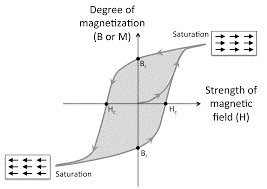
The intensity of magnetic field (H) is increased first from a state of zero magnetization. When it reaches a somewhat constant value, H is decreased to zero. Here we see that due to applied magnetic field there is an induced magnetization B. this is due to the fact that the individual domains in the material are aligned along the direction of applied magnetic field. This value of B is called the retentivity of material. It is defined as the magnetization of material when the magnetic field is zero. Magnets made of ferromagnetic materials have large retentivity while certain metals and insulators have low retentivity.
When the intensity of applied magnetic field is further reduced i.e. the direction of magnetic field is reversed then the magnetization starts to reduce and eventually goes to zero. The value at which this happens is known as coercivity of the material. It is defined as the magnetic field required to demagnetize the material. Materials like soft iron have very low coercivity while cobalt iron has large coercivity.
Obviously, a permanent magnet has large coercivity or else it would have been easily demagnetized even in Earth’s magnetic field and wouldn’t have been permanent anymore. While materials like soft iron have small coercivity and hence are used in electromagnets and transformers (to reduce hysteresis loss). It changes its alignment very rapidly according to the applied magnetic field.
Further the H is increased again which traces the given curve as shown. Hence the closed curve is known as hysteresis loop. The permanent magnet has high retentivity as well as high coercivity and therefore the hysteresis curve will be both tall and wide.
The correct answer is option C.
Note:Whenever confused in figuring out the shape of hysteresis loop, begin again from the very basic i.e. the type of material used in the magnet (diamagnetic, ferromagnetic, ferrimagnetic, etc.). Then, see how the domains of the material will react in a given magnetic field and by implying conditions like M=0 or H=0 figure out the curve. Only find one half of the curve, the other half is just a mirror image on the y-axis (B or M axis).
Complete step by step answer:
The hysteresis loop is the curve relating magnetization of a material and the applied magnetic field on the material. One such hysteresis loop is given below:
The intensity of magnetic field (H) is increased first from a state of zero magnetization. When it reaches a somewhat constant value, H is decreased to zero. Here we see that due to applied magnetic field there is an induced magnetization B. this is due to the fact that the individual domains in the material are aligned along the direction of applied magnetic field. This value of B is called the retentivity of material. It is defined as the magnetization of material when the magnetic field is zero. Magnets made of ferromagnetic materials have large retentivity while certain metals and insulators have low retentivity.
When the intensity of applied magnetic field is further reduced i.e. the direction of magnetic field is reversed then the magnetization starts to reduce and eventually goes to zero. The value at which this happens is known as coercivity of the material. It is defined as the magnetic field required to demagnetize the material. Materials like soft iron have very low coercivity while cobalt iron has large coercivity.
Obviously, a permanent magnet has large coercivity or else it would have been easily demagnetized even in Earth’s magnetic field and wouldn’t have been permanent anymore. While materials like soft iron have small coercivity and hence are used in electromagnets and transformers (to reduce hysteresis loss). It changes its alignment very rapidly according to the applied magnetic field.
Further the H is increased again which traces the given curve as shown. Hence the closed curve is known as hysteresis loop. The permanent magnet has high retentivity as well as high coercivity and therefore the hysteresis curve will be both tall and wide.
The correct answer is option C.
Note:Whenever confused in figuring out the shape of hysteresis loop, begin again from the very basic i.e. the type of material used in the magnet (diamagnetic, ferromagnetic, ferrimagnetic, etc.). Then, see how the domains of the material will react in a given magnetic field and by implying conditions like M=0 or H=0 figure out the curve. Only find one half of the curve, the other half is just a mirror image on the y-axis (B or M axis).
Recently Updated Pages
Master Class 12 Social Science: Engaging Questions & Answers for Success

Master Class 12 Physics: Engaging Questions & Answers for Success
Master Class 12 Maths: Engaging Questions & Answers for Success
Master Class 12 Economics: Engaging Questions & Answers for Success
Master Class 12 Chemistry: Engaging Questions & Answers for Success
Master Class 12 Business Studies: Engaging Questions & Answers for Success
Trending doubts
Which are the Top 10 Largest Countries of the World?
Draw a labelled sketch of the human eye class 12 physics CBSE
Explain the structure of megasporangium class 12 biology CBSE
What are the major means of transport Explain each class 12 social science CBSE
How many chromosomes are found in human ovum a 46 b class 12 biology CBSE
The diagram of the section of a maize grain is given class 12 biology CBSE