




The hyper conjugative stabilities of tert-butyl cation and $2$-butene, respectively, are due to:
A. $\sigma \to p$ (empty) and $\sigma \to {{\pi }^{*}}$ electron delocalisations.
B. $\sigma \to {{\sigma }^{*}}$ and $\sigma \to \pi $ electron delocalisations.
C. $\sigma \to p$ (filled) and $\sigma \to \pi $ electron delocalisations.
D. $p (filled)\to {{\sigma }^{*}}$ and $\sigma \to {{\pi }^{*}}$ electron delocalisations.
Answer
 Verified
647.4k+ views
Hint: To find out the correct option for the given question, you have to state what is hyperconjugation and what is the reason behind the hyperconjugation. Try to state about the interaction of the electrons present in different orbitals.
Complete step by step answer:
So, to find the appropriate solution let us first know about what is hyperconjugation.
Hyperconjugation is the stabilising interaction which further results from the interaction of the electrons in a sigma bond, which is denoted by $\sigma $ (usually between a carbon and hydrogen atom or a carbon and carbon atom) with an adjacent empty or partially filled non-bonding p-orbital or an antibonding $\pi $ orbital or filled $\pi $ orbital, to give an extended molecular orbital that increases that stability of the system or compound. So, the hyperconjugation ultimately results in the extended molecular orbital and increases the stability of the compound.
So, we can say that the systems containing a delocalisation in $\sigma \to p$(empty) orbital or $\sigma \to p$(partly filled) orbital or $\sigma \to {{\pi }^{*}}$ orbital or in $\sigma \to \pi $ orbital will tend to give an extended molecular orbital and increase their stability.
Now, let us look on the compounds given in the question and see what type of delocalisation they have.
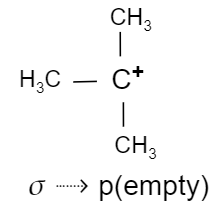
So, in case of tert-butyl cation, the hyperconjugation is due to the interaction of the electrons in the $\sigma $ bond with the adjacent empty p-orbital.
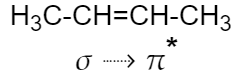
While in case of $2$-butene, the hyperconjugation is due to the interaction of $\sigma $ orbital electrons with the antibonding $\pi $ orbital electrons (${{\pi }^{*}}$).
Therefore, the hyper conjugative stabilities of tert-butyl cation and $2$-butene, respectively, are due to $\sigma \to p$ (empty) and $\sigma \to {{\pi }^{*}}$ electron delocalisations.
So, the correct answer is “Option A”.
Note: The stabilisation due to hyperconjugation arises because the orbital interaction leads to the electrons being in a lower energy orbital. The more hyperconjugation there is, the greater the stabilisation of the system. It is also known as “no bond resonance”.
Complete step by step answer:
So, to find the appropriate solution let us first know about what is hyperconjugation.
Hyperconjugation is the stabilising interaction which further results from the interaction of the electrons in a sigma bond, which is denoted by $\sigma $ (usually between a carbon and hydrogen atom or a carbon and carbon atom) with an adjacent empty or partially filled non-bonding p-orbital or an antibonding $\pi $ orbital or filled $\pi $ orbital, to give an extended molecular orbital that increases that stability of the system or compound. So, the hyperconjugation ultimately results in the extended molecular orbital and increases the stability of the compound.
So, we can say that the systems containing a delocalisation in $\sigma \to p$(empty) orbital or $\sigma \to p$(partly filled) orbital or $\sigma \to {{\pi }^{*}}$ orbital or in $\sigma \to \pi $ orbital will tend to give an extended molecular orbital and increase their stability.
Now, let us look on the compounds given in the question and see what type of delocalisation they have.
So, in case of tert-butyl cation, the hyperconjugation is due to the interaction of the electrons in the $\sigma $ bond with the adjacent empty p-orbital.
While in case of $2$-butene, the hyperconjugation is due to the interaction of $\sigma $ orbital electrons with the antibonding $\pi $ orbital electrons (${{\pi }^{*}}$).
Therefore, the hyper conjugative stabilities of tert-butyl cation and $2$-butene, respectively, are due to $\sigma \to p$ (empty) and $\sigma \to {{\pi }^{*}}$ electron delocalisations.
So, the correct answer is “Option A”.
Note: The stabilisation due to hyperconjugation arises because the orbital interaction leads to the electrons being in a lower energy orbital. The more hyperconjugation there is, the greater the stabilisation of the system. It is also known as “no bond resonance”.
Recently Updated Pages
If x a + bt + ct2 where x is in meters and t is in class 11 physics CBSE

A car covers the first half distance between two places class 11 physics CBSE
The resultant of two vectors overrightarrow P and overrightarrow class 11 physics CBSE
Find the value of cos 135 class 11 maths CBSE
A mass M is held in place by an applied force F and class 11 physics CBSE
A solution of glucose in water is labelled as 10 dfracwv class 11 chemistry CBSE
Trending doubts
One Metric ton is equal to kg A 10000 B 1000 C 100 class 11 physics CBSE
Find the value of the expression given below sin 30circ class 11 maths CBSE
Draw a diagram of nephron and explain its structur class 11 biology CBSE
10 examples of friction in our daily life
Proton was discovered by A Thomson B Rutherford C Chadwick class 11 chemistry CBSE
Bond order ofO2 O2+ O2 and O22 is in order A O2 langle class 11 chemistry CBSE