




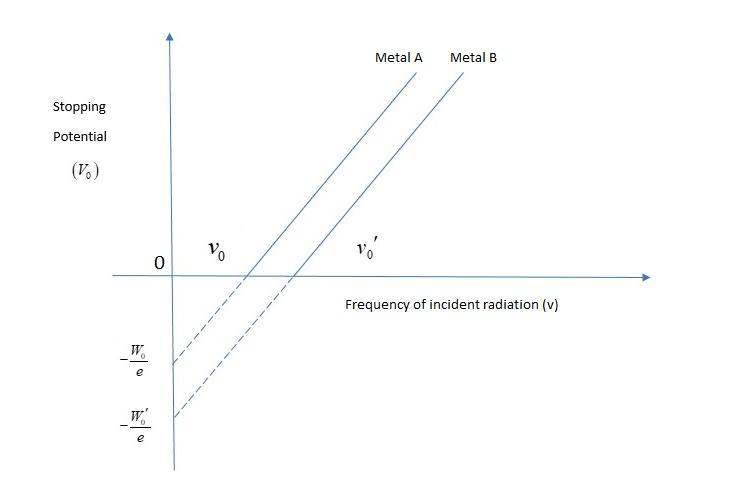
The graph shows variation of stopping potential \[{V_0}\] versus frequency of incident radiation for two photosensitive metals A and B. Which of the two metals has higher threshold frequency and why?
Answer
 Verified
536.5k+ views
- Hint: Here we will proceed by defining the term threshold frequency and then we will be discussing which metal has high threshold frequency by using the given graph and explaining the exact reasons.
Complete step-by-step solution -
Threshold frequency: The threshold frequency is defined as the minimum frequency of incident radiation below which the photoelectric emission is not possible completely, irrespective of the incident radiation i.e., this frequency is just able to eject electrons without giving them additional energy.
Also stopping potential is the potential necessary to stop any electron from reaching the outside.
As the frequency increases stopping potential also increases. At zero stopping potential the frequency of incident radiation is more to metal A. Both the metals have the same stopping potential at different frequencies and this frequency is more than metal A. So, metal A has a higher threshold frequency.
Thus, metal A has high threshold frequency.
Note: Stopping potential is defined as the potential required to stop ejection of electrons from a metal surface to stop ejection of electrons from a metal surface when an incident beam of energy greater than the work potential of metal is directed on it.
Complete step-by-step solution -
Threshold frequency: The threshold frequency is defined as the minimum frequency of incident radiation below which the photoelectric emission is not possible completely, irrespective of the incident radiation i.e., this frequency is just able to eject electrons without giving them additional energy.
Also stopping potential is the potential necessary to stop any electron from reaching the outside.
As the frequency increases stopping potential also increases. At zero stopping potential the frequency of incident radiation is more to metal A. Both the metals have the same stopping potential at different frequencies and this frequency is more than metal A. So, metal A has a higher threshold frequency.
Thus, metal A has high threshold frequency.
Note: Stopping potential is defined as the potential required to stop ejection of electrons from a metal surface to stop ejection of electrons from a metal surface when an incident beam of energy greater than the work potential of metal is directed on it.
Recently Updated Pages
Basicity of sulphurous acid and sulphuric acid are

Master Class 12 English: Engaging Questions & Answers for Success
Master Class 12 Social Science: Engaging Questions & Answers for Success
Master Class 12 Maths: Engaging Questions & Answers for Success
Master Class 12 Economics: Engaging Questions & Answers for Success
Master Class 12 Physics: Engaging Questions & Answers for Success
Trending doubts
Draw a labelled sketch of the human eye class 12 physics CBSE
Which are the Top 10 Largest Countries of the World?
Draw ray diagrams each showing i myopic eye and ii class 12 physics CBSE
Giving reasons state the signs positive or negative class 12 physics CBSE
Explain esterification reaction with the help of a class 12 chemistry CBSE
What is defined as a solenoid Depict a diagram with class 12 physics CBSE