




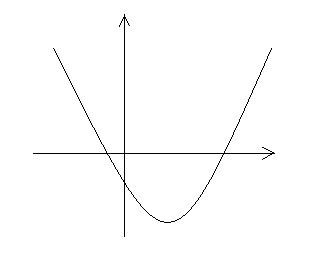
The graph of the quadratic polynomial; y = $ a{{x}^{2}} $ + bx + c is as shown in the figure. Then:
A. $ {{b}^{2}} $ − 4ac > 0
B. b > 0
C. a < 0
D. All of these.
Answer
 Verified
593.7k+ views
Hint: Observe that the parabola is opening upwards which means that the values of y are increasing in the positive direction. What does it tell about the coefficient a of the term $ a{{x}^{2}} $ ?
Locate the position of the roots of the parabola. Are real roots real or imaginary (no real roots)? What does it tell about the value of the discriminant $ {{b}^{2}} $ − 4ac?
Complete step-by-step answer:
It should be observed that the value of $ {{x}^{2}} $ is always positive and greater than the terms bx and c for large magnitudes of x. Therefore, the sign of the multiplier a in the term $ a{{x}^{2}} $ , decides whether the value of y will move in the positive or negative direction for an increase in the magnitude of x in either direction. This is illustrated in the following graphs:
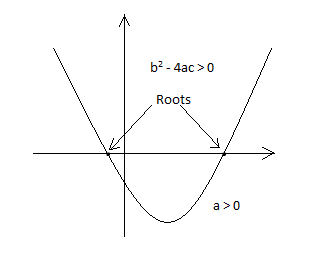
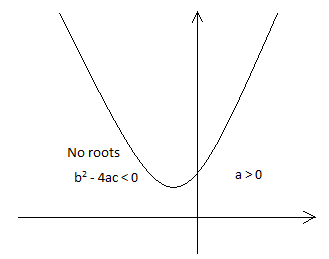
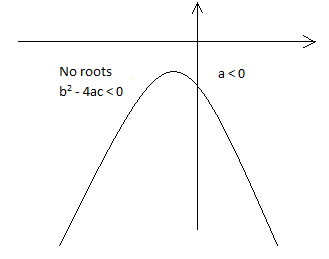
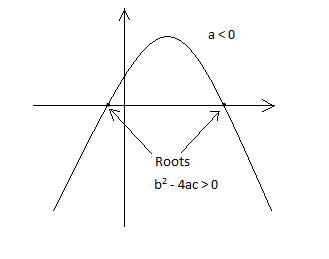
Since the given graph has two real roots and it opens upwards in the positive direction, we can conclude that a > 0 and $ {{b}^{2}} $ − 4ac > 0 (see Note below).
The correct answer is A. $ {{b}^{2}} $ − 4ac > 0.
Note: The roots (also called as zeros, y = 0) of the quadratic equation $ a{{x}^{2}} $ + bx + c = 0 are given by x = $ \dfrac{-b\pm \sqrt{{{b}^{2}}-4ac}}{2a} $ . The quantity $ {{b}^{2}} $ − 4ac is called the discriminant of the equation and determines the nature of its roots.
If $ {{b}^{2}} $ − 4ac ≥ 0, the roots are real.
If $ {{b}^{2}} $ − 4ac = 0, the roots are real and equal.
If $ {{b}^{2}} $ − 4ac < 0, the roots are complex and conjugates of each other.
Locate the position of the roots of the parabola. Are real roots real or imaginary (no real roots)? What does it tell about the value of the discriminant $ {{b}^{2}} $ − 4ac?
Complete step-by-step answer:
It should be observed that the value of $ {{x}^{2}} $ is always positive and greater than the terms bx and c for large magnitudes of x. Therefore, the sign of the multiplier a in the term $ a{{x}^{2}} $ , decides whether the value of y will move in the positive or negative direction for an increase in the magnitude of x in either direction. This is illustrated in the following graphs:
Since the given graph has two real roots and it opens upwards in the positive direction, we can conclude that a > 0 and $ {{b}^{2}} $ − 4ac > 0 (see Note below).
The correct answer is A. $ {{b}^{2}} $ − 4ac > 0.
Note: The roots (also called as zeros, y = 0) of the quadratic equation $ a{{x}^{2}} $ + bx + c = 0 are given by x = $ \dfrac{-b\pm \sqrt{{{b}^{2}}-4ac}}{2a} $ . The quantity $ {{b}^{2}} $ − 4ac is called the discriminant of the equation and determines the nature of its roots.
If $ {{b}^{2}} $ − 4ac ≥ 0, the roots are real.
If $ {{b}^{2}} $ − 4ac = 0, the roots are real and equal.
If $ {{b}^{2}} $ − 4ac < 0, the roots are complex and conjugates of each other.
Recently Updated Pages
Master Class 10 English: Engaging Questions & Answers for Success

Master Class 10 Social Science: Engaging Questions & Answers for Success
Master Class 10 Computer Science: Engaging Questions & Answers for Success
Class 10 Question and Answer - Your Ultimate Solutions Guide
Master Class 10 General Knowledge: Engaging Questions & Answers for Success
Master Class 10 Maths: Engaging Questions & Answers for Success
Trending doubts
Explain the Treaty of Vienna of 1815 class 10 social science CBSE
Who Won 36 Oscar Awards? Record Holder Revealed
What is the median of the first 10 natural numbers class 10 maths CBSE
Why is it 530 pm in india when it is 1200 afternoon class 10 social science CBSE
Make a sketch of the human nerve cell What function class 10 biology CBSE
Define Potential, Developed, Stock and Reserved resources