




The given diagram represents the mechanism of action for two categories of hormones. Which of the following options correctly identifies the label A to I?
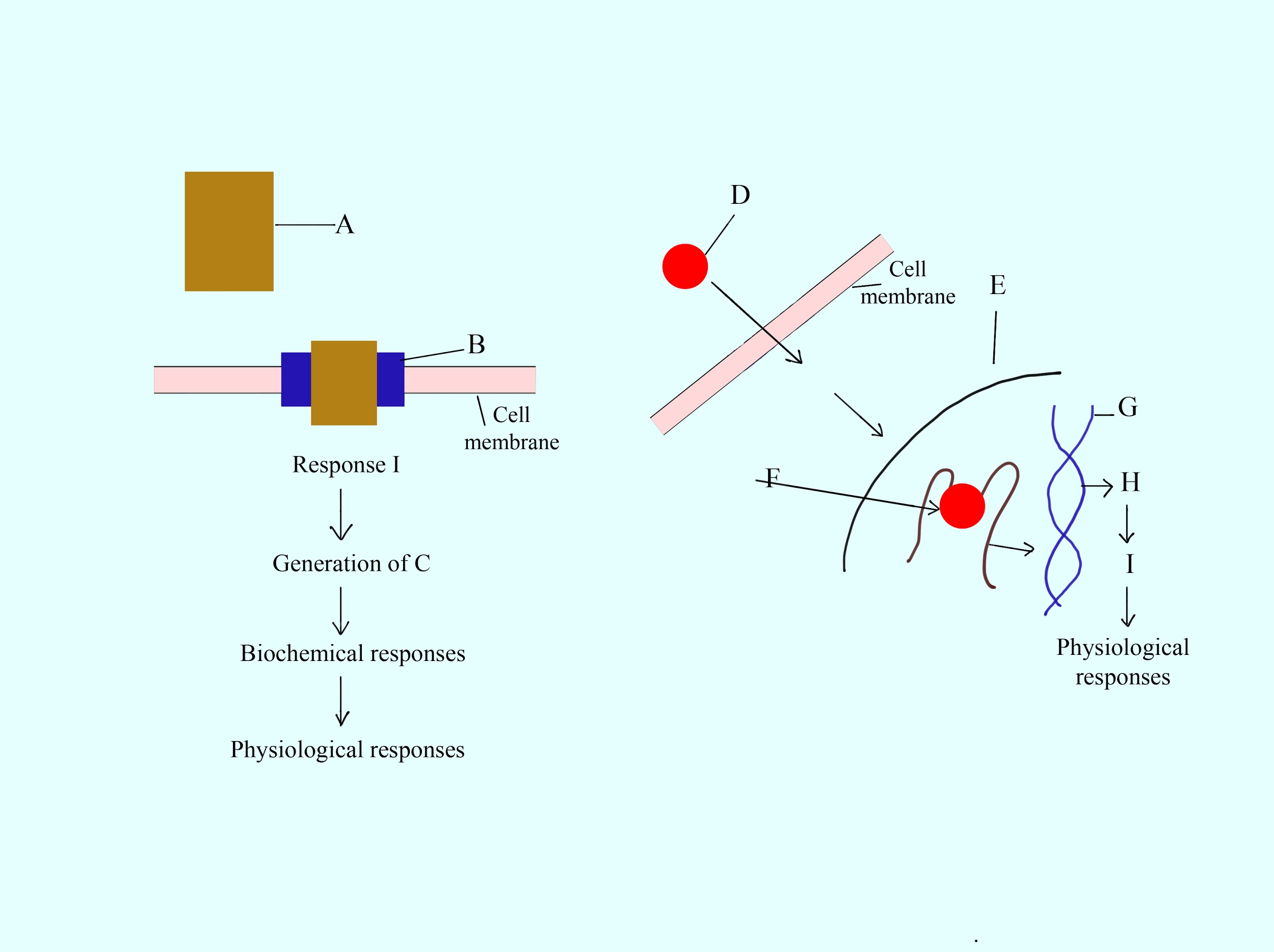
(a) A- Steroid hormone, B-Receptor, C-Secondary messenger, D-Non-steroid hormone, E-Nucleus, F-Hormone-receptor complex, G-Genome, H-mRNA, I-protein
(b) A- Non-Steroid hormone, B-Receptor, C-Secondary messenger, D-Steroid hormone, E-Nucleus, F-Hormone-receptor complex, G-Genome, H-mRNA, I-protein
(c) A-Steroid hormone, B-Receptor, C-primary messenger, D-Non-steroid hormone, E-Nucleus, F-Hormone-receptor complex, G-Genome, H-mRNA, I-protein
(d) A-Steroid hormone, B-enzyme, C-Secondary messenger, D-Non-steroid hormone, E-Nucleus, F-Hormone-receptor complex, G-Genome, H-mRNA, I-protein
Answer
 Verified
596.4k+ views
Hint: Most of the endocrine hormones are involved in the first shown pathway and most of the sex organs are involved in the second signaling pathway shown above. The peptide hormones are polar and stored in vesicles whereas the hormones involved at the nuclear level are secreted immediately.
Complete step by step answer:
- Steroid hormones are lipids so they can easily cross the cell membrane
- Once inside, it binds to a steroid receptor protein and forms a hormone-receptor complex.
- Steroid hormones act by entering the nucleus of a cell and changing the pattern of gene expression.mRNA is produced after activating specific target genes.
- The mRNA moves into the cytoplasm and directs protein synthesis.
- Non-steroid hormones consist of amino acids that are the reason why they are not fat-soluble, and can not diffuse across the plasma membrane of target cells.
- A nonsteroid hormone binds to receptors on the cell membrane.
- The binding of the hormone activates enzymes on the inner surface of the cell membrane.
- These enzymes release secondary messengers to relay the hormone’s message within the cell.
- These secondary messengers can activate or inhibit a wide range of cell activities.
- The signaling of the non-steroid pathway is fast while the steroid signaling pathway is slow.
So, the correct answer is ‘A-Non-Steroid hormone, B-Receptor, C-Secondary messenger, D-Steroid hormone, E-Nucleus, F-Hormone-receptor complex, G-Genome, H-mRNA, I-protein.’
Note:
- Glucocorticoids, mineralocorticoids, androgens, estrogens, and progestogens are steroid hormones.
- Secondary messengers include cyclic AMP (cAMP), calcium ions, nitric oxide (NO), and protein kinases.
- The use of second messengers enables the amplification of the initial original signal.
- Peptide hormones include insulin, glucagon, leptin, ADH, and oxytocin.
Complete step by step answer:
- Steroid hormones are lipids so they can easily cross the cell membrane
- Once inside, it binds to a steroid receptor protein and forms a hormone-receptor complex.
- Steroid hormones act by entering the nucleus of a cell and changing the pattern of gene expression.mRNA is produced after activating specific target genes.
- The mRNA moves into the cytoplasm and directs protein synthesis.
- Non-steroid hormones consist of amino acids that are the reason why they are not fat-soluble, and can not diffuse across the plasma membrane of target cells.
- A nonsteroid hormone binds to receptors on the cell membrane.
- The binding of the hormone activates enzymes on the inner surface of the cell membrane.
- These enzymes release secondary messengers to relay the hormone’s message within the cell.
- These secondary messengers can activate or inhibit a wide range of cell activities.
- The signaling of the non-steroid pathway is fast while the steroid signaling pathway is slow.
So, the correct answer is ‘A-Non-Steroid hormone, B-Receptor, C-Secondary messenger, D-Steroid hormone, E-Nucleus, F-Hormone-receptor complex, G-Genome, H-mRNA, I-protein.’
Note:
- Glucocorticoids, mineralocorticoids, androgens, estrogens, and progestogens are steroid hormones.
- Secondary messengers include cyclic AMP (cAMP), calcium ions, nitric oxide (NO), and protein kinases.
- The use of second messengers enables the amplification of the initial original signal.
- Peptide hormones include insulin, glucagon, leptin, ADH, and oxytocin.
Recently Updated Pages
Master Class 11 Social Science: Engaging Questions & Answers for Success

Master Class 11 Physics: Engaging Questions & Answers for Success
Master Class 11 Maths: Engaging Questions & Answers for Success
Master Class 11 Economics: Engaging Questions & Answers for Success
Master Class 11 Computer Science: Engaging Questions & Answers for Success
Master Class 11 Chemistry: Engaging Questions & Answers for Success
Trending doubts
One Metric ton is equal to kg A 10000 B 1000 C 100 class 11 physics CBSE
There are 720 permutations of the digits 1 2 3 4 5 class 11 maths CBSE
1 Quintal is equal to a 110 kg b 10 kg c 100kg d 1000 class 11 physics CBSE
State and prove Bernoullis theorem class 11 physics CBSE
Difference Between Prokaryotic Cells and Eukaryotic Cells
Which among the following are examples of coming together class 11 social science CBSE