




The gene ‘rop’ present in pBR322 cloning vector, codes for
(a) The protein involved in the translation
(b) The protein involved in the replication of the plasmid
(c) The protein involved in the synthesis of the ampicillin only
(d) The proteins involved in the synthesis of tetracycline only
Answer
 Verified
657k+ views
Hint: Cloning vectors are used to pass the recombinant DNA to the host cell for the multiplication. The different genes present in the vector have different functions.
Complete answer:
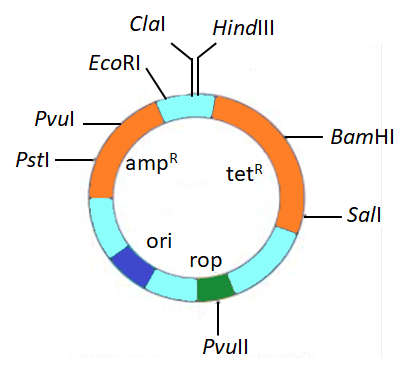
The ‘rop’ gene which is present in the pBR322 codes for the rop protein. Its main function is in decreasing the copy number and so this gene is involved in the replication of the plasmid.
Additional information:
-When a plasmid is used to make copies of a foreign DNA sequence, it is called a cloning vector, or simply a vector.
-Commonly either bacteriophages or plasmids are chosen as a cloning vector. Some plasmids may have only one or two copies per cell whereas others may have more than 20-100.
-Origin of replication is a sequence in the vector from where the replication starts and any piece of a foreign DNA which is lined to ori can be replicated.
-pBR322 is isolated from the E. coli bacterium. And this is most commonly used as an E.coli cloning vector.
-There are approximately 4632 gene pairs present in pBR322 plasmid and there are 2 selectable markers of this plasmid namely amp and tet which stands for resistance against ampicillin and tetracycline respectively.
So, the correct answer is ‘the protein involved in the replication of the plasmid’.
Notes:
-Recombinant DNA is also known as chimeric DNA.
-The polymerase chain reaction was developed by Kary Mullis in 1983.
-The DNA polymerase used in the PCR is obtained from a bacterium known as Thermus aquaticus. This remains active even in the high temperatures of the process.
Complete answer:
The ‘rop’ gene which is present in the pBR322 codes for the rop protein. Its main function is in decreasing the copy number and so this gene is involved in the replication of the plasmid.
Additional information:
-When a plasmid is used to make copies of a foreign DNA sequence, it is called a cloning vector, or simply a vector.
-Commonly either bacteriophages or plasmids are chosen as a cloning vector. Some plasmids may have only one or two copies per cell whereas others may have more than 20-100.
-Origin of replication is a sequence in the vector from where the replication starts and any piece of a foreign DNA which is lined to ori can be replicated.
-pBR322 is isolated from the E. coli bacterium. And this is most commonly used as an E.coli cloning vector.
-There are approximately 4632 gene pairs present in pBR322 plasmid and there are 2 selectable markers of this plasmid namely amp and tet which stands for resistance against ampicillin and tetracycline respectively.
So, the correct answer is ‘the protein involved in the replication of the plasmid’.
Notes:
-Recombinant DNA is also known as chimeric DNA.
-The polymerase chain reaction was developed by Kary Mullis in 1983.
-The DNA polymerase used in the PCR is obtained from a bacterium known as Thermus aquaticus. This remains active even in the high temperatures of the process.
Recently Updated Pages
Master Class 11 Social Science: Engaging Questions & Answers for Success

Master Class 11 English: Engaging Questions & Answers for Success
Master Class 11 Accountancy: Engaging Questions & Answers for Success
Master Class 11 Physics: Engaging Questions & Answers for Success
Master Class 11 Computer Science: Engaging Questions & Answers for Success
Master Class 11 Business Studies: Engaging Questions & Answers for Success
Trending doubts
Find the value of the expression given below sin 30circ class 11 maths CBSE
One Metric ton is equal to kg A 10000 B 1000 C 100 class 11 physics CBSE
Draw a diagram of nephron and explain its structur class 11 biology CBSE
10 examples of friction in our daily life
Proton was discovered by A Thomson B Rutherford C Chadwick class 11 chemistry CBSE
The teeth used for biting and cutting food are called class 11 biology CBSE