




The functional unit of the Golgi apparatus is
A. Thylakoids
B. Oxysomes
C. Cristae
D. Cisternae
Answer
 Verified
599.4k+ views
Hint:Golgi apparatus is an organelle that forms a complex of vesicles and folding membranes within the cytoplasm that participate in the secretion and intracellular transportation of eukaryotic cells. This helps in the modification, processing, and packaging of proteins for secretion and also helps in the transport of lipids and the formation of lysosomes.
Complete answer:The cisternae, which are considered the functional units of this organelle, are the folds of the Golgi body. The Golgi apparatus is a cell organelle found in eukaryotic cells. It was discovered in 1897 by an Italian physicist, Camillo Golgi. Within the cytoplasm, the Golgi apparatus forms a complex of vesicles and folded membranes that are involved in secretion and assist in intracellular transport. In general, the appearance of the cisternae is compared to a deflated balloon stack.
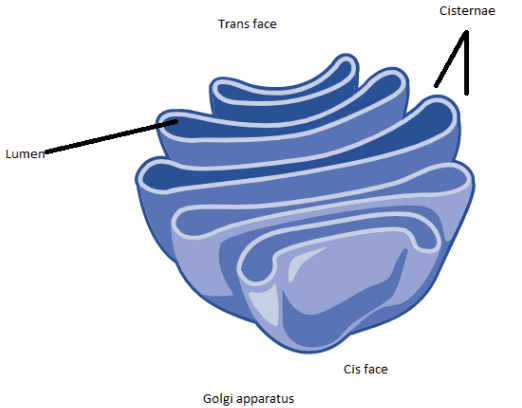
The stacks of the Golgi body join vesicles that extend from the endoplasmic reticulum. It plays an important role in modifying and transporting the proteins produced within the cell in the Endoplasmic Reticulum. The primary role of this apparatus is to guide the body's essential carbohydrates and proteins to their proper destination. The roles of cisternae change as they undergo various stages of maturation. Vesicles from the endoplasmic reticulum are received by immature cisternae. The next stage begins when cisternae exchange material for carbohydrate synthesis through vesicles. The mature cisternae enter the final stage when the cargo proteins are sent to transport carriers.
Hence, the correct response is D- 'Cisternae’.
Note: A flattened membrane disc of the endoplasmic reticulum and Golgi body may be a cistern (plural cisternae). There can be anywhere from three to twenty cisternae in a Golgi stack, but most contain about six cisternae. Golgi cisternae are often divided into four categories: cis, medial, trans, and TGN (trans-Golgi network). Each type of cistern includes numerous enzymes to stop any redundant enzymatic operation. Multiple stacking occurs in almost all cisternae within the Golgi body. There are evolutionary lines, however, during which the stacked function is lost.
Complete answer:The cisternae, which are considered the functional units of this organelle, are the folds of the Golgi body. The Golgi apparatus is a cell organelle found in eukaryotic cells. It was discovered in 1897 by an Italian physicist, Camillo Golgi. Within the cytoplasm, the Golgi apparatus forms a complex of vesicles and folded membranes that are involved in secretion and assist in intracellular transport. In general, the appearance of the cisternae is compared to a deflated balloon stack.
The stacks of the Golgi body join vesicles that extend from the endoplasmic reticulum. It plays an important role in modifying and transporting the proteins produced within the cell in the Endoplasmic Reticulum. The primary role of this apparatus is to guide the body's essential carbohydrates and proteins to their proper destination. The roles of cisternae change as they undergo various stages of maturation. Vesicles from the endoplasmic reticulum are received by immature cisternae. The next stage begins when cisternae exchange material for carbohydrate synthesis through vesicles. The mature cisternae enter the final stage when the cargo proteins are sent to transport carriers.
Hence, the correct response is D- 'Cisternae’.
Note: A flattened membrane disc of the endoplasmic reticulum and Golgi body may be a cistern (plural cisternae). There can be anywhere from three to twenty cisternae in a Golgi stack, but most contain about six cisternae. Golgi cisternae are often divided into four categories: cis, medial, trans, and TGN (trans-Golgi network). Each type of cistern includes numerous enzymes to stop any redundant enzymatic operation. Multiple stacking occurs in almost all cisternae within the Golgi body. There are evolutionary lines, however, during which the stacked function is lost.
Recently Updated Pages
Master Class 12 Economics: Engaging Questions & Answers for Success

Master Class 12 English: Engaging Questions & Answers for Success
Master Class 12 Social Science: Engaging Questions & Answers for Success
Master Class 12 Maths: Engaging Questions & Answers for Success
Master Class 12 Physics: Engaging Questions & Answers for Success
Master Class 11 Social Science: Engaging Questions & Answers for Success
Trending doubts
One Metric ton is equal to kg A 10000 B 1000 C 100 class 11 physics CBSE
Difference Between Prokaryotic Cells and Eukaryotic Cells
Two of the body parts which do not appear in MRI are class 11 biology CBSE
1 ton equals to A 100 kg B 1000 kg C 10 kg D 10000 class 11 physics CBSE
Draw a diagram of nephron and explain its structur class 11 biology CBSE
10 examples of friction in our daily life