




The four sigma bonds in perchlorate ion are as follows:
A.$s{{p}^{3}}-s{{p}^{3}}$ bond
B.$s{{p}^{3}}-p$ bond
C.$s{{p}^{2}}-s{{p}^{2}}$ bond
D.$s{{p}^{2}}-p$ bond
Answer
 Verified
594.6k+ views
Hint: We know Hybridization happens when the atom bonds, using electrons from both the S and P -orbitals, create a difference in the energy levels of the electrons. In order to equalise these energy levels, the corresponding s and p orbitals are combined to create hybrid orbitals.
Complete step by step answer:
As we know sigma and pi bonds include the process of hybridisation.
Talking about the concepts of hybridization it refers to the mixing of atomic orbitals into new hybrid orbitals (with different energies, shapes, etc.,) suitable for the pairing of electrons to make chemical bonds in valence bond theory. Hybrid orbitals are very useful within the explanation of molecular geometry and atomic bonding properties and are symmetrically disposed in space.
About Perchlorate, it is defined as a monovalent inorganic anion obtained by deprotonation of perchloric acid. It's a monovalent inorganic anion and a chlorine oxo anion. it's a conjugate base of a perchloric acid.
As the question is related to sigma and pi bond here is its general definition:
The covalent bond formed by the coaxial overlap of atomic orbitals is termed as sigma bonding, for example methane molecules contain $4\text{ }C-H$ sigma bonding.
The covalent bond formed by lateral overlap of atomic orbitals is termed as pi bond. As an example, ethylene molecules contain 5 sigma bonding and 1 pi bonding in it.
According the question the formation of perchlorate ion is below
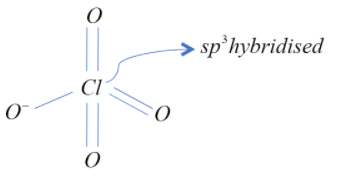
Therefore, all four bonds are $s{{p}^{3}}-p$ bond as oxygen is meant to bring its $p-$orbital for bonding.
Hence Option B is the correct answer of the question.
Note:
Here are some Hybridization points which involves combining and recasting
the same element of atomic orbitals.
The orbitals involved in this process must have almost the same energy.
Only atomic orbitals, not electrons, undergo hybridization.
Number of hybrid orbitals produced = number of hybrid orbitals involved in hybridisation.
Complete step by step answer:
As we know sigma and pi bonds include the process of hybridisation.
Talking about the concepts of hybridization it refers to the mixing of atomic orbitals into new hybrid orbitals (with different energies, shapes, etc.,) suitable for the pairing of electrons to make chemical bonds in valence bond theory. Hybrid orbitals are very useful within the explanation of molecular geometry and atomic bonding properties and are symmetrically disposed in space.
About Perchlorate, it is defined as a monovalent inorganic anion obtained by deprotonation of perchloric acid. It's a monovalent inorganic anion and a chlorine oxo anion. it's a conjugate base of a perchloric acid.
As the question is related to sigma and pi bond here is its general definition:
The covalent bond formed by the coaxial overlap of atomic orbitals is termed as sigma bonding, for example methane molecules contain $4\text{ }C-H$ sigma bonding.
The covalent bond formed by lateral overlap of atomic orbitals is termed as pi bond. As an example, ethylene molecules contain 5 sigma bonding and 1 pi bonding in it.
According the question the formation of perchlorate ion is below
Therefore, all four bonds are $s{{p}^{3}}-p$ bond as oxygen is meant to bring its $p-$orbital for bonding.
Hence Option B is the correct answer of the question.
Note:
Here are some Hybridization points which involves combining and recasting
the same element of atomic orbitals.
The orbitals involved in this process must have almost the same energy.
Only atomic orbitals, not electrons, undergo hybridization.
Number of hybrid orbitals produced = number of hybrid orbitals involved in hybridisation.
Recently Updated Pages
Master Class 11 Social Science: Engaging Questions & Answers for Success

Master Class 11 Physics: Engaging Questions & Answers for Success
Master Class 11 Maths: Engaging Questions & Answers for Success
Master Class 11 Economics: Engaging Questions & Answers for Success
Master Class 11 Computer Science: Engaging Questions & Answers for Success
Master Class 11 Chemistry: Engaging Questions & Answers for Success
Trending doubts
One Metric ton is equal to kg A 10000 B 1000 C 100 class 11 physics CBSE
There are 720 permutations of the digits 1 2 3 4 5 class 11 maths CBSE
1 Quintal is equal to a 110 kg b 10 kg c 100kg d 1000 class 11 physics CBSE
State and prove Bernoullis theorem class 11 physics CBSE
Difference Between Prokaryotic Cells and Eukaryotic Cells
Which among the following are examples of coming together class 11 social science CBSE