




The force required just to move the body up an inclined plane is double the force required just to prevent the body from sliding down. If the coefficient of friction is $0.25$ the angle of inclination of the plane is
A. $36.8^\circ $
B. $45^\circ $
C. $30^\circ $
D. $42.6^\circ $
Answer
 Verified
531.6k+ views
Hint: In order to solve this question we need to understand friction and Newton's second law of motion. Friction is an opposing force which always acts against the motion of the body and this force is directly proportional to normal on the body where coefficient of friction is proportionality constant. There are two types of friction one is static friction and other is kinetic friction, static friction acts on the body when the body is kept at rest while the kinetic friction acts on the body when the body is moving. So to move the body we just have to apply force which is equal or greater than friction.
Complete step by step answer:
Coefficient of friction is $\mu = 0.25$. Let the angle inclination of the plane be $\theta $. So while moving up the inclined plane, from the figure
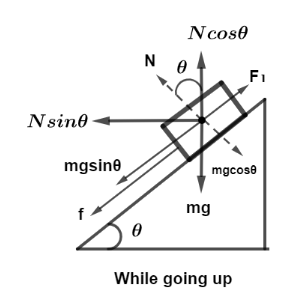
The normal is $N = mg\cos \theta $.
So the frictional force acts in downward direction along inclined plane is,
$f = \mu N$
$\Rightarrow f = \mu mg\cos \theta $
Also the component of gravity force in downward direction along inclined planes is $mg\sin \theta $. So total force that needed just to move up the inclined plane is given by,
$F = mg\sin \theta + f$
Putting values we get, $F = mg\sin \theta + \mu mg\cos \theta $
While moving down the inclined plane,
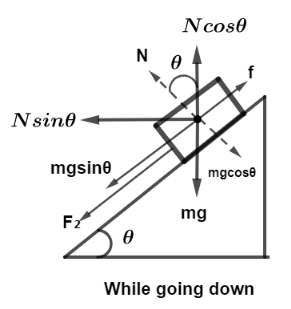
The normal is $N = mg\cos \theta $.
So the frictional force acts in upward direction along inclined plane is, $f = \mu N$
$f = \mu mg\cos \theta $
Also the component of gravity force in downward direction along inclined planes is $mg\sin \theta $.So total force that needed just to move up the inclined plane is given by,
${F_1} = mg\sin \theta - f$
Putting values we get,
${F_1} = mg\sin \theta - \mu mg\cos \theta $
So according to question,
$F = 2{F_1}$
Putting values we get,
$mg\sin \theta + \mu mg\cos \theta = 2(mg\sin \theta - \mu mg\cos \theta )$
$\Rightarrow 3\mu mg\cos \theta = mg\sin \theta $
$\Rightarrow 3\mu = \tan \theta $
$\Rightarrow \theta = {\tan ^{ - 1}}(3 \times 0.25)$
$\Rightarrow \theta = {\tan ^{ - 1}}(0.75)$
$\therefore \theta = 36.86^\circ $
So the correct option is A.
Note: It should be remembered that both the forces either frictional or downward component of gravitational force produce torque but in opposite direction and equal in magnitude so net torque is zero and that’s why body only translates rather than it rotates.There are four fundamental forces in nature.
Complete step by step answer:
Coefficient of friction is $\mu = 0.25$. Let the angle inclination of the plane be $\theta $. So while moving up the inclined plane, from the figure
The normal is $N = mg\cos \theta $.
So the frictional force acts in downward direction along inclined plane is,
$f = \mu N$
$\Rightarrow f = \mu mg\cos \theta $
Also the component of gravity force in downward direction along inclined planes is $mg\sin \theta $. So total force that needed just to move up the inclined plane is given by,
$F = mg\sin \theta + f$
Putting values we get, $F = mg\sin \theta + \mu mg\cos \theta $
While moving down the inclined plane,
The normal is $N = mg\cos \theta $.
So the frictional force acts in upward direction along inclined plane is, $f = \mu N$
$f = \mu mg\cos \theta $
Also the component of gravity force in downward direction along inclined planes is $mg\sin \theta $.So total force that needed just to move up the inclined plane is given by,
${F_1} = mg\sin \theta - f$
Putting values we get,
${F_1} = mg\sin \theta - \mu mg\cos \theta $
So according to question,
$F = 2{F_1}$
Putting values we get,
$mg\sin \theta + \mu mg\cos \theta = 2(mg\sin \theta - \mu mg\cos \theta )$
$\Rightarrow 3\mu mg\cos \theta = mg\sin \theta $
$\Rightarrow 3\mu = \tan \theta $
$\Rightarrow \theta = {\tan ^{ - 1}}(3 \times 0.25)$
$\Rightarrow \theta = {\tan ^{ - 1}}(0.75)$
$\therefore \theta = 36.86^\circ $
So the correct option is A.
Note: It should be remembered that both the forces either frictional or downward component of gravitational force produce torque but in opposite direction and equal in magnitude so net torque is zero and that’s why body only translates rather than it rotates.There are four fundamental forces in nature.
Recently Updated Pages
Master Class 11 Social Science: Engaging Questions & Answers for Success

Master Class 11 Chemistry: Engaging Questions & Answers for Success
Master Class 12 Business Studies: Engaging Questions & Answers for Success
Master Class 12 Chemistry: Engaging Questions & Answers for Success
Master Class 12 Biology: Engaging Questions & Answers for Success
Class 12 Question and Answer - Your Ultimate Solutions Guide
Trending doubts
One Metric ton is equal to kg A 10000 B 1000 C 100 class 11 physics CBSE
Difference Between Prokaryotic Cells and Eukaryotic Cells
How many of the following diseases can be studied with class 11 biology CBSE
Two of the body parts which do not appear in MRI are class 11 biology CBSE
Which of the following enzymes is used for carboxylation class 11 biology CBSE
Explain zero factorial class 11 maths CBSE