




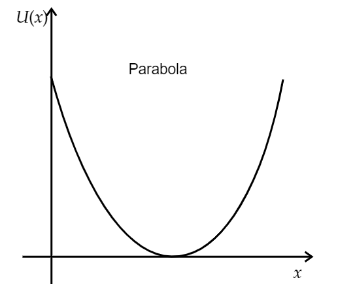
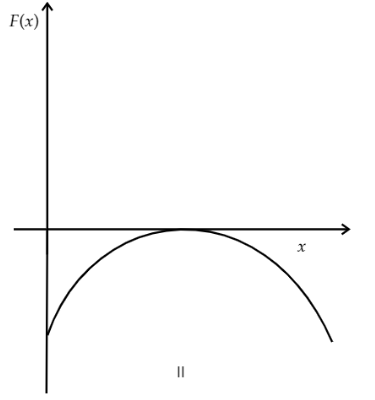
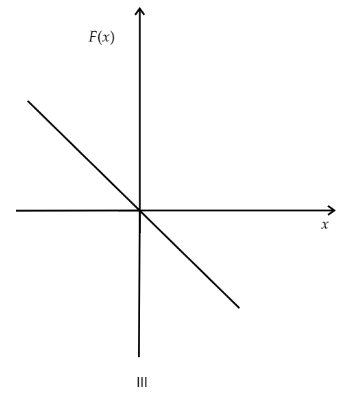
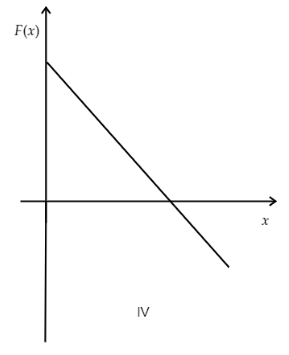
The first graph shows the potential energy U(x) for a particle moving on the x-axis.Which of the following graphs will correctly give the force $F$ exerted on the particle.
(I)

(II)
(III)
(IV)
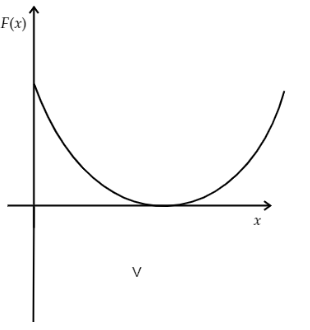
(V)
A. I
B. II
C. III
D. IV
E. V
Answer
 Verified
543.6k+ views
Hint:Use the relation between the potential energy of a system with the force and displacement to recognize the correct graph. Potential energy is a type of energy of a system which is stored in the field and only depends on the position of the system, it is independent of momentum of the system.
Formula used:
The force of a system is related to potential energy as,
\[F = - \dfrac{{\partial U}}{{\partial x}}\]
Where, \[F\] is the force which is generating the potential energy, \[U\] is the potential energy of the system and \[x\] is the displacement due to the force.
Complete step by step answer:
We know that the potential energy of a 1D system is generated due to the force
\[F = - \dfrac{{\partial U}}{{\partial x}}\]
Now, here we can see that the graph is a parabola and it is of the form, \[U(x) = a{x^2} + c\] where \[a\], \[c\] are some constants.
Now, if we partially differentiate w.r.t x we will have,
\[\dfrac{{\partial U}}{{\partial x}} = 2ax\]
So, the force exerted on the particle will be,
\[F = - \dfrac{{\partial U}}{{\partial x}} = - 2ax\]
Hence, we can see that it is a straight line with slope \[ - 2a\]. Now, if we put initial condition that the potential energy has some value at
\[x = 0\]
\[\Rightarrow U = c\]
So, the force will also have some value of \[F(x)\] at \[x = 0\] and at some finite value of $x$,
\[U = 0\]or the slope of the $U$ curve is zero. So, also the force law will have zero value at some finite value of $x$. Hence, graph of force versus displacement will look as below:
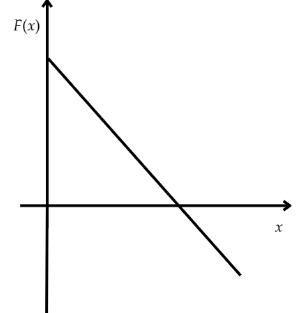
So, we can see that this only matches with the curve number (IV).
Hence, option D is the correct answer.
Note:The force law for a potential of a system is nothing but the slope of the curve. So, if we can know the nature of the curve we can easily find the slope at each point of the curve by differentiating at each point or the expression. Curve (III) and (IV) can be confusing since both of them are straight lines. But we can easily differentiate between them using the boundary conditions at \[x = 0\]and \[U = 0\].Since, U has a finite value at \[x = 0\]so F will also have the same, but for curve (III), F is zero at \[x = 0\]. Hence, curve (III) is an incorrect representation of \[F(x)\].
Formula used:
The force of a system is related to potential energy as,
\[F = - \dfrac{{\partial U}}{{\partial x}}\]
Where, \[F\] is the force which is generating the potential energy, \[U\] is the potential energy of the system and \[x\] is the displacement due to the force.
Complete step by step answer:
We know that the potential energy of a 1D system is generated due to the force
\[F = - \dfrac{{\partial U}}{{\partial x}}\]
Now, here we can see that the graph is a parabola and it is of the form, \[U(x) = a{x^2} + c\] where \[a\], \[c\] are some constants.
Now, if we partially differentiate w.r.t x we will have,
\[\dfrac{{\partial U}}{{\partial x}} = 2ax\]
So, the force exerted on the particle will be,
\[F = - \dfrac{{\partial U}}{{\partial x}} = - 2ax\]
Hence, we can see that it is a straight line with slope \[ - 2a\]. Now, if we put initial condition that the potential energy has some value at
\[x = 0\]
\[\Rightarrow U = c\]
So, the force will also have some value of \[F(x)\] at \[x = 0\] and at some finite value of $x$,
\[U = 0\]or the slope of the $U$ curve is zero. So, also the force law will have zero value at some finite value of $x$. Hence, graph of force versus displacement will look as below:
So, we can see that this only matches with the curve number (IV).
Hence, option D is the correct answer.
Note:The force law for a potential of a system is nothing but the slope of the curve. So, if we can know the nature of the curve we can easily find the slope at each point of the curve by differentiating at each point or the expression. Curve (III) and (IV) can be confusing since both of them are straight lines. But we can easily differentiate between them using the boundary conditions at \[x = 0\]and \[U = 0\].Since, U has a finite value at \[x = 0\]so F will also have the same, but for curve (III), F is zero at \[x = 0\]. Hence, curve (III) is an incorrect representation of \[F(x)\].
Recently Updated Pages
Master Class 11 Social Science: Engaging Questions & Answers for Success

Master Class 11 Chemistry: Engaging Questions & Answers for Success
Master Class 9 General Knowledge: Engaging Questions & Answers for Success
Master Class 9 Maths: Engaging Questions & Answers for Success
Master Class 9 Science: Engaging Questions & Answers for Success
Master Class 9 English: Engaging Questions & Answers for Success
Trending doubts
One Metric ton is equal to kg A 10000 B 1000 C 100 class 11 physics CBSE
Difference Between Prokaryotic Cells and Eukaryotic Cells
Two of the body parts which do not appear in MRI are class 11 biology CBSE
1 ton equals to A 100 kg B 1000 kg C 10 kg D 10000 class 11 physics CBSE
10 examples of friction in our daily life
Name the Largest and the Smallest Cell in the Human Body ?