




The filtration unit of the kidney is called
A) Ureter
B) Urethra
C) Neurons
D) Nephrons
Answer
 Verified
612.3k+ views
Hint: It is a functional unit of the kidney and produces urine. The process of removal of waste and excess substance from the blood ultimately produces urine. It also works as a two- step process, Firstly it filters our blood and secondly returns needed substance in our blood and removes wastes.
Complete step by step answer:
- Our kidney is made up of millions of filtering units called nephrons. Each of the nephrons includes a filter called the glomerulus and a tubule.
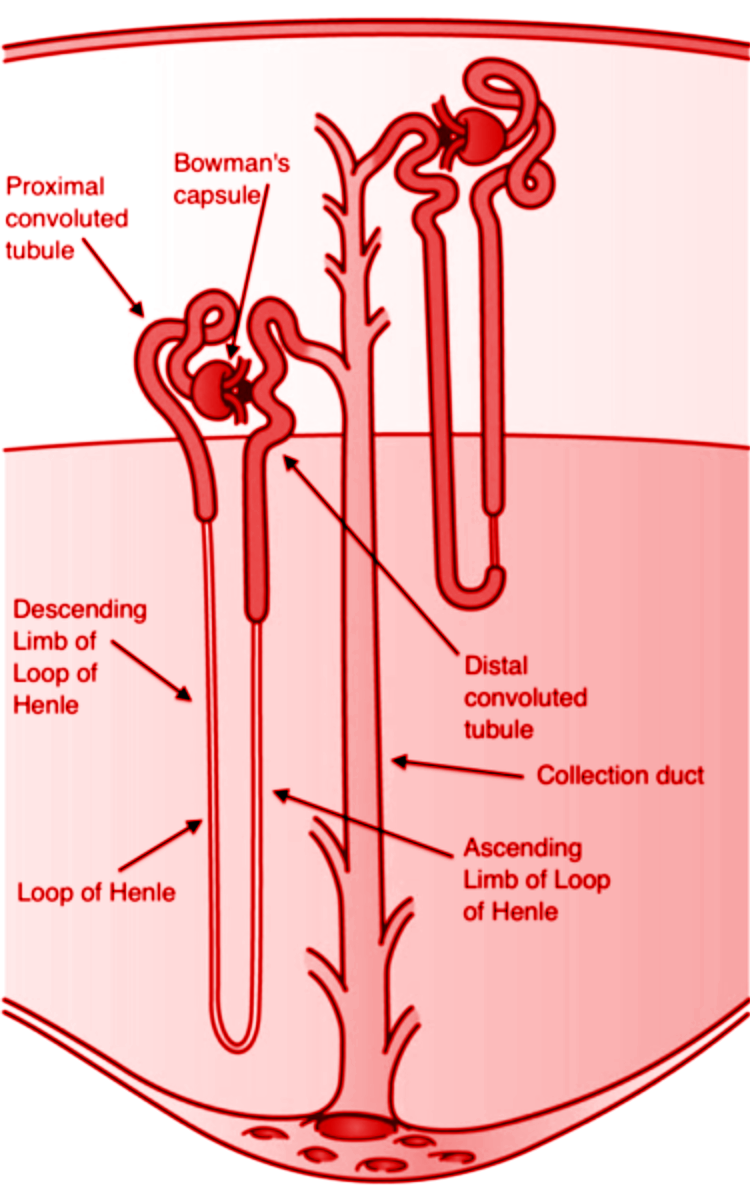
- The nephrons work in a two-step process:
1) The blood is filtered by the glomerulus.
2) The needed substance is returned by the tubule in blood and then removed waste.
- When the filtrate passes through the tubule of the nephron, it's concentration increases into the urine. The waste products are passed from the blood into the filtrate and the needed nutrients are absorbed again from the filtrate into the blood.
- There are 3 parts of a nephron - renal corpuscle, a renal tubule, and the associated capillary network which generate from the cortical radiate arteries.
- The renal corpuscle present in the renal cortex is composed of a large network of capillaries called a glomerulus and a cup- shaped chamber called glomerular or Bowman's capsules.
Additional information:
Ureter: Urine is carried out from the kidney to the urinary bladder by ureter.
Urethra: Male urethra connects the urinary bladder to the penis. The female urethra is a simple tube- like structure whose purpose is conducting urine from the bladder to the outside of the body.
Neurons- these are cells within the nervous system which transfer information to the other nerve cells or muscle cells.
So, the correct answer is, "Nephrons".
Note: Each kidney of humans mainly consists of about 1,000,000 Nephrons.
- primitive fish, amphibian larvae, and embryos of more advanced vertebrates contain the most primitive nephrons.
- Reptiles birds and mammals contains advanced nephrons which occur in the adult kidneys or metanephros.
Complete step by step answer:
- Our kidney is made up of millions of filtering units called nephrons. Each of the nephrons includes a filter called the glomerulus and a tubule.
- The nephrons work in a two-step process:
1) The blood is filtered by the glomerulus.
2) The needed substance is returned by the tubule in blood and then removed waste.
- When the filtrate passes through the tubule of the nephron, it's concentration increases into the urine. The waste products are passed from the blood into the filtrate and the needed nutrients are absorbed again from the filtrate into the blood.
- There are 3 parts of a nephron - renal corpuscle, a renal tubule, and the associated capillary network which generate from the cortical radiate arteries.
- The renal corpuscle present in the renal cortex is composed of a large network of capillaries called a glomerulus and a cup- shaped chamber called glomerular or Bowman's capsules.
Additional information:
Ureter: Urine is carried out from the kidney to the urinary bladder by ureter.
Urethra: Male urethra connects the urinary bladder to the penis. The female urethra is a simple tube- like structure whose purpose is conducting urine from the bladder to the outside of the body.
Neurons- these are cells within the nervous system which transfer information to the other nerve cells or muscle cells.
So, the correct answer is, "Nephrons".
Note: Each kidney of humans mainly consists of about 1,000,000 Nephrons.
- primitive fish, amphibian larvae, and embryos of more advanced vertebrates contain the most primitive nephrons.
- Reptiles birds and mammals contains advanced nephrons which occur in the adult kidneys or metanephros.
Recently Updated Pages
Master Class 11 English: Engaging Questions & Answers for Success

Master Class 11 Social Science: Engaging Questions & Answers for Success
Master Class 11 Maths: Engaging Questions & Answers for Success
Master Class 11 Chemistry: Engaging Questions & Answers for Success
Master Class 11 Biology: Engaging Questions & Answers for Success
Master Class 11 Physics: Engaging Questions & Answers for Success
Trending doubts
One Metric ton is equal to kg A 10000 B 1000 C 100 class 11 physics CBSE
Difference Between Prokaryotic Cells and Eukaryotic Cells
Find the value of the expression given below sin 30circ class 11 maths CBSE
1 ton equals to A 100 kg B 1000 kg C 10 kg D 10000 class 11 physics CBSE
Two of the body parts which do not appear in MRI are class 11 biology CBSE
Draw a diagram of nephron and explain its structur class 11 biology CBSE