




The filiform apparatus is located at the
(a) Tip of Microsporangium.
(b) Tip of the filament.
(c) Tip of the megasporangium.
(d) Pericarp.
Answer
 Verified
597.6k+ views
Hint: Filiform apparatus forms finger-like projections in the synergid cytoplasm. This structure is found within the ovary of the flower that helps in the guidance of the pollen inside the ovary for fusion.
Complete answer:
The filiform apparatus is located at the tip of the megasporangium or the embryo sac. At the tip of the micropylar end, We can find a thickened structure called filiform apparatus. The filiform apparatus plays a significant role in leading the pollen tubes towards the embryo.
So, the correct answer is 'Tip of megasporangium'.
Additional information:
During angiosperm reproduction, two products are formed: a zygote and the endosperm. A zygote will grow and develop into an embryo, or into a baby plant. The food source of plant embryos is the endosperm formed. This process is called double fertilization, and it is a unique characteristic of a flowering plant.
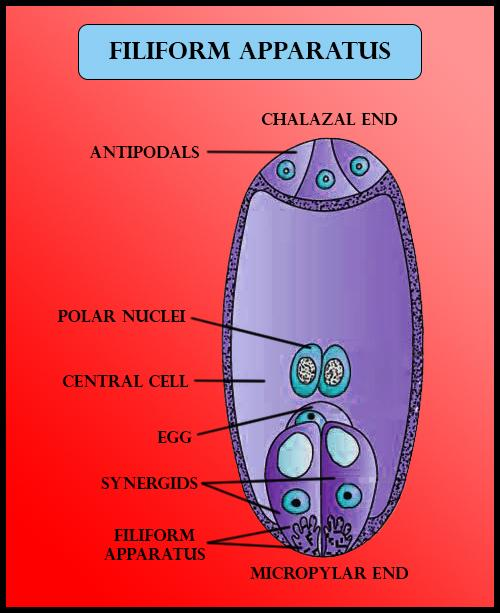
The Process of Double Fertilization:
An ovary contains at least one ovule. Inside an ovule, cells divide to give an egg and two other cells called polar nuclei. These three cells are haploid, which means they have one set of chromosomes and are designated by n. Most cells in angiosperms are diploid or have two sets of chromosomes. In diploid (2n) cells, one set of chromosomes comes from the male plant and therefore the other set comes from the female plant parent.
In addition to eggs and polar nuclei, sperm cells from a pollen grain are also haploid. When The pollen tube reaches the micropylar end it releases two haploid (n) sperm cells into the ovule. One of the male gametes will fuse with the egg, leading to a diploid zygote. The other sperm will fuse with the 2 polar nuclei, creating a triploid (3n) structure which will grow rapidly into the endosperm.
Note:
- All angiosperms are characterized by a singular process called "double fertilization", which was discovered by S.G.Nawaschin (1898) in Lilium and Fritillaria species.
- 2 sperm cells enter the embryo sac and fuse with the egg cell to form a zygote and other with polar nuclei to form a triploid cell which leads to endosperm.
- At the end of fertilization, the ovary develops into fruit and ovules to seeds.
Complete answer:
The filiform apparatus is located at the tip of the megasporangium or the embryo sac. At the tip of the micropylar end, We can find a thickened structure called filiform apparatus. The filiform apparatus plays a significant role in leading the pollen tubes towards the embryo.
So, the correct answer is 'Tip of megasporangium'.
Additional information:
During angiosperm reproduction, two products are formed: a zygote and the endosperm. A zygote will grow and develop into an embryo, or into a baby plant. The food source of plant embryos is the endosperm formed. This process is called double fertilization, and it is a unique characteristic of a flowering plant.
The Process of Double Fertilization:
An ovary contains at least one ovule. Inside an ovule, cells divide to give an egg and two other cells called polar nuclei. These three cells are haploid, which means they have one set of chromosomes and are designated by n. Most cells in angiosperms are diploid or have two sets of chromosomes. In diploid (2n) cells, one set of chromosomes comes from the male plant and therefore the other set comes from the female plant parent.
In addition to eggs and polar nuclei, sperm cells from a pollen grain are also haploid. When The pollen tube reaches the micropylar end it releases two haploid (n) sperm cells into the ovule. One of the male gametes will fuse with the egg, leading to a diploid zygote. The other sperm will fuse with the 2 polar nuclei, creating a triploid (3n) structure which will grow rapidly into the endosperm.
Note:
- All angiosperms are characterized by a singular process called "double fertilization", which was discovered by S.G.Nawaschin (1898) in Lilium and Fritillaria species.
- 2 sperm cells enter the embryo sac and fuse with the egg cell to form a zygote and other with polar nuclei to form a triploid cell which leads to endosperm.
- At the end of fertilization, the ovary develops into fruit and ovules to seeds.
Recently Updated Pages
Master Class 11 Social Science: Engaging Questions & Answers for Success

Master Class 11 Physics: Engaging Questions & Answers for Success
Master Class 11 Maths: Engaging Questions & Answers for Success
Master Class 11 Economics: Engaging Questions & Answers for Success
Master Class 11 Computer Science: Engaging Questions & Answers for Success
Master Class 11 Chemistry: Engaging Questions & Answers for Success
Trending doubts
One Metric ton is equal to kg A 10000 B 1000 C 100 class 11 physics CBSE
How many bones are in the spine class 11 biology CBSE
1 Quintal is equal to a 110 kg b 10 kg c 100kg d 1000 class 11 physics CBSE
There are 720 permutations of the digits 1 2 3 4 5 class 11 maths CBSE
State and prove Bernoullis theorem class 11 physics CBSE
Difference Between Prokaryotic Cells and Eukaryotic Cells