




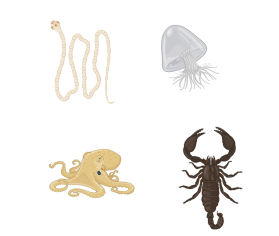
The figure shows four animals (a), (b), (c) and (d). Select the correct answer with respect to a common characteristic of two of these animals.
A. (a)and (d) respire mainly through the body wall.
B. (b)and (c) show radial symmetry.
C. (a)and (b) have cnidoblasts for self-defence.
D. (c) and (d) have a true coelom.
Answer
 Verified
614.4k+ views
Hint: The first organism mentioned in the picture above belongs to the class of worms while the second has true tissues, the third one is characterized by the presence of mantle and the fourth one has joined limbs.
Complete step by step answer: All advanced animals have a real coelom (cavity), as well as the mollusks, annelids, arthropods, echinoderms, and chordates and are called eucoelomates or coelomates. They need a true coelom, that's fully lined by the mesoderm layer. An octopus is a species of cephalopod and is an invertebrate of the order Octopoda. Octopuses are among the foremost intelligent and behaviorally versatile of all invertebrates. All the advanced invertebrate phyla have a real coelom. In mollusks, annelids, and arthropods, the cavity forms by ripping of the mesodermal layer. Therefore, they're known as the schizocoelomates. Scorpions are predatory invertebrate animals of the order Scorpiones belonging to class Arachnida. In echinoderms and chordates, the cavity forms by out pocketing which occurs in the primitive gut. It is thus known as enterocoelomates.
Let us take a look at all the options to get the correct answer,
(a) Taenia (human tapeworm) belongs to the Platyhelminthes.
(b) Aurelia belongs to phylum Cnidaria. Both Taenia and Aurelia are acoelomates.
(c) Octopus is a member of phylum Mollusca. This phylum is characterized by features like their body is bilaterally symmetrical, they’re triploblastic and coelomate.
(d) Scorpion is a member of phylum Arthropoda. This phylum is characterized by various features like their body triploblastic, they’re coelomate, bilaterally symmetrical and their body is metamerically divided.
Thus, choice D is the correct answer.
Note: The true coelom may be defined as a body cavity that arises from the cavity in the embryonic mesoderm. The true coelom is of two types; schizocoelom (schizocoel) and enterocoelom (enterocoelom). Schizocoelom develops as a split within the mesodermal sheet. It's found in annelids, arthropods, and mollusks. In enterocoelom, mesoderm arises from the wall of the embryonic cut of the GI tract as hollow outgrowths. It happens in echinoderms and chordates.
Complete step by step answer: All advanced animals have a real coelom (cavity), as well as the mollusks, annelids, arthropods, echinoderms, and chordates and are called eucoelomates or coelomates. They need a true coelom, that's fully lined by the mesoderm layer. An octopus is a species of cephalopod and is an invertebrate of the order Octopoda. Octopuses are among the foremost intelligent and behaviorally versatile of all invertebrates. All the advanced invertebrate phyla have a real coelom. In mollusks, annelids, and arthropods, the cavity forms by ripping of the mesodermal layer. Therefore, they're known as the schizocoelomates. Scorpions are predatory invertebrate animals of the order Scorpiones belonging to class Arachnida. In echinoderms and chordates, the cavity forms by out pocketing which occurs in the primitive gut. It is thus known as enterocoelomates.
Let us take a look at all the options to get the correct answer,
(a) Taenia (human tapeworm) belongs to the Platyhelminthes.
(b) Aurelia belongs to phylum Cnidaria. Both Taenia and Aurelia are acoelomates.
(c) Octopus is a member of phylum Mollusca. This phylum is characterized by features like their body is bilaterally symmetrical, they’re triploblastic and coelomate.
(d) Scorpion is a member of phylum Arthropoda. This phylum is characterized by various features like their body triploblastic, they’re coelomate, bilaterally symmetrical and their body is metamerically divided.
Thus, choice D is the correct answer.
Note: The true coelom may be defined as a body cavity that arises from the cavity in the embryonic mesoderm. The true coelom is of two types; schizocoelom (schizocoel) and enterocoelom (enterocoelom). Schizocoelom develops as a split within the mesodermal sheet. It's found in annelids, arthropods, and mollusks. In enterocoelom, mesoderm arises from the wall of the embryonic cut of the GI tract as hollow outgrowths. It happens in echinoderms and chordates.
Recently Updated Pages
Master Class 11 English: Engaging Questions & Answers for Success

Master Class 11 Social Science: Engaging Questions & Answers for Success
Master Class 11 Maths: Engaging Questions & Answers for Success
Master Class 11 Biology: Engaging Questions & Answers for Success
Master Class 11 Physics: Engaging Questions & Answers for Success
Master Class 11 Chemistry: Engaging Questions & Answers for Success
Trending doubts
One Metric ton is equal to kg A 10000 B 1000 C 100 class 11 physics CBSE
Difference Between Prokaryotic Cells and Eukaryotic Cells
Find the value of the expression given below sin 30circ class 11 maths CBSE
1 ton equals to A 100 kg B 1000 kg C 10 kg D 10000 class 11 physics CBSE
Two of the body parts which do not appear in MRI are class 11 biology CBSE
What are hard magnetic materials class 11 physics CBSE