




The figure shows a square loop L of side $5cm$ which is connected to a network of resistances. The whole setup is moving towards right with a constant speed of $1\,cm{{s}^{-1}}$. At some instant, a part of L is in a uniform magnetic field of $1T$, perpendicular to the plane of the loop. If the resistance of L is $1.7\Omega $, what will be the approximate current in the loop at that instant?
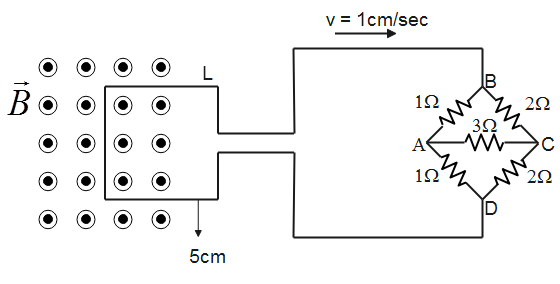
A. $115\mu A$
B. $170\mu A$
C. $60\mu A$
D. $150\mu A$
Answer
 Verified
603.6k+ views
Hint: First, calculate the total resistance of the loop. The network of resistors appears to be a Wheatstone bridge. Varying magnetic flux through the loop induced emf. Use the expression of motional emf to find the emf induced. The motional emf is equivalent to voltage across the circuit. Use Ohm’s law to obtain electric current in the loop.
Formula used:
Ohm’s law, $V=IR$
Complete step by step answer:
First, we shall calculate the resistance of the loop. We can note that the resistances between B and D are in Wheatstone bridge form as
$\dfrac{{{R}_{BA}}}{{{R}_{AD}}}=\dfrac{{{R}_{BC}}}{{{R}_{CD}}}$
Therefore, the $3\Omega $ resistance can be neglected as no current flows through it.
Now the circuit becomes as shown below.
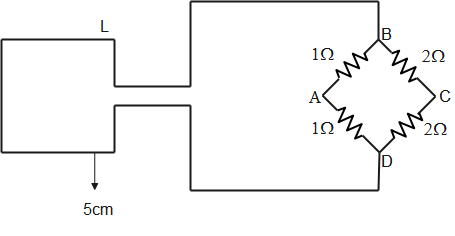
The resistances ${{R}_{BA}}$ and ${{R}_{AD}}$; and ${{R}_{CA}}$ and ${{R}_{CD}}$ are in series and therefore can be replaced with single resistance equivalent to sum of their resistances. Now the circuit can be redrawn as shown below.
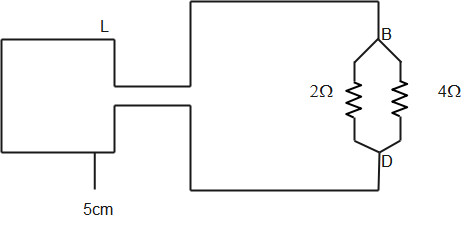
We can note that, the $2\Omega $ and $4\Omega $ are in parallel and their equivalent resistance is given by
$\dfrac{1}{{{R}_{eq}}}=\dfrac{1}{2}+\dfrac{1}{4}=\dfrac{3}{4}$
$\Rightarrow {{R}_{eq}}=\dfrac{4}{3}\Omega \approx 1.3\Omega $
Given that the resistance of L is $1.7\Omega $. Therefore, net resistance through the loop is ${{R}_{loop}}=1.7+1.3\approx 3\Omega $
Emf induced in a loop with its area vector along magnetic field and moving perpendicular to the magnetic field is given by
$\epsilon=Blv$
Where b is the magnetic field and $l$ is the length which is perpendicular to motion of the loop.
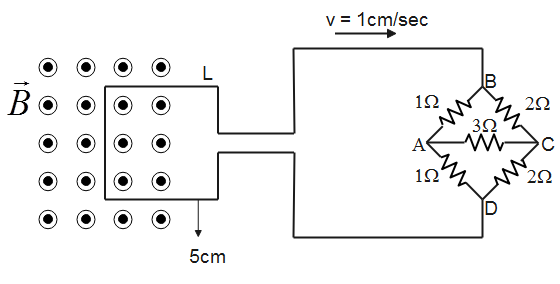
Substituting the values, we have
$\epsilon =1T\times 5cm\times 1cm/s=5\times {{10}^{-4}}T{{m}^{2}}/s$
Current through the loop,
$I=\dfrac{\epsilon }{{{R}_{loop}}}=\dfrac{5\times {{10}^{-4}}V}{3\Omega }=1.67\times {{10}^{-4}}A\approx 170\mu A$
Therefore, option B is correct.
Note:
Varying magnetic field induces electric current and therefore induces electric field. If magnetic flux through the loop is not changing, induced current will be zero.
Some basic conversions are often required in numerical problems. So, learn about milli-, centi-, micro-, kilo- etc.
Formula used:
Ohm’s law, $V=IR$
Complete step by step answer:
First, we shall calculate the resistance of the loop. We can note that the resistances between B and D are in Wheatstone bridge form as
$\dfrac{{{R}_{BA}}}{{{R}_{AD}}}=\dfrac{{{R}_{BC}}}{{{R}_{CD}}}$
Therefore, the $3\Omega $ resistance can be neglected as no current flows through it.
Now the circuit becomes as shown below.
The resistances ${{R}_{BA}}$ and ${{R}_{AD}}$; and ${{R}_{CA}}$ and ${{R}_{CD}}$ are in series and therefore can be replaced with single resistance equivalent to sum of their resistances. Now the circuit can be redrawn as shown below.
We can note that, the $2\Omega $ and $4\Omega $ are in parallel and their equivalent resistance is given by
$\dfrac{1}{{{R}_{eq}}}=\dfrac{1}{2}+\dfrac{1}{4}=\dfrac{3}{4}$
$\Rightarrow {{R}_{eq}}=\dfrac{4}{3}\Omega \approx 1.3\Omega $
Given that the resistance of L is $1.7\Omega $. Therefore, net resistance through the loop is ${{R}_{loop}}=1.7+1.3\approx 3\Omega $
Emf induced in a loop with its area vector along magnetic field and moving perpendicular to the magnetic field is given by
$\epsilon=Blv$
Where b is the magnetic field and $l$ is the length which is perpendicular to motion of the loop.
Substituting the values, we have
$\epsilon =1T\times 5cm\times 1cm/s=5\times {{10}^{-4}}T{{m}^{2}}/s$
Current through the loop,
$I=\dfrac{\epsilon }{{{R}_{loop}}}=\dfrac{5\times {{10}^{-4}}V}{3\Omega }=1.67\times {{10}^{-4}}A\approx 170\mu A$
Therefore, option B is correct.
Note:
Varying magnetic field induces electric current and therefore induces electric field. If magnetic flux through the loop is not changing, induced current will be zero.
Some basic conversions are often required in numerical problems. So, learn about milli-, centi-, micro-, kilo- etc.
Recently Updated Pages
Master Class 12 Business Studies: Engaging Questions & Answers for Success

Master Class 12 Biology: Engaging Questions & Answers for Success
Master Class 12 Chemistry: Engaging Questions & Answers for Success
Class 12 Question and Answer - Your Ultimate Solutions Guide
Master Class 11 Social Science: Engaging Questions & Answers for Success
Master Class 11 English: Engaging Questions & Answers for Success
Trending doubts
Which are the Top 10 Largest Countries of the World?
Draw a labelled sketch of the human eye class 12 physics CBSE
Name the crygenes that control cotton bollworm and class 12 biology CBSE
Differentiate between homogeneous and heterogeneous class 12 chemistry CBSE
Ribosomal RNA is actively synthesised in A Nucleoplasm class 12 biology CBSE
How many molecules of ATP and NADPH are required information class 12 biology CBSE