




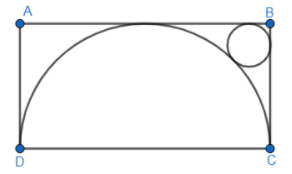
The figure shows a rectangle ABCD with a semicircle and a circle inscribed inside it as shown. What is the ratio of the area of the semi circle to that of the circle?
Answer
 Verified
676.5k+ views
Hint: Start by drawing a figure with all necessary constructions and let the centre of DC and the semicircle be O and the point where the semi-circle is touching AB be P. Let the centre of the circle be C’, the point of intersection of the line CB with the circle be T. Also, let the radius of the semicircle be R and that of the circle be r. Now use the required construction and properties of the geometrical figures to find a relation between r and R. Finally find the ratio between $\pi {{r}^{2}}\text{ and }\dfrac{\pi {{R}^{2}}}{2}$ to get the answer. You might use the fact that the radius of the director circle is $\sqrt{2}\left( radius \right)$ .
Complete step-by-step answer:
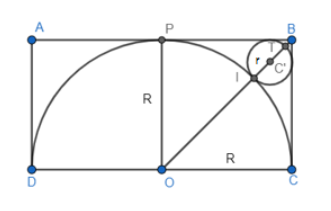
Let us start by drawing a figure with necessary points and constructions for better visualisation. We let the centre of DC and the semicircle be O and the point where the semi-circle is touching AB be P. Let the centre of the circle be C’, the point of intersection of the line C’B with the circle be T. Also, let the radius of the semicircle be R and that of the circle be r.
Now according to the given and assumed things:
OP=OC=PB=BC=R
Hence, POCB is a square. Therefore, we can say that OB is $\sqrt{2}$ times the side of the square POCB, i.e., $OB=\sqrt{2}R$ .
Now looking at the diagram we can say:
$BT=OB-OI-IC'-C'T=\sqrt{2}R-R-r-r=\sqrt{2}R-R-2r.........(i)$
Also, the perpendicular tangents of a circle lie on the director circle, i.e., the distance of the point of intersection of perpendicular tangents of a circle is at a distance of $\sqrt{2}$ times the radius. So, in the circle, $C'B=\sqrt{2}r$
$\therefore BT=C'B-C'T=\sqrt{2}r-r......(ii)$
Equation equation (i) and (ii), we get
$\sqrt{2}R-R-2r=\sqrt{2}r-r$
$\Rightarrow \sqrt{2}R-R=\sqrt{2}r+r$
$\Rightarrow \left( \sqrt{2}-1 \right)R=\left( \sqrt{2}+1 \right)r$
\[\Rightarrow \dfrac{r}{R}=\dfrac{\sqrt{2}-1}{\sqrt{2}+1}\times \dfrac{\sqrt{2}-1}{\sqrt{2}-1}\]
Now we know that $\left( a+b \right)\left( a-b \right)={{a}^{2}}-{{b}^{2}}$ .
\[\dfrac{r}{R}={{\left( \sqrt{2}-1 \right)}^{2}}\]
Now, we know that the area of the circle is $\pi {{r}^{2}}$ and area of the semi-circle is $\dfrac{\pi {{R}^{2}}}{2}$ . Therefore, the required ratio is:
$\dfrac{\pi {{r}^{2}}}{\dfrac{\pi {{R}^{2}}}{2}}=\dfrac{2{{r}^{2}}}{{{R}^{2}}}=2\times {{\left( \dfrac{r}{R} \right)}^{2}}=2\times {{\left( \sqrt{2}-1 \right)}^{4}}$
Hence, the answer to the above question is $2\times {{\left( \sqrt{2}-1 \right)}^{4}}$ .
Note: Never put the value of $\pi $ in the initial steps, as the value of $\pi $ is a complicated decimal number which can make the calculations very complex. Also, it is necessary that you remember that the director circle of the circle ${{x}^{2}}+{{y}^{2}}={{a}^{2}}$ is also a circle with the same centre but radius $\sqrt{2}$ times the original circle.
Complete step-by-step answer:
Let us start by drawing a figure with necessary points and constructions for better visualisation. We let the centre of DC and the semicircle be O and the point where the semi-circle is touching AB be P. Let the centre of the circle be C’, the point of intersection of the line C’B with the circle be T. Also, let the radius of the semicircle be R and that of the circle be r.
Now according to the given and assumed things:
OP=OC=PB=BC=R
Hence, POCB is a square. Therefore, we can say that OB is $\sqrt{2}$ times the side of the square POCB, i.e., $OB=\sqrt{2}R$ .
Now looking at the diagram we can say:
$BT=OB-OI-IC'-C'T=\sqrt{2}R-R-r-r=\sqrt{2}R-R-2r.........(i)$
Also, the perpendicular tangents of a circle lie on the director circle, i.e., the distance of the point of intersection of perpendicular tangents of a circle is at a distance of $\sqrt{2}$ times the radius. So, in the circle, $C'B=\sqrt{2}r$
$\therefore BT=C'B-C'T=\sqrt{2}r-r......(ii)$
Equation equation (i) and (ii), we get
$\sqrt{2}R-R-2r=\sqrt{2}r-r$
$\Rightarrow \sqrt{2}R-R=\sqrt{2}r+r$
$\Rightarrow \left( \sqrt{2}-1 \right)R=\left( \sqrt{2}+1 \right)r$
\[\Rightarrow \dfrac{r}{R}=\dfrac{\sqrt{2}-1}{\sqrt{2}+1}\times \dfrac{\sqrt{2}-1}{\sqrt{2}-1}\]
Now we know that $\left( a+b \right)\left( a-b \right)={{a}^{2}}-{{b}^{2}}$ .
\[\dfrac{r}{R}={{\left( \sqrt{2}-1 \right)}^{2}}\]
Now, we know that the area of the circle is $\pi {{r}^{2}}$ and area of the semi-circle is $\dfrac{\pi {{R}^{2}}}{2}$ . Therefore, the required ratio is:
$\dfrac{\pi {{r}^{2}}}{\dfrac{\pi {{R}^{2}}}{2}}=\dfrac{2{{r}^{2}}}{{{R}^{2}}}=2\times {{\left( \dfrac{r}{R} \right)}^{2}}=2\times {{\left( \sqrt{2}-1 \right)}^{4}}$
Hence, the answer to the above question is $2\times {{\left( \sqrt{2}-1 \right)}^{4}}$ .
Note: Never put the value of $\pi $ in the initial steps, as the value of $\pi $ is a complicated decimal number which can make the calculations very complex. Also, it is necessary that you remember that the director circle of the circle ${{x}^{2}}+{{y}^{2}}={{a}^{2}}$ is also a circle with the same centre but radius $\sqrt{2}$ times the original circle.
Recently Updated Pages
Master Class 10 Computer Science: Engaging Questions & Answers for Success

Differentiate between voluntary action and reflex class 10 biology CBSE
The uses of bleaching powder are A It is used bleaching class 10 chemistry CBSE
Fill in the blanks with abstract nouns of the words class 10 english CBSE
How many threedigit numbers are there class 10 maths CBSE
What is a reflex arc class 10 biology CBSE
Trending doubts
Explain the Treaty of Vienna of 1815 class 10 social science CBSE
In basketball, how many quarters are played in an NBA game?
10 examples of evaporation in daily life with explanations
Which country is known as "The land of Fire and Ice"?
What is the full form of POSCO class 10 social science CBSE
In which year voting age was reduced from 21 to 18?