




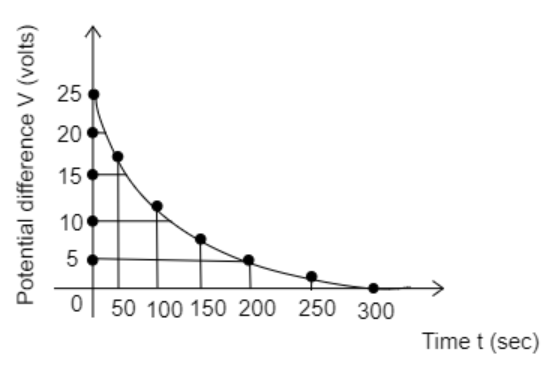
The figure represents an experiment plot for the discharging of a capacitor in an R-C circuit. Find the range of time in which the time constant lies.
The graph between potential difference and time
A) 0 sec and 50 sec
B) 50 sec and 100 sec
C) 100 sec and 150 sec
D) 150 sec and 200 sec
Answer
 Verified
609.6k+ views
Hint:The figure shows that the potential difference decreases exponentially with time. The time constant in an R-C circuit refers to the time taken to charge the capacitor to 0.632 of the applied voltage. This suggests that after a time equal to the time constant the potential difference will be 0.368 of its initial voltage as the capacitor discharges.
Formula used:
-The decrease in the potential difference in an R-C circuit while discharging can be expressed as $V = {V_0}{e^{\dfrac{{ - t}}{T}}}$ where ${V_0}$ is the initial voltage before the capacitor discharges, $t$ is the time taken to discharge in seconds and $T$ is the time constant of the R-C circuit.
Complete step by step answer.
Step 1: Sketch the experiment plot given in the question and identify the initial voltage ${V_0}$ from the plot.
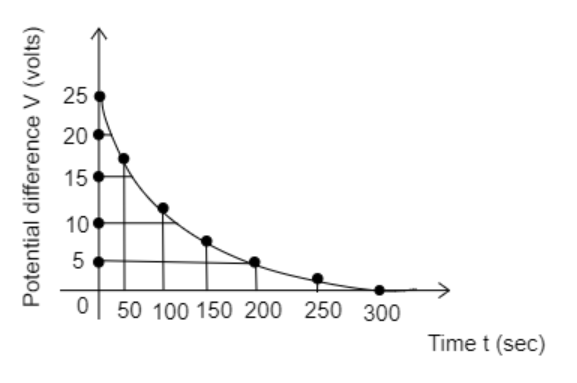
The initial voltage ${V_0}$ is the potential difference present before the capacitor discharges i.e., the value of $V$ at $t = 0{\text{sec}}$
So, from the graph, we observe that at $t = 0{\text{sec}}$, ${V_0} = 25{\text{V}}$
Step 2: Express the decrease in the potential difference $V$ .
The decrease in the potential difference during discharging of the capacitor in an R-C circuit is given by, $V = {V_0}{e^{\dfrac{{ - t}}{T}}}$ --------- (1)
where ${V_0}$ is the initial voltage before the capacitor discharges, $t$ is the time taken to discharge in seconds and $T$ is the time constant of the R-C circuit.
Here, ${V_0} = 25{\text{V}}$ then equation (1) becomes $V = 25{e^{\dfrac{{ - t}}{T}}}$ -------- (2)
Step 3: Find the time constant by substituting any value of $V$ and the corresponding value of $t$ from the graph in equation (2).
Equation (2) gives us $V = 25{e^{\dfrac{{ - t}}{T}}}$
Substitute the value of the potential difference $V = 5{\text{V}}$ and the time $t = 200{\text{sec}}$ in equation (2).
Then we have, $5 = 25{e^{\dfrac{{ - 200}}{T}}}$
Simplifying the above equation we get, $\dfrac{1}{5} = {e^{\dfrac{{ - 200}}{T}}}$
Taking the logarithm to the base $e$ on both sides we get, $ - {\log _e}5 = - {\log _e}{e^{\dfrac{{200}}{T}}}$
We know, ${\log _e}5 = 1.60$ so the above equation becomes $1.60 = \dfrac{{200}}{T}$ or on rearranging we get, $T = \dfrac{{200}}{{1.60}} = 125{\text{sec}}$
$\therefore $ The time constant is $T = 125{\text{sec}}$ .
Thus the time constant lies in the time range 100 sec to 150 sec. The correct option is C.
Note: After one time constant, the capacitor must have discharged to 1−0.632 of its initial voltage. We can check if the obtained time constant is correct.
According to the statement when $t = T$ the potential difference must be $V = \left( {1 - 0.632} \right){V_0}$ .
Since ${V_0} = 25{\text{V}}$ at $t = T$, $V = \left( {1 - 0.632} \right) \times 25 = 9.05{\text{V}}$
Now, substituting $t = T$ in equation (2) we get $V = 25{e^{\dfrac{{ - T}}{T}}} = \dfrac{{25}}{e} = 9.1 \cong 9.05$
The obtained time constant is correct.
Formula used:
-The decrease in the potential difference in an R-C circuit while discharging can be expressed as $V = {V_0}{e^{\dfrac{{ - t}}{T}}}$ where ${V_0}$ is the initial voltage before the capacitor discharges, $t$ is the time taken to discharge in seconds and $T$ is the time constant of the R-C circuit.
Complete step by step answer.
Step 1: Sketch the experiment plot given in the question and identify the initial voltage ${V_0}$ from the plot.
The graph between potential difference and time
The initial voltage ${V_0}$ is the potential difference present before the capacitor discharges i.e., the value of $V$ at $t = 0{\text{sec}}$
So, from the graph, we observe that at $t = 0{\text{sec}}$, ${V_0} = 25{\text{V}}$
Step 2: Express the decrease in the potential difference $V$ .
The decrease in the potential difference during discharging of the capacitor in an R-C circuit is given by, $V = {V_0}{e^{\dfrac{{ - t}}{T}}}$ --------- (1)
where ${V_0}$ is the initial voltage before the capacitor discharges, $t$ is the time taken to discharge in seconds and $T$ is the time constant of the R-C circuit.
Here, ${V_0} = 25{\text{V}}$ then equation (1) becomes $V = 25{e^{\dfrac{{ - t}}{T}}}$ -------- (2)
Step 3: Find the time constant by substituting any value of $V$ and the corresponding value of $t$ from the graph in equation (2).
Equation (2) gives us $V = 25{e^{\dfrac{{ - t}}{T}}}$
Substitute the value of the potential difference $V = 5{\text{V}}$ and the time $t = 200{\text{sec}}$ in equation (2).
Then we have, $5 = 25{e^{\dfrac{{ - 200}}{T}}}$
Simplifying the above equation we get, $\dfrac{1}{5} = {e^{\dfrac{{ - 200}}{T}}}$
Taking the logarithm to the base $e$ on both sides we get, $ - {\log _e}5 = - {\log _e}{e^{\dfrac{{200}}{T}}}$
We know, ${\log _e}5 = 1.60$ so the above equation becomes $1.60 = \dfrac{{200}}{T}$ or on rearranging we get, $T = \dfrac{{200}}{{1.60}} = 125{\text{sec}}$
$\therefore $ The time constant is $T = 125{\text{sec}}$ .
Thus the time constant lies in the time range 100 sec to 150 sec. The correct option is C.
Note: After one time constant, the capacitor must have discharged to 1−0.632 of its initial voltage. We can check if the obtained time constant is correct.
According to the statement when $t = T$ the potential difference must be $V = \left( {1 - 0.632} \right){V_0}$ .
Since ${V_0} = 25{\text{V}}$ at $t = T$, $V = \left( {1 - 0.632} \right) \times 25 = 9.05{\text{V}}$
Now, substituting $t = T$ in equation (2) we get $V = 25{e^{\dfrac{{ - T}}{T}}} = \dfrac{{25}}{e} = 9.1 \cong 9.05$
The obtained time constant is correct.
Recently Updated Pages
Master Class 12 Business Studies: Engaging Questions & Answers for Success

Master Class 12 Biology: Engaging Questions & Answers for Success
Master Class 12 Chemistry: Engaging Questions & Answers for Success
Class 12 Question and Answer - Your Ultimate Solutions Guide
Master Class 11 Social Science: Engaging Questions & Answers for Success
Master Class 11 English: Engaging Questions & Answers for Success
Trending doubts
Which are the Top 10 Largest Countries of the World?
Draw a labelled sketch of the human eye class 12 physics CBSE
Name the crygenes that control cotton bollworm and class 12 biology CBSE
Differentiate between homogeneous and heterogeneous class 12 chemistry CBSE
Ribosomal RNA is actively synthesised in A Nucleoplasm class 12 biology CBSE
How many molecules of ATP and NADPH are required information class 12 biology CBSE