




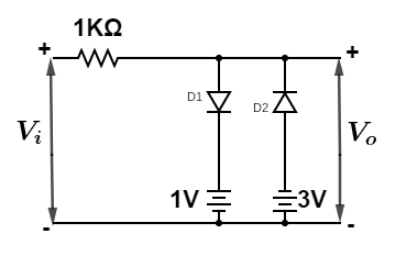
The figure below shows a circuit and its input voltage ${v_i}$ as a function of time $t$. Assuming diodes to be ideal, which of the following graphs depicts the output voltage ${v_0}$ as a function of time $t$?
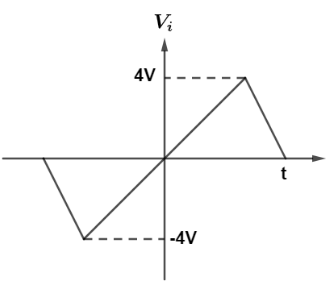
A.
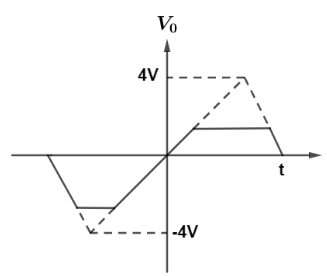
B.
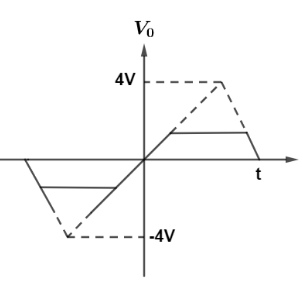
C.
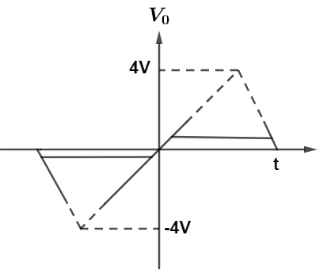
D. Output graph is not possible
Answer
 Verified
545.7k+ views
Hint: In order to solve the question we need to understand diodes and clipper circuits. Diodes are combinations of P-type and N-type semiconductor and it behaves differently when forward bias (P side voltage is greater than N side voltage) and reverse bias (P side voltage is less than N side voltage). In forward bias diodes constitute current and an ideal diode behaves as a closed circuit whereas in reverse bias diodes do not conduct current and hence ideal diodes behave as open circuit. A clipper circuit is a combination of resistance and diode circuit, this circuit is helpful in clipping the input voltage to our needs.
Complete step by step answer:
Let us first mark the diodes. Let Diodes be denoted as ${D_1}$ and ${D_2}$.Since there is voltage of $ + 1V$ and $ - 3V$ at ${D_1}$ and ${D_2}$ respectively. So we would divide input voltage section in $4$ different parts as follows
Case $1$ : When the input voltage is $0 \leqslant V \leqslant 1$
Then Voltage across diode ${D_1}$ is reverse bias so it behaves as open circuit
And voltage across diode ${D_2}$ is reverse bias so it behaves as open circuit
So output voltage is ${v_0} = {v_i}$
Case $2$ : When the input voltage is $1 \leqslant V \leqslant 4$.
Then voltage across diode ${D_1}$ is forward bias so it behaves as a closed circuit.
And voltage across diode ${D_2}$ is reverse biased so it behaves as an open circuit.
So output voltage is ${v_0} = 1V$.
Case $3$ : When the input voltage is $ - 3 \leqslant V \leqslant 0$.
Then voltage across diode ${D_1}$ is reversed so it behaves as an open circuit.
And voltage across diode ${D_2}$ is reverse biased so it behaves as an open circuit.
So output voltage is ${v_0} = {v_i}$.
Case $4$ : When the input voltage is $ - 4 \leqslant V \leqslant - 3$.
Then voltage across diode ${D_1}$ is reverse biased so it behaves as a closed circuit.
And voltage across diode ${D_2}$ is forward bias so it behaves as a closed circuit.
So output voltage is ${v_0} = - 3V$.
So the correct option is A.
Note: It should be remembered that if any of diode is forward bias output voltage is equal to either $ + 1V$ or $ - 3V$ because output voltage is nothing but final voltage develop across diodes and in case diodes are reverse bias then output voltage is equal to input voltage because of no dissipating element in circuit and circuit is open circuit.
Complete step by step answer:
Let us first mark the diodes. Let Diodes be denoted as ${D_1}$ and ${D_2}$.Since there is voltage of $ + 1V$ and $ - 3V$ at ${D_1}$ and ${D_2}$ respectively. So we would divide input voltage section in $4$ different parts as follows
Case $1$ : When the input voltage is $0 \leqslant V \leqslant 1$
Then Voltage across diode ${D_1}$ is reverse bias so it behaves as open circuit
And voltage across diode ${D_2}$ is reverse bias so it behaves as open circuit
So output voltage is ${v_0} = {v_i}$
Case $2$ : When the input voltage is $1 \leqslant V \leqslant 4$.
Then voltage across diode ${D_1}$ is forward bias so it behaves as a closed circuit.
And voltage across diode ${D_2}$ is reverse biased so it behaves as an open circuit.
So output voltage is ${v_0} = 1V$.
Case $3$ : When the input voltage is $ - 3 \leqslant V \leqslant 0$.
Then voltage across diode ${D_1}$ is reversed so it behaves as an open circuit.
And voltage across diode ${D_2}$ is reverse biased so it behaves as an open circuit.
So output voltage is ${v_0} = {v_i}$.
Case $4$ : When the input voltage is $ - 4 \leqslant V \leqslant - 3$.
Then voltage across diode ${D_1}$ is reverse biased so it behaves as a closed circuit.
And voltage across diode ${D_2}$ is forward bias so it behaves as a closed circuit.
So output voltage is ${v_0} = - 3V$.
So the correct option is A.
Note: It should be remembered that if any of diode is forward bias output voltage is equal to either $ + 1V$ or $ - 3V$ because output voltage is nothing but final voltage develop across diodes and in case diodes are reverse bias then output voltage is equal to input voltage because of no dissipating element in circuit and circuit is open circuit.
Recently Updated Pages
Master Class 12 Business Studies: Engaging Questions & Answers for Success

Master Class 12 Chemistry: Engaging Questions & Answers for Success
Master Class 12 Biology: Engaging Questions & Answers for Success
Class 12 Question and Answer - Your Ultimate Solutions Guide
Master Class 11 English: Engaging Questions & Answers for Success
Master Class 11 Social Science: Engaging Questions & Answers for Success
Trending doubts
Which are the Top 10 Largest Countries of the World?
Draw a labelled sketch of the human eye class 12 physics CBSE
Differentiate between homogeneous and heterogeneous class 12 chemistry CBSE
In order to find out the different types of gametes class 12 biology NEET_UG
Why is the cell called the structural and functional class 12 biology CBSE
Draw ray diagrams each showing i myopic eye and ii class 12 physics CBSE