




The equation of the tangents drawn from the origin to the circle${{x}^{2}}+{{y}^{2}}-2rx-2hy+{{h}^{2}}=0,$ are
(a) $x=0$
(b) $y=0$
(c) $\left( {{h}^{2}}-{{r}^{2}} \right)x-2rhy=0$
(d) $\left( {{h}^{2}}-{{r}^{2}} \right)x+2rhy=0$
Answer
 Verified
652.8k+ views
Hint: The equation of a line passing through the origin can be assumed as y = mx where m is the slope of this line. Since this line is a tangent to the given circle i.e. ${{x}^{2}}+{{y}^{2}}-2rx-2hy+{{h}^{2}}=0$, we can apply the condition of tangency for a line to be the tangent of the circle from which, we will get an equation which can be solved to obtain the value of m.
Complete step by step answer:
It is given a circle ${{x}^{2}}+{{y}^{2}}-2rx-2hy+{{h}^{2}}=0..........(i)$
For a general circle ${{x}^{2}}+{{y}^{2}}+2gx+2fy+C=0$
Centre is $\left( -g,-f \right)$ and radius $=\sqrt{{{g}^{2}}+{{f}^{2}}-C}$
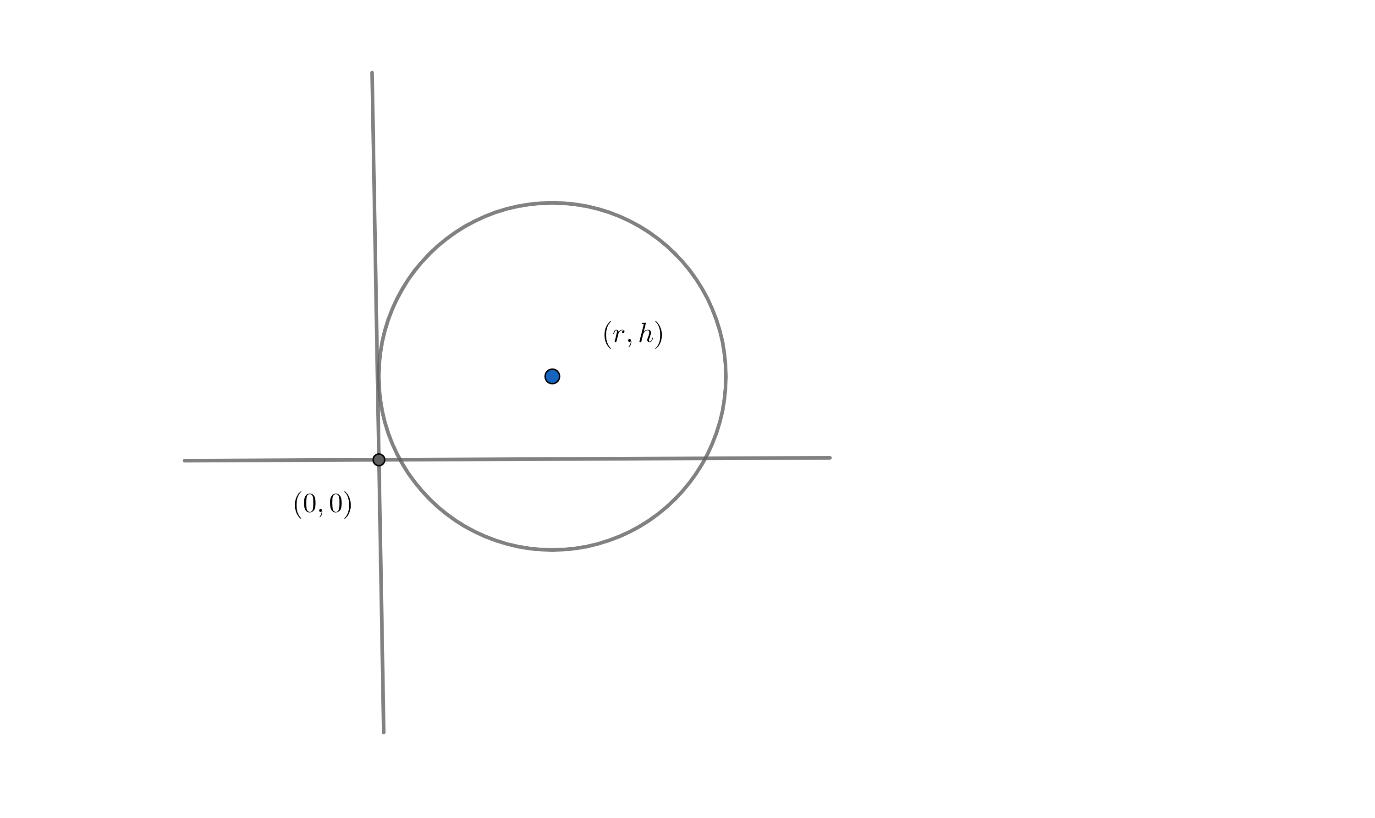
So, for the given circle in equation $\left( i \right)$, centre $\equiv \left( r,h \right)$ and radius
$\begin{align}
& =\sqrt{{{r}^{2}}+{{h}^{2}}-{{h}^{2}}} \\
& =\sqrt{{{r}^{2}}} \\
& =r \\
\end{align}$
Now, we can plot this circle using the above data 🡪
Since tangent is to be drawn from the origin, let the equation of the tangent be,
$y=mx..........(ii)$
We can see the above line has (0,0) on it.
Substituting tangent equation $\left( ii \right)$ in equation$\left( i \right)$, we get ,
${{x}^{2}}+{{\left( mx \right)}^{2}}-2rx-2h(mx)+{{h}^{2}}=0$
$\begin{align}
& {{x}^{2}}+{{m}^{2}}{{x}^{2}}-2rx-2hmx+{{h}^{2}}=0 \\
& \Rightarrow {{x}^{2}}+\left( {{m}^{2}}+1 \right)-2x\left( r+mh \right)+{{h}^{2}}=0...........(iii) \\
\end{align}$
The above equation is a quadratic equation. For the equation $\left( ii \right)$ to be tangent, it must touch the circle at a single point. This means the above quadratic equation must have the same roots which is possible only when discriminant $\left( D \right)=0$.
For quadratic equation $a{{x}^{2}}+bx+C=0$
$D={{b}^{2}}-4ac$
From equation$\left( iii \right)$, substituting $a=\left( {{m}^{2}}+1 \right),\text{ }b\left( -2\left( r+mh \right) \right)\text{ and }C={{h}^{2}}$, we get,
$D={{\left( -2\left( r+mh \right) \right)}^{2}}-4{{h}^{2}}\left( {{m}^{2}}+1 \right)$
As explained int the above paragraph, discriminant $D=0$.
\[\begin{align}
& \Rightarrow 4{{\left( r+mh \right)}^{2}}-4{{h}^{2}}\left( {{m}^{2}}+1 \right)=0 \\
& \Rightarrow 4\left( {{r}^{2}}+{{m}^{2}}{{h}^{2}}+2rmh \right)-4{{h}^{2}}{{m}^{2}}-4{{h}^{2}}=0 \\
& \Rightarrow 4{{r}^{2}}+4{{m}^{2}}{{h}^{2}}+8rmh-4{{m}^{2}}{{h}^{2}}-4{{h}^{2}}=0 \\
& \Rightarrow 4{{r}^{2}}+8rmh-4{{h}^{2}}=0 \\
& \Rightarrow {{r}^{2}}+2rmn-{{h}^{2}}=0 \\
& \Rightarrow \left( 2rh \right)m={{h}^{2}}-{{r}^{2}} \\
& \Rightarrow m=\dfrac{{{h}^{2}}-{{r}^{2}}}{2rh} \\
\end{align}\]
Substituting this value of $m$in equation $\left( ii \right)$,
Equation of tangent$\to y=\dfrac{\left( {{h}^{2}}-{{r}^{2}} \right)}{2hr}x$
$\Rightarrow \left( {{h}^{2}}-{{r}^{2}} \right)x-2hry=0$
If we observe carefully in the figure that we have drawn, we can see the circle is touching the $y$ - axis.
So, $y$ - axis is also a tangent.
So, another tangent is $x=0$ i.e. $y$- axis.
The two tangents are,
$x=0$ and $\left( {{h}^{2}}-{{r}^{2}} \right)x-2hry=0$
So, Option (a) and Option (c).
Note: There may be a possibility that one may not notice $x=0$ as the tangent. So, we should carefully observe the figure and this shows the importance of plotting the curve in a question.
Complete step by step answer:
It is given a circle ${{x}^{2}}+{{y}^{2}}-2rx-2hy+{{h}^{2}}=0..........(i)$
For a general circle ${{x}^{2}}+{{y}^{2}}+2gx+2fy+C=0$
Centre is $\left( -g,-f \right)$ and radius $=\sqrt{{{g}^{2}}+{{f}^{2}}-C}$
So, for the given circle in equation $\left( i \right)$, centre $\equiv \left( r,h \right)$ and radius
$\begin{align}
& =\sqrt{{{r}^{2}}+{{h}^{2}}-{{h}^{2}}} \\
& =\sqrt{{{r}^{2}}} \\
& =r \\
\end{align}$
Now, we can plot this circle using the above data 🡪
Since tangent is to be drawn from the origin, let the equation of the tangent be,
$y=mx..........(ii)$
We can see the above line has (0,0) on it.
Substituting tangent equation $\left( ii \right)$ in equation$\left( i \right)$, we get ,
${{x}^{2}}+{{\left( mx \right)}^{2}}-2rx-2h(mx)+{{h}^{2}}=0$
$\begin{align}
& {{x}^{2}}+{{m}^{2}}{{x}^{2}}-2rx-2hmx+{{h}^{2}}=0 \\
& \Rightarrow {{x}^{2}}+\left( {{m}^{2}}+1 \right)-2x\left( r+mh \right)+{{h}^{2}}=0...........(iii) \\
\end{align}$
The above equation is a quadratic equation. For the equation $\left( ii \right)$ to be tangent, it must touch the circle at a single point. This means the above quadratic equation must have the same roots which is possible only when discriminant $\left( D \right)=0$.
For quadratic equation $a{{x}^{2}}+bx+C=0$
$D={{b}^{2}}-4ac$
From equation$\left( iii \right)$, substituting $a=\left( {{m}^{2}}+1 \right),\text{ }b\left( -2\left( r+mh \right) \right)\text{ and }C={{h}^{2}}$, we get,
$D={{\left( -2\left( r+mh \right) \right)}^{2}}-4{{h}^{2}}\left( {{m}^{2}}+1 \right)$
As explained int the above paragraph, discriminant $D=0$.
\[\begin{align}
& \Rightarrow 4{{\left( r+mh \right)}^{2}}-4{{h}^{2}}\left( {{m}^{2}}+1 \right)=0 \\
& \Rightarrow 4\left( {{r}^{2}}+{{m}^{2}}{{h}^{2}}+2rmh \right)-4{{h}^{2}}{{m}^{2}}-4{{h}^{2}}=0 \\
& \Rightarrow 4{{r}^{2}}+4{{m}^{2}}{{h}^{2}}+8rmh-4{{m}^{2}}{{h}^{2}}-4{{h}^{2}}=0 \\
& \Rightarrow 4{{r}^{2}}+8rmh-4{{h}^{2}}=0 \\
& \Rightarrow {{r}^{2}}+2rmn-{{h}^{2}}=0 \\
& \Rightarrow \left( 2rh \right)m={{h}^{2}}-{{r}^{2}} \\
& \Rightarrow m=\dfrac{{{h}^{2}}-{{r}^{2}}}{2rh} \\
\end{align}\]
Substituting this value of $m$in equation $\left( ii \right)$,
Equation of tangent$\to y=\dfrac{\left( {{h}^{2}}-{{r}^{2}} \right)}{2hr}x$
$\Rightarrow \left( {{h}^{2}}-{{r}^{2}} \right)x-2hry=0$
If we observe carefully in the figure that we have drawn, we can see the circle is touching the $y$ - axis.
So, $y$ - axis is also a tangent.
So, another tangent is $x=0$ i.e. $y$- axis.
The two tangents are,
$x=0$ and $\left( {{h}^{2}}-{{r}^{2}} \right)x-2hry=0$
So, Option (a) and Option (c).
Note: There may be a possibility that one may not notice $x=0$ as the tangent. So, we should carefully observe the figure and this shows the importance of plotting the curve in a question.
Recently Updated Pages
Master Class 11 English: Engaging Questions & Answers for Success

Master Class 11 Social Science: Engaging Questions & Answers for Success
Master Class 11 Maths: Engaging Questions & Answers for Success
Master Class 11 Biology: Engaging Questions & Answers for Success
Master Class 11 Physics: Engaging Questions & Answers for Success
Master Class 11 Chemistry: Engaging Questions & Answers for Success
Trending doubts
One Metric ton is equal to kg A 10000 B 1000 C 100 class 11 physics CBSE
What is cell theory Who formulated it class 11 biology CBSE
Phyllotaxy is the arrangement of ALeaflets BLeaves class 11 biology CBSE
Difference Between Prokaryotic Cells and Eukaryotic Cells
The symbiotic association of fungi and algae is called class 11 biology CBSE
Cell theory was formulated by A Schleiden and Schwann class 11 biology CBSE