




The equation of the latus rectum of the ellipse $9{{x}^{2}}+4{{y}^{2}}-18x-8y-23=0$ are
A. $y=\pm \sqrt{5}$
B. $y=-\sqrt{5}$
C. $y=1\pm \sqrt{5}$
D. $y=-1\pm \sqrt{5}$
Answer
 Verified
640.5k+ views
Hint: To solve this question, we should know that latus rectum of an ellipse like $\dfrac{{{\left( x-4 \right)}^{2}}}{{{a}^{2}}}+\dfrac{{{\left( y-k \right)}^{2}}}{{{b}^{2}}}=1$ is nothing but $\dfrac{2{{b}^{2}}}{a}$, where $b$ is the minor axis of the ellipse and $a$ is the major axis of the ellipse. By using these relations, we will solve the given question.
Complete step-by-step solution -
In this question, we have been asked to find the equation of latus rectum of the ellipse having equation $9{{x}^{2}}+4{{y}^{2}}-18x-8y-23=0$. We know that to find the equation of latus rectum, we should know the equation of ellipse is $\dfrac{{{\left( x-4 \right)}^{2}}}{{{a}^{2}}}+\dfrac{{{\left( y-k \right)}^{2}}}{{{b}^{2}}}=1$. We will convert the given equation of ellipse to the standard form. So, we can write, $9{{x}^{2}}+4{{y}^{2}}-18x-8y-23=0$ as, $9{{x}^{2}}-18x+4{{y}^{2}}-8y-23=0$
Now, we will add and subtract 9 from the equation. So, we get, $9{{x}^{2}}-18x+9+4{{y}^{2}}-8y-23-9=0$
Now, we will also add and subtract 4 from the equation. So, we get, $9{{x}^{2}}-18x+9+4{{y}^{2}}-8y+4-23-9-4=0$
Now we can write this equation as the squares. So, we get,
$\begin{align}
& {{\left( 3x-3 \right)}^{2}}+{{\left( 2y-2 \right)}^{2}}-36=0 \\
& \Rightarrow {{3}^{2}}{{\left( x-1 \right)}^{2}}+{{2}^{2}}{{\left( y-1 \right)}^{2}}=36 \\
\end{align}$
Now, we will divide the whole equation by 36. So, we get,
$\begin{align}
& \dfrac{9{{\left( x-1 \right)}^{2}}}{36}+\dfrac{4{{\left( y-1 \right)}^{2}}}{36}=1 \\
& \Rightarrow \dfrac{{{\left( x-1 \right)}^{2}}}{4}+\dfrac{{{\left( y-1 \right)}^{2}}}{9}=1 \\
\end{align}$
Hence, we can say that $y$ axis is the major axis and $x$ axis is the minor axis. So, we get ${{b}^{2}}=4$ and ${{a}^{2}}=9$ or we can say that $b=\pm 2$ and $a=\pm 3$.
Now, we know that the ellipse will look something like the figure below.
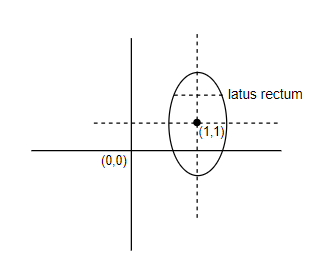
Now, we know that the latus rectum is always parallel to the minor axis of the ellipse. So, the slope of the latus rectum is 0. We also know that latus rectum passes through the foci of the ellipse, that is $\left( c,k \right)$, where $c=\sqrt{{{a}^{2}}-{{b}^{2}}}$ and $k$ is the $y$ coordinate of centre of ellipse. So, we get,
$\begin{align}
& c=\pm \sqrt{{{\left( 3 \right)}^{2}}-{{\left( 2 \right)}^{2}}} \\
& \Rightarrow c=\pm \sqrt{9-4} \\
& \Rightarrow c=\pm \sqrt{5} \\
\end{align}$
So, the latus rectum passes through $\left( \pm \sqrt{5},1 \right)$. We know that equation of line using the slope of line and point can be determined as, $\left( y-{{y}_{1}} \right)=m\left( x-{{x}_{1}} \right)$, where $\left( x,y \right)$ is the point through which the line passes. So, we will get the equation of latus rectum as,
$\begin{align}
& \left( y-\left( \pm \sqrt{5} \right) \right)=0\left( x-1 \right) \\
& \Rightarrow y-\left( \pm \sqrt{5} \right)=0 \\
& \Rightarrow y=\pm \sqrt{5} \\
\end{align}$
Hence, the correct answer to the given question is option A.
Note: In this question, the possible mistakes that the students can make is by considering the length of latus rectum as the equation of latus rectum. But it is not correct and will lead to the wrong answer.
Complete step-by-step solution -
In this question, we have been asked to find the equation of latus rectum of the ellipse having equation $9{{x}^{2}}+4{{y}^{2}}-18x-8y-23=0$. We know that to find the equation of latus rectum, we should know the equation of ellipse is $\dfrac{{{\left( x-4 \right)}^{2}}}{{{a}^{2}}}+\dfrac{{{\left( y-k \right)}^{2}}}{{{b}^{2}}}=1$. We will convert the given equation of ellipse to the standard form. So, we can write, $9{{x}^{2}}+4{{y}^{2}}-18x-8y-23=0$ as, $9{{x}^{2}}-18x+4{{y}^{2}}-8y-23=0$
Now, we will add and subtract 9 from the equation. So, we get, $9{{x}^{2}}-18x+9+4{{y}^{2}}-8y-23-9=0$
Now, we will also add and subtract 4 from the equation. So, we get, $9{{x}^{2}}-18x+9+4{{y}^{2}}-8y+4-23-9-4=0$
Now we can write this equation as the squares. So, we get,
$\begin{align}
& {{\left( 3x-3 \right)}^{2}}+{{\left( 2y-2 \right)}^{2}}-36=0 \\
& \Rightarrow {{3}^{2}}{{\left( x-1 \right)}^{2}}+{{2}^{2}}{{\left( y-1 \right)}^{2}}=36 \\
\end{align}$
Now, we will divide the whole equation by 36. So, we get,
$\begin{align}
& \dfrac{9{{\left( x-1 \right)}^{2}}}{36}+\dfrac{4{{\left( y-1 \right)}^{2}}}{36}=1 \\
& \Rightarrow \dfrac{{{\left( x-1 \right)}^{2}}}{4}+\dfrac{{{\left( y-1 \right)}^{2}}}{9}=1 \\
\end{align}$
Hence, we can say that $y$ axis is the major axis and $x$ axis is the minor axis. So, we get ${{b}^{2}}=4$ and ${{a}^{2}}=9$ or we can say that $b=\pm 2$ and $a=\pm 3$.
Now, we know that the ellipse will look something like the figure below.
Now, we know that the latus rectum is always parallel to the minor axis of the ellipse. So, the slope of the latus rectum is 0. We also know that latus rectum passes through the foci of the ellipse, that is $\left( c,k \right)$, where $c=\sqrt{{{a}^{2}}-{{b}^{2}}}$ and $k$ is the $y$ coordinate of centre of ellipse. So, we get,
$\begin{align}
& c=\pm \sqrt{{{\left( 3 \right)}^{2}}-{{\left( 2 \right)}^{2}}} \\
& \Rightarrow c=\pm \sqrt{9-4} \\
& \Rightarrow c=\pm \sqrt{5} \\
\end{align}$
So, the latus rectum passes through $\left( \pm \sqrt{5},1 \right)$. We know that equation of line using the slope of line and point can be determined as, $\left( y-{{y}_{1}} \right)=m\left( x-{{x}_{1}} \right)$, where $\left( x,y \right)$ is the point through which the line passes. So, we will get the equation of latus rectum as,
$\begin{align}
& \left( y-\left( \pm \sqrt{5} \right) \right)=0\left( x-1 \right) \\
& \Rightarrow y-\left( \pm \sqrt{5} \right)=0 \\
& \Rightarrow y=\pm \sqrt{5} \\
\end{align}$
Hence, the correct answer to the given question is option A.
Note: In this question, the possible mistakes that the students can make is by considering the length of latus rectum as the equation of latus rectum. But it is not correct and will lead to the wrong answer.
Recently Updated Pages
Master Class 11 Social Science: Engaging Questions & Answers for Success

Master Class 11 English: Engaging Questions & Answers for Success
Master Class 11 Maths: Engaging Questions & Answers for Success
Master Class 11 Chemistry: Engaging Questions & Answers for Success
Master Class 11 Biology: Engaging Questions & Answers for Success
Master Class 11 Physics: Engaging Questions & Answers for Success
Trending doubts
One Metric ton is equal to kg A 10000 B 1000 C 100 class 11 physics CBSE
Difference Between Prokaryotic Cells and Eukaryotic Cells
How many of the following diseases can be studied with class 11 biology CBSE
Two of the body parts which do not appear in MRI are class 11 biology CBSE
Which of the following enzymes is used for carboxylation class 11 biology CBSE
Explain zero factorial class 11 maths CBSE